Anthropic’s latest foundation model, Claude Opus 4.5, is now available on Amazon Bedrock, a fully managed service offering a selection of high-performance foundation models from leading AI companies. Opus 4.5 is a meaningful step forward in what AI systems can do, setting new standards across coding, agents, computer usage, and office tasks. Outperforms both Sonnet 4.5 and Opus 4.1, offering Opus-level features at one-third the cost.
In this post, we demonstrate the differences in this model, discuss key business applications, and show you how to use Opus 4.5’s new tooling features with Amazon Bedrock. By the end, you will be able to understand how to use the features of this model for production agent deployment.
Claude Opus 4.5: Differences in this model
Opus 4.5 is the most advanced model of the Opus class offered by Anthropic, designed for developers building advanced AI agents that can reason, plan, and execute complex tasks with minimal supervision. Upgrade Sonnet 4.5 to improve performance for existing use cases and add new features for complex workflows.
This model is excellent for professional software engineering, achieving 80.9% in SWE bench validation and helping you convert days-long development projects into hours-long tasks. This works independently, including improved multilingual coding capabilities and enhanced behavior such as more efficient code, better test coverage, and cleaner architectural choices. To increase office productivity, this model handles complex projects end-to-end. It empowers agents to create professionally polished PowerPoint presentations, Excel spreadsheets, and Word documents, including redlining contracts and NDA documents. This model also produces higher quality React and HTML artifacts. Maintain consistency and accuracy, important for finance and other industries where accuracy is critical, and maintain full file context across long projects.
This is Anthropic’s best vision model to date, achieving 80.7% in MMMU for workflows that rely on complex visual interpretation and multi-step navigation, such as analyzing design mockups, processing documents with complex layouts, and automating browser-based tasks, further improving computer usage performance.
This model introduces two important improvements for agent developers. The tool search tool allows agents to work with hundreds of tools by dynamically discovering and loading only the ones they need, rather than preloading all definitions. This could potentially save you tens of thousands of tokens and prevent schema confusion when expanding to large tool libraries. Tool usage examples improve accuracy for complex schemas containing nested objects or arrays by providing sample tool calls directly into the tool definition.
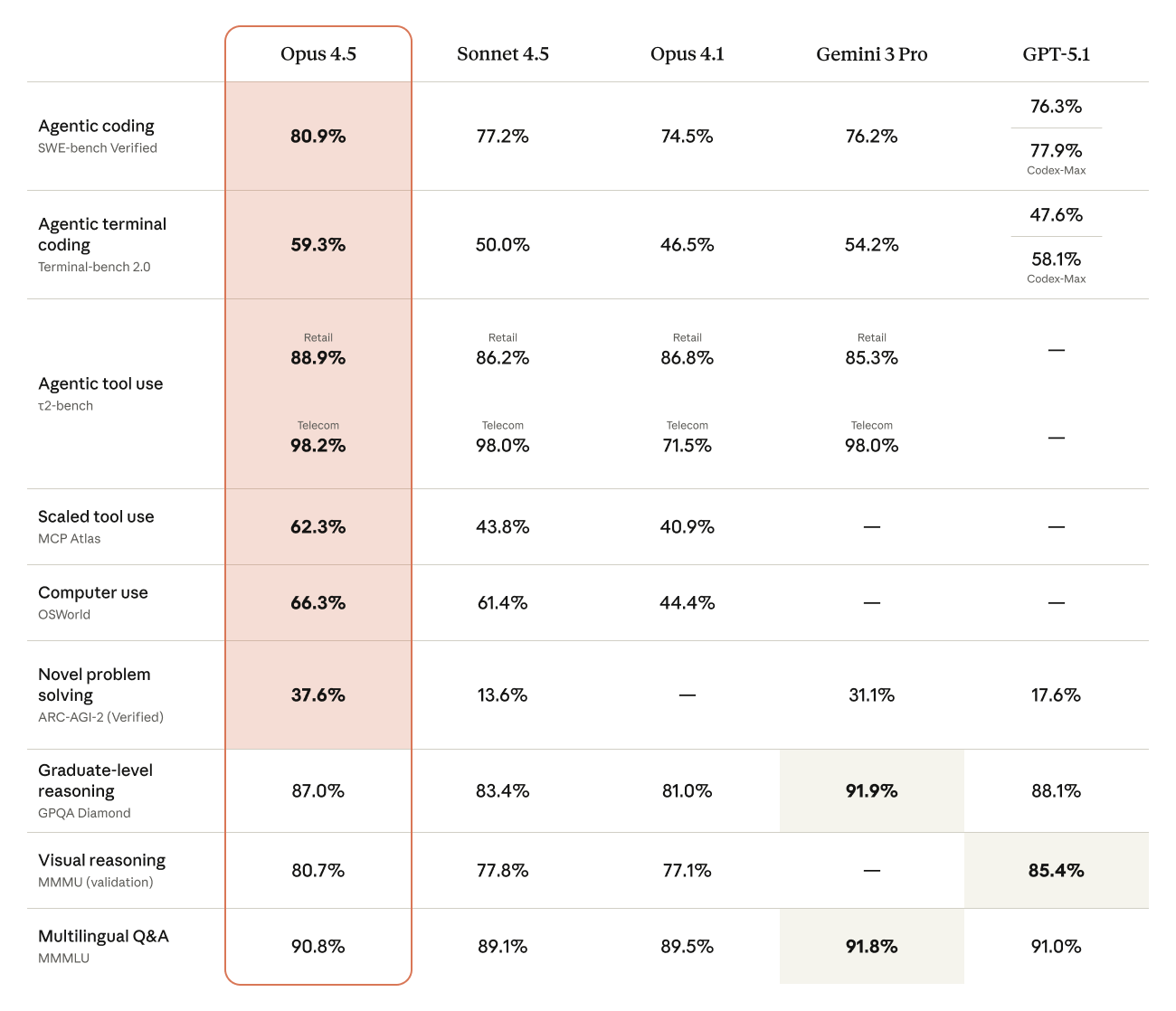
Opus 4.5 performance benchmarks
sauce: https://www.anthropic.com/news/claude-opus-4-5
Business applications and use cases
Opus 4.5 excels in the following use cases:
- software development: Build agents to write and refactor code across projects, manage full-stack architectures, or design agent systems that break down high-level goals into executable steps. This generation of Claude covers the entire development lifecycle. Opus 4.5 is production code and advanced agents (agents that use 10+ tools in end-to-end software engineering, cybersecurity, financial analysis, and other workflows), Sonnet 4.5 is rapid iteration and an enhanced user experience, and Haiku 4.5 is subagents and free tier products. Opus 4.5 allows you to analyze technical documentation, plan your software implementation, write the necessary code, and iterate on it while tracking requirements and architectural context throughout the process.
- Corporate management and office work: Manage complex projects from start to finish. Opus 4.5 uses memory to maintain context and consistency between files and improves the creation of spreadsheets, slides, and documents. This model handles ongoing enterprise projects and automates manual workflows.
- financial analysis: Work across complex information systems such as regulatory filings, market reports, and internal data to enable predictive modeling and proactive compliance. The consistency and accuracy of the model makes it useful in finance and other industries where accuracy is important.
- cyber security: Brings professional-level analysis to security workflows, correlation logs, security issue databases, and security intelligence for security event detection and automated incident response.
Integration with Amazon Bedrock AgentCore
Amazon Bedrock provides an enterprise foundation for deploying Opus 4.5 into production. Fully managed services provide a unified API for the underlying model with enterprise-grade security, compliance, and governance.
Opus 4.5 is integrated with Amazon Bedrock AgentCore, which provides the infrastructure and primitives for building production agents. AgentCore includes persistent memory to maintain context between sessions, a tooling gateway to transform APIs and Lambda functions into agent-compatible tools, and built-in identity and access management for secure resource access. You can deploy and monitor agents with full session isolation, long-running workflow support (up to 8 hours), and observability features, so you can focus on building agents instead of managing infrastructure.
Amazon Bedrock AgentCore provides additional functionality for production deployments. The Tools Gateway transforms your existing APIs and Lambda functions into agent-compatible tools with minimal code, and works with the model’s tool search capabilities to coordinate hundreds of tools. Built-in observability through Amazon CloudWatch tracks token usage, latency, and error rates throughout the agent’s workflow.
Start
Access Opus 4.5 models through Amazon Bedrock today. We will demonstrate the tool search functionality of this model. This feature allows agents to work with hundreds of tools without having to load all definitions into the context beforehand. First, import the required modules and set up the Amazon Bedrock client.
This example defines multiple tools as follows: defer_loading Enable tool search. This allows the model to discover and load only the tools it needs, rather than preloading all definitions.
Now call the model using: invoke_model API with effort parameter set as follows medium:
The model uses tool search to find related tools (get_weather) from the library without loading all tool definitions first. Effort parameters, available in beta, control how freely the model spends tokens across thoughts, tool calls, and responses. You can set the effort value by high For best results, medium for balanced use, or low For conservative token usage.
Main features of agent development
Opus 4.5 has several features that make it suitable for building production agents. This model maintains consistency across scaled workflows for consistent decision-making for agents running multi-step processes over hours or days. Improved tool processing allows agents to interact more reliably with external systems, APIs, and software interfaces, allowing models to select appropriate tools and more accurately interpret results. Opus 4.5 also tracks information and maintains context across conversation turns, helping agents accumulate knowledge over time and make decisions based on history.
Effort parameters available in the beta version allow you to control the use of your tokens. can be set to high For best results when quality matters most, medium for balanced performance, or low For conservative token usage. Opus 4.5 adjusts token spending across thoughts, tool calls, and responses based on this setting. For production deployments, Amazon Bedrock AgentCore provides monitoring and observability through CloudWatch integration to track token usage in real time (useful when adjusting effort parameters), latency metrics, session duration, and error rates to help optimize agent performance and manage costs.
Pricing
This model is priced at $5 per million input tokens and $25 per million output tokens, giving you access to Opus-level intelligence at one-third the cost of previous products.
Availability and access
This model is currently available on Amazon Bedrock through cross-region inference, which automatically routes requests to available capacity across AWS Regions to increase throughput during peak demand times.
Use this model for agents that handle long-running tasks, coordinate multiple tools, and maintain context across extended sessions.
For more information on availability, pricing, and model specifications, please see the Amazon Bedrock documentation.
conclusion
In this post, we showed you how to get started using Claude Opus 4.5 on Amazon Bedrock. Opus 4.5 excels in complex, long-term workflows such as software development and business operations. Opus 4.5’s tooling, context management, and decision-making features are valuable for building agents that work reliably in production. This model is suitable for software engineering, research integration, and enterprise workflow automation agents.
We encourage you to try Opus 4.5 for your own agent workflows. Consider how the feature could improve manual processes within your organization or support new types of automation. The capabilities of Opus 4.5 combined with the enterprise capabilities of Amazon Bedrock provide the foundation for production AI agents.
To get started, try out the model in the Amazon Bedrock console, explore the technical documentation, and check out Anthropic’s Claude model details page to learn more about its features. To deploy agents at scale, consider Opus 4.5 on Amazon Bedrock AgentCore for managed infrastructure with tool orchestration and monitoring.
We’d love to hear what you build with this model. Please share your experiences and agent usage examples in the comments below.
About the author
 Jonathan Evans is a Worldwide Solutions Architect for Generative AI on AWS, helping customers leverage cutting-edge AI technology to solve complex business challenges using Anthropic’s Claude Models on Amazon Bedrock. With a background in AI/ML engineering and hands-on experience supporting machine learning workflows in the cloud, Jonathan is passionate about making advanced AI accessible and impactful for organizations of all sizes.