

Content creators are reporting unprecedented consensus in evaluating artificial intelligence tools, and a new study from Later reveals that not a single creator surveyed experienced a decline in campaign performance after implementing AI into their workflow.
A survey of 120 creators who have used AI tools in the past year documents a striking pattern. 87% report that AI assistance has improved the quality of their content, while the remaining 12.5% believe there has been no impact on quality. Zero creators indicated that AI reduced the quality of their output.
Performance indicators show similar uniformity
Campaign performance data reflects quality findings. 75% of creators reported improved campaign performance compared to their previous work using AI, while 25% saw no change in performance. No creators reported a drop in campaign results after implementing AI tools.
The absence of negative results represents an unusual pattern in technology adoption research, where new tools typically produce mixed results across user populations. Later’s research suggests that the integration of AI in creator workflows has reached a level of maturity that offers measurable benefits while minimizing risk.
Quality improvement spans multiple indicators
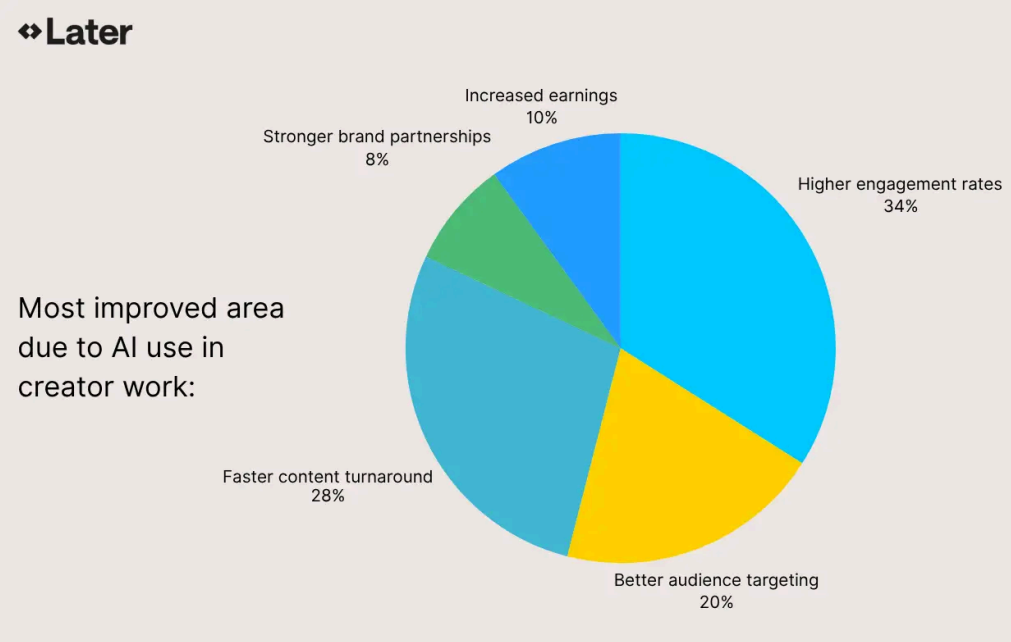
Creators identify specific areas where AI will bring the most significant improvements. 34.4% cited increased engagement rates as the most improved area of their work, and 27.8% cited faster content delivery as a key benefit.
20% of creators say improved audience targeting is the biggest improvement, and 10% say increased revenue. 7.8% report stronger relationships with brands as the biggest improvement in their work since implementing AI tools.
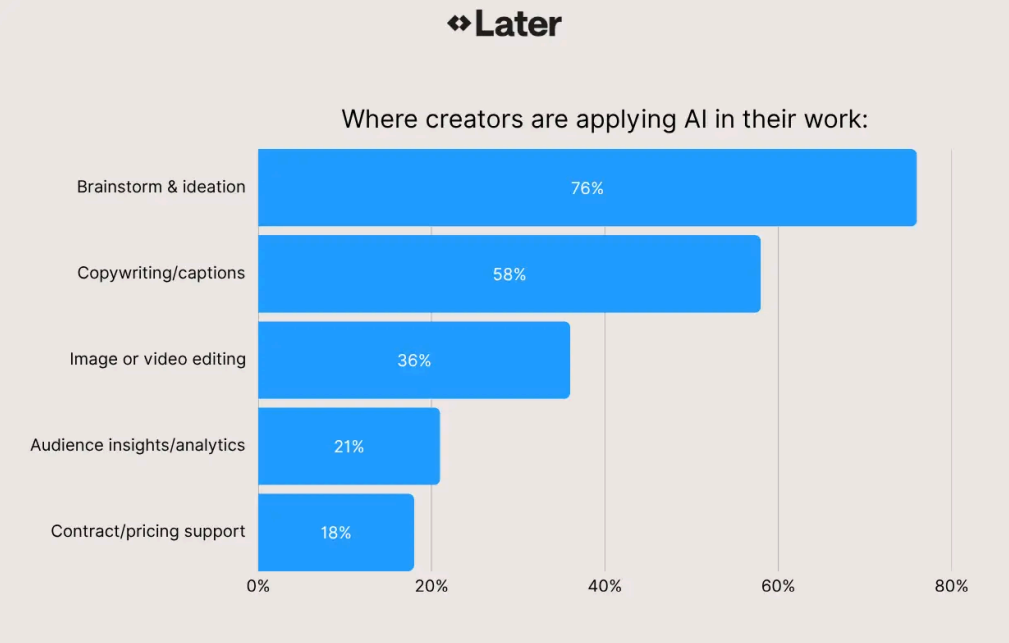
This study documents AI applications across three major workflow areas. 76% of creators are using AI for brainstorming and ideation, addressing one of the most persistent challenges in content creation found in our research: generating fresh ideas.
58% rely on AI for copywriting and caption generation. Rather than simply copying and pasting AI-generated text, these creators talk about using AI to structure your thinking, refine your messages, and refine your writing. One survey respondent said the AI “takes my thoughts and ideas and translates them into more professional captions.”
36% are using AI for image or video editing, 21% for audience insights and analytics, and 18% for additional applications such as contracts or pricing support.
Focus tool deployment on established platforms
The tool landscape shows clear concentration, with ChatGPT having a 94% adoption rate among creators using AI. Google Gemini ranks second with 19%, a distant second.
This concentration suggests that creators will gravitate toward established general-purpose AI platforms rather than fragmenting into a number of specialized tools. This pattern is likely to contribute to uniformly positive results, as creators use well-tested, mature technologies rather than experimental or niche applications.
Increased efficiency enables strategic focus
Creators report that AI delivers its most significant value by eliminating time-consuming tasks that don’t differentiate content. According to survey responses, many creators said that AI cut their editing time in half.
These efficiencies free creators to focus on what makes their work stand out: their unique perspective, their relationship with their audience, and genuine expertise in their niche. This research suggests that AI acts as a force multiplier, handling mundane tasks while creators focus on high-value activities that cannot be replicated by AI.
One creator emphasizes that while they create original captions themselves, they “mainly use AI for copywriting to make things flow more smoothly.” This approach leverages AI to refine and polish while preserving the unique voice of the creator.
Training AI tools produce better results
Creators reporting the best results invest time in training AI tools to fit their voice and style. This process includes feeding the AI with examples of the best captions, providing detailed style guidelines, or iterating multiple times until the AI-generated suggestions accurately reflect your tone.
The study identifies this customization as a key factor separating creators who have made significant improvements from those who have had minimal impact. AI tools perform better when adapted to an individual creator’s style than when used with generic prompts or default settings.
Brand response validates creators’ achievements
A uniformly positive creator experience aligns with brand reputation for AI-assisted campaigns. 77% of brands using AI in their influencer marketing campaigns report better results, with 37% describing their results as “much better.”
Of creators who disclose their AI usage to brand partners, 60% choose to do so, but only 2% report negative reactions. 42% describe the brand’s response as neutral, while 16% report a positive response.
Brands that respond positively typically appreciate improved content quality and, in some cases, note increased sales with AI-assisted campaigns. This feedback loop strengthens creators’ confidence in AI adoption and facilitates continued integration into their workflows.
Audience reception exceeded expectations
Audience reactions to published AI uses follow a similar pattern to brand reactions. Of the 53% of creators who disclose their use of AI to their audiences, only 1% report negative reactions.
34% of audience reactions are neutral and 18% positive. This research identifies several factors that encourage positive audience reactions. It’s about general acceptance of AI technology, curiosity and engagement when AI creates visual content, and an appreciation for content that maintains the authentic voice of the creator.
The minimal negative response rate questions industry assumptions about audience resistance to AI-assisted content. Data suggests that viewers evaluate content based on quality and authenticity, rather than the tools used in its production.
Later’s research documents 120 creators who have extensively tested AI tools, measured results, and reached clear conclusions about integrating them into their professional work. Their unanimity of positive or neutral ratings represents a noteworthy data point in the broader debate about AI adoption in the creative industries.
Image credit: Later
Full report available here


