Ohio University is steadily expanding its presence in artificial intelligence, and momentum continues to grow across campus. Russ College of Engineering is launching the state’s first Bachelor of Science in Artificial Intelligence program in 2024, adding a new AI-focused elective to its master’s program in project management, and preparing for the College of Business’s AI in Business graduate certificate to be introduced in summer 2025. These programs reflect the industry’s growing demand for graduates who understand both the technical and human aspects of AI. With this foundation in place, the university is deepening its AI research and collaboration efforts.
Ohio University explores national AI trends at first EECS workshop
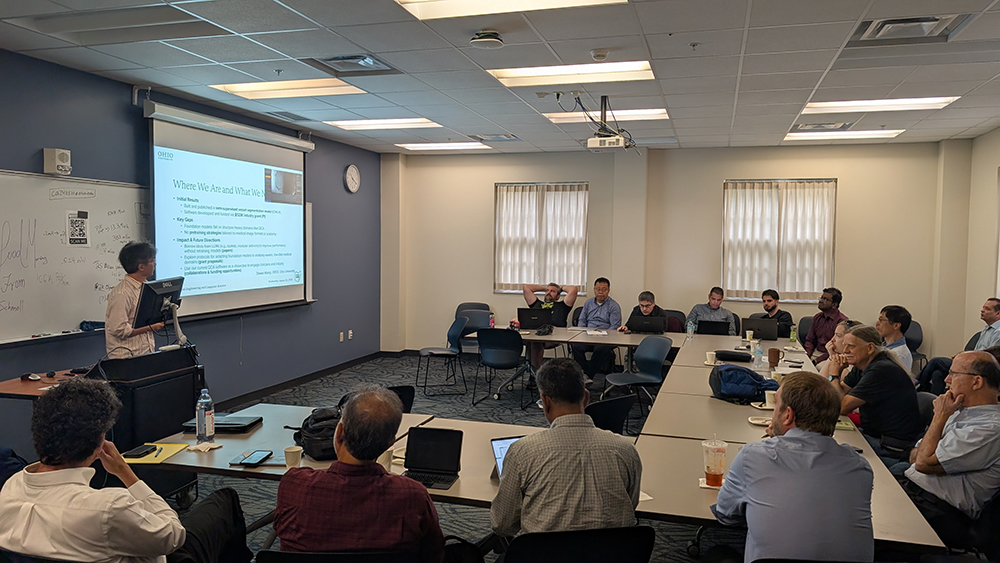
The initiative took center stage at the First Workshop on AI (WISE), held on August 20 and hosted by the Department of Electrical Engineering and Computer Science. The goal was simple. Our goal is to bring together faculty to assess how AI is reshaping education, research, and economic development, and plan how Russ University can lead in this rapidly changing field.
The workshop began with a shared reference point: the Stanford AI Index. Faculty members talked about several clear trends: AI systems are rapidly advancing and investment in this field continues to increase. Tools that were expensive even a few years ago are now inexpensive and readily available, opening the door to new research and classroom use. At the same time, major challenges remain. Schools across the country are still struggling to teach AI well, the public’s trust in AI systems needs to be rebuilt, and complex reasoning is an area where AI still falls short. With that context in mind, the conversation turned to the research being done within EECS.
Faculty from across the school presented their research, demonstrating how the scope of AI research is expanding.
Safety and trust
- Ahmed Mahada Tanvir shared how AI uses motion sensors on devices to enhance authentication.
- Ahmed Own explained how deep learning can enhance real-world side-channel attacks, giving researchers new insights into system vulnerabilities.
hardware, materials, computing
- Savas Kaya and Ismail Tirtom investigated the use of memristors and FeFET devices for in-memory computing.
- Wojciech Jadwisienczak showed how AI and machine learning can drive autonomous materials discovery.
- Faiz Rahman demonstrated AI and machine learning tools to detect defects in semiconductor wafer processing.
- Avinash Karanth outlined how silicon photonics can be used to build neural networks that go beyond traditional electrical design.
Networking and wireless systems
- Animesh Yadav introduced how deep unfolding technology can support next-generation 5G and 6G technologies.
Human-centered AI application
- Trevor Bihl discussed AI plus X and the idea of a cognitive exoskeleton to support human decision-making.
- Chad Mourning discussed image-based machine learning techniques for recognizing weather conditions.
- Chang Liu demonstrated how generative AI can enhance game-based agents.
- Xiangxu Lin explored how AI and robots can embody intelligence in educational settings.
Healthcare AI
- Zhewei Wang used a coronary imaging project as an example to explain how specialized medical AI models can be extended.
- Ziyang Song presented new research on building reliable generative AI models for health applications.
After the presentations, faculty divided into working groups focused on two areas: core AI, which includes deep learning and hardware, and applied AI, which includes health, cybersecurity, and robotics. These conversations centered on new collaborations, shared resources, and ways to strengthen the university’s research impact.
The second half of the workshop moved on to AI education. Led by Professor David Juedes, faculty discussed how AI education is changing nationally, guided in part by insights from the recent CRA AI Summit. A panel discussion featuring Jundong Liu, Chad Mourning, Chang Liu, and Nasseef Abukamail, moderated by Juedes, explored ways to make AI education accessible to students across disciplines. The working group then outlined ideas for new courses, certificates, and minors at both the undergraduate and graduate levels, reflecting the university’s continued commitment to preparing students for an AI-driven world.
Russ University team recognized for groundbreaking advances in quantum computing and photonics
The workshop wasn’t the only AI milestone for the university this fall. Russ College also celebrated major research achievements at IEEE Quantum Week 2025. ZachTakacs, Harsha Chenji, and Avinash Karanth’s paper, “Quantum Integrated Photonic Network-on-a-Chip for Manycore Architectures,” won the Best Paper Award in Photonics. Their work showed how silicon photonics can support secure quantum communication between cores within a chip, addressing both energy efficiency and security vulnerabilities. This work introduces a new class of multicore architectures that fuse secure quantum communications and high-speed photonic links, a promising direction for future chip design.
Taken together, these achievements demonstrate that the university is moving forward with purpose. Russ University is expanding AI education, strengthening research, and building partnerships to keep pace with the rapidly evolving field. With programs that prepare students for new careers and faculty who push the limits of AI and quantum technology, the university is shaping the next chapter of innovation at Ohio University and the world.