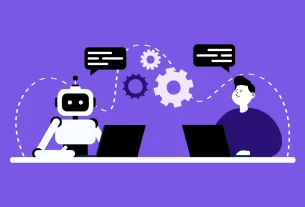
Customers want to talk to others when they need help. Instead, like chatbots powered by artificial intelligence, we don’t want machines to sound too human when we need to interact with them.
For example, a joke from a human customer service agent shows cooperation and helpfulness.
But according to Marat Bakpayev, an assistant marketing professor at the Labovits School of Business and Economics at the University of Minnesota-Duluth, AI agents with a sense of humor can be uncooperative and even threatening to those they interact with. may be considered.
So, with ChatGPT-4 and other generative AI models increasingly mimicking human language, Bakpayev wants brands and marketers to make consumer-machine interactions simple and direct. I advise you to keep
Bakpayev bases his recommendations on the results of a large multi-year research project on AI and language. He works with her Ann Kronrod, a marketing professor and linguist at the University of Massachusetts Lowell.
“Basically, we live in a new world and want to understand how we talk to things.
Bakpayev said the question is not whether to use AI agents, but how to use them, as companies are incorporating AI agents into their businesses at an accelerating pace. For customer service, AI is a highly scalable way to automate many of these processes.
But “if you’re designing interactions and you think it’s cool for AI to jump in with idioms and metaphors, that’s what people do. No,” Bakpayev said. “[Machines] not seen as a person. … more basic, more literal. That’s what consumers want. ”
Brands need to involve different disciplines (especially linguists, sociologists, anthropologists, etc.) to get the consumer-machine interaction right. Consider the context, user experience, and language you use with your consumers.
“We need to understand that human-AI communication needs to be carefully designed,” said Bakpayev. “He is becoming one in the field of how we design interactions. We now have designers creating conversations. We need to consider it.”
In one test of Bakpayev’s research project, participants were more likely to book a hotel room with a human than a human service representative after providing humorous answers to an inquiry. has increased. In another example, AI agents were significantly less willing to book a room when they were joking than when they were serious, according to an extended summary of a paper written by Bakpayev and Kronrod.
“If it’s too human, we don’t want it and we feel threatened,” Bakpayev said of his interactions with machine agents.
According to Bakpaev, the difference comes down to expectations and perceptions.
Consumers expect human service agents to use figurative language such as humor, metaphor, and exaggeration. Consumers perceive human agents who joke or say irrelevant things as more supportive conversational partners, he says. Although the use of figurative language can break customary rules of consumer-agent interaction.
Underpinning that perception is what psychology calls theory of mind, or the ability to understand others by inferring their mental states.
“At this point our minds seem to be speaking correctly [of a conversation]’ said Bakpaev.
But people don’t expect machine agents to be able to guess their mental state. Humor and other figurative language used by AI models raises alarm.
Humans are more comfortable interacting with AI service models when they communicate with literal words.
Bakpayev works as an expert in consumer research and consumption, not AI, but has long-standing interests in technology, robotics, and science fiction. His PhD thesis in business administration, completed in France, was on the acceptance of robots by senior consumers.
A summary of his paper with Kronrod includes references to the sci-fi film ‘Blade Runner’ and to Rossum’s 100-year-old play ‘RUR’ for Universal Robots, which introduced the word ‘robot’. It proposes further research on consumer service interactions to help marketers “avoid the undesirable consequences of competing for human-like AI conversations.”
Todd Nelson is a freelance writer for Lake Elmo. His email is todd_nelson@mac.com.