

AI in Sales Market Revenue Scope
Key Highlights
| Study Period | 2019 – 2032 |
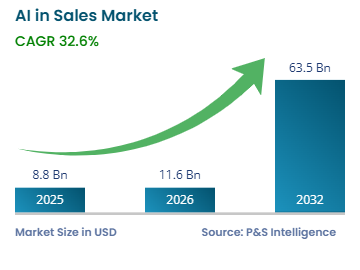
| Market Size in 2025 | USD 8.8 Billion |
| Market Size in 2026 | USD 11.6 Billion |
| Market Size by 2032 | USD 63.5 Billion |
| Projected CAGR | 32.6% |
| Largest Region | North America |
| Fastest Growing Region | APAC |
| Market Structure | Fragmented |
Market Size
Explore the market potential with our data-driven report
AI in Sales Market Outlook
The AI in sales market size will be an estimated USD 8.8 billion for 2025, and it will grow by 32.6% during 2026–2032, to reach USD 63.5 billion by 2032.
The market expansion is driven by accelerating adoption of AI-powered solutions across sales organizations, with enterprises increasingly recognizing the technology’s potential to enhance lead generation, improve sales forecasting accuracy, and deliver personalized customer experiences at scale. Studies predict the global marketing automation market size to reach USD 17.5 billion by 2032.
The integration of generative AI and predictive analytics into sales processes represents a fundamental shift in how organizations approach revenue generation. This widespread adoption reflects the technology’s proven ability to drive tangible business outcomes, such as increased sales and reduced customer acquisition costs, for early adopters often seeing the greatest benefits. Moreover, the convergence of advanced machine learning algorithms, natural language processing capabilities, and cloud computing infrastructure has created an environment where AI-powered sales tools can process vast amounts of customer data in real-time.
AI in Sales Market Segmentation Analysis
Component Analysis
The software category holds the larger market share, of 70%, in 2025, driven by the rapid deployment of AI-powered CRM systems, sales intelligence platforms, and analytics software across organizations of all sizes. This dominance reflects the critical role that software solutions play in enabling AI capabilities, from basic lead scoring to sophisticated predictive analytics and conversational AI interfaces.
The services category will have the higher CAGR, as organizations increasingly require specialized expertise for AI implementation, customization, and ongoing optimization. The complexity of integrating AI into existing sales processes, combined with the need for continuous model training and refinement, drives demand for managed services, professional consulting, and comprehensive training programs. Organizations are recognizing that successful AI adoption requires not just technology but also strategic guidance and change management support.
Government initiatives play a pivotal role in fostering this adoption. In India, the ‘Digital India’ program aims to enhance online infrastructure and increase Internet connectivity, facilitating the growth of digital services, including AI applications, and supporting enterprises in implementing AI-driven sales solutions effectively.
The components analyzed in this report are:
- Software (Larger Category)
- AI-powered CRM Systems
- Sales Intelligence Platforms
- Sales Analytics Software
- Services (Faster-Growing Category)
- Managed
- Professional
- Training & Support
Deployment Mode Analysis
The cloud-based category holds the largest market share, of 60%, in 2025, and it will have the highest CAGR, reflecting organizations’ preference for scalable, accessible, and cost-effective AI solutions. Cloud deployment enables rapid implementation, seamless updates, and the computational power necessary for processing large datasets and running complex AI algorithms without significant infrastructure investment. The global spending on marketing cloud platforms will likely cross USD 21.9 billion by 2030.
It supports seamless updates and integration with existing CRM systems, marketing automation platforms, and communication tools, ensuring that AI-driven insights are always current and actionable. Moreover, cloud-based AI can handle large volumes of customer data, from interaction histories to behavioral analytics, to generate predictive sales forecasts, personalized recommendations, and automated lead scoring.
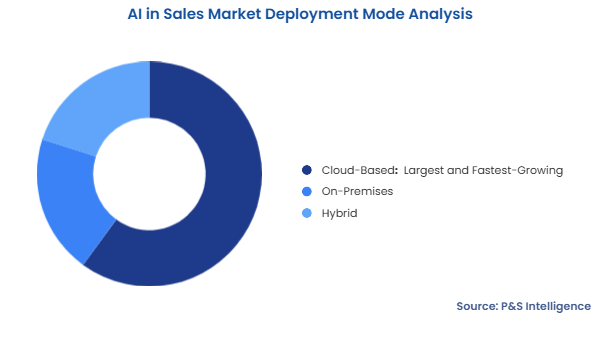
The deployment modes analyzed in this report are:
- Cloud-Based (Largest and Fastest-Growing Category)
- On-Premises
- Hybrid
Technology Analysis
The ML category holds the largest market share, of 35%, in 2025, forming the foundation for most AI sales applications, including lead scoring, customer segmentation, and sales forecasting. ML algorithms’ ability to continuously learn from new data and improve predictions makes them essential for dynamic sales environments where customer behaviors and market conditions constantly evolve. As per the latest research, the global spending on MLops and autoML could cross USD 29.4 billion by 2032 and USD 15,499.3 million by 2030, respectively.
The generative AI category will have the highest CAGR, because it enables sales teams to work faster, smarter, and more efficiently. It automates repetitive tasks such as drafting emails, proposals, and chat responses, allowing sales professionals to focus on closing deals. It also provides personalization at scale, creating personalized messages for thousands of prospects using data from CRM systems, past interactions, and social profiles, which increases engagement and conversion rates. As per studies, enterprises and individuals worldwide could spend more than USD 81.1 billion on generative AI tools by the end of this decade.
Generative AI also accelerates sales processes by summarizing documents, analyzing customer data, and suggesting next steps in real time, shortening sales cycles, and improving productivity. Additionally, it enhances customer engagement through AI-powered chatbots and virtual assistants that interact with prospects 24/7. Its integration with advanced analytics further enables smarter decision-making, making it highly attractive for enterprises seeking competitive advantage, which drives its rapid adoption across the market.
The technologies analyzed in this report are:
- Generative AI (Fastest-Growing Category)
- Predictive Analytics
- Natural Language Processing (NLP)
- Machine Learning (ML) (Largest Category)
- Computer Vision
- Context-Aware Computing
- Others
End User Analysis
The retail & e-commerce category holds the largest market share, of 25%, in 2025, driven by the industry’s need to personalize customer experiences at scale, optimize pricing strategies, and manage vast product catalogs efficiently. Online retailers particularly benefit from AI’s ability to analyze browsing behavior, predict purchase intent, and deliver real-time product recommendations that drive conversion rates. The U.S. ITA expects the global B2B e-commerce sales value to reach USD 36 trillion by 2026.
The healthcare, medical devices, & pharmaceuticals category will have the highest CAGR. This rapid growth stems from the industry’s complex sales cycles, stringent regulatory requirements, and the need to effectively target healthcare professionals with relevant information. AI helps pharmaceutical sales teams identify prescribing patterns, optimize territory management, and ensure compliant communications while improving engagement with healthcare providers.
The end users analyzed in this report are:
- Retail & E-commerce (Largest Category)
- Healthcare, Medical Devices, & Pharmaceuticals (Fastest-Growing Category)
- BFSI
- IT & Telecommunications
- Automotive & Transportation
- Education
- Manufacturing & Industrial
- Government & Public Sector
- Chemicals & Petrochemicals
- Others
Drive strategic growth with comprehensive market analysis
AI in Sales Market Regional Outlook
North America AI in Sales Market Size
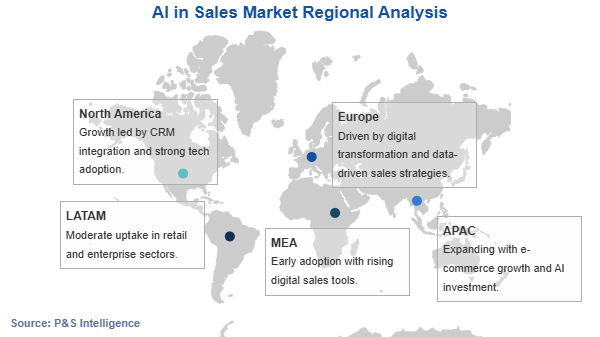
North America holds the largest market share, of 40%, in 2025. This is attributed to the region’s mature technology infrastructure, high concentration of AI technology providers, and early adoption of advanced sales technologies across enterprises. The presence of major cloud providers and AI platform companies in the United States provides organizations with ready access to cutting-edge AI capabilities and extensive implementation support. The investment level, combined with a culture of innovation and risk-taking, positions North American companies at the forefront of AI sales transformation.
Furthermore, the region benefits from a highly digitized business environment where B2B buyers expect sophisticated online experiences and personalized engagement throughout their purchasing journey. North American sales organizations are leveraging AI to meet these expectations while managing increasingly complex sales cycles that involve multiple stakeholders and extended decision-making processes. Moreover, the U.S. federal government has launched the National AI Initiative Act to promote AI research, development, and adoption across industries. This includes funding for AI in business applications, helping enterprises deploy AI-driven sales solutions more effectively.
Asia-Pacific AI in Sales Market Size
Asia-Pacific will have the highest CAGR, of approx. 32.6%, driven by rapid digital transformation, expanding e-commerce ecosystems, and increasing adoption of cloud-based technologies. The region’s large and growing consumer base, combined with mobile-first digital behaviors, creates unique opportunities for AI-powered sales solutions.
Government initiatives supporting AI development, such as China’s national AI strategy, are accelerating technology adoption across industries. The proliferation of digital payment systems and e-commerce platforms in Southeast Asian markets further drives demand for AI sales tools that can handle high transaction volumes and diverse customer preferences.
The region’s manufacturing and technology sectors are particularly aggressive in adopting AI for B2B sales processes, using the technology to manage complex supply chains, optimize pricing strategies, and enhance customer service across multiple languages and cultural contexts.
Europe AI in Sales Market Size
Europe represents a significant market for AI in sales solutions, driven by stringent data privacy regulations that paradoxically accelerate adoption of sophisticated, compliant AI systems. The implementation of GDPR has pushed organizations to invest in AI solutions that can deliver personalized experiences while maintaining strict data governance standards.
Germany leads the European market with its strong manufacturing base increasingly adopting AI for industrial sales processes, while the U.K. shows the fastest growth rate, particularly in financial services and professional services sectors. The region’s focus on ethical AI and explainable algorithms is shaping the development of next-generation sales tools that provide transparency in decision-making processes.
The geographical breakdown of the market is as follows:
- North America (Largest Regional Market)
- U.S. (Larger Country)
- Canada (Faster-Growing Country)
- Europe
- Germany
- U.K. (Largest Country)
- France (Fastest-Growing Country)
- Italy
- Russia
- Rest of Europe
- Asia-Pacific (Fastest-Growing Regional Market)
- China (Largest Country)
- India (Fastest-Growing Country)
- Japan
- South Korea
- Australia
- Rest of APAC
- Latin America
- Brazil (Largest Country)
- Mexico (Fastest-Growing Country)
- Rest of LATAM
- Middle East and Africa
- Saudi Arabia (Largest Country)
- South Africa
- U.A.E. (Fastest-Growing Country)
- Rest of MEA
AI in Sales Market Share Analysis
The market is fragmented with numerous players competing across different technology segments and geographical regions. While several large technology corporations dominate the platform and infrastructure layers, hundreds of specialized vendors offer niche solutions for specific sales use cases, creating a dynamic and competitive landscape. This competitive environment drives rapid innovation as companies strive to differentiate through advanced features, industry-specific solutions, and superior integration capabilities. Leading technology giants like Microsoft, Salesforce, and Google have established strong positions through comprehensive AI platforms that integrate with existing enterprise systems. Emerging players are finding success by focusing on specific industries or use cases, such as AI-powered sales coaching, conversation intelligence, or revenue operations optimization.
Key AI in Sales Companies:
- Microsoft Corporation
- Google LLC
- Salesforce, Inc.
- CopyAI, Inc.
- Outreach Corporation
- HubSpot, Inc.
- Amazon.com, Inc.
- Clari, Inc.
- Oracle Corporation
- 6sense Insights, Inc.
- Highspot, Inc.
- Data Robot Inc.


