Mexico's Supreme Court (SCJN) has determined that in an era of increasingly influenced and even generated by artificial intelligence (AI), works generated by AI cannot be registered in the copyright system. According to the verdict, the authors belong to humans only.
“This resolution establishes legal precedents for AI and intellectual property in Mexico,” says the National Institute of Copyright (Nurse) On August 28, it was stated in a statement on the official X account following the decision by SCJN.
The unanimous decision of SCJN is determined by the Federal Copyright Act (LFDA). Reserve the author to humanand that creative inventions exclusively generated by algorithms do not have human authors to which moral rights can belong.
According to the Supreme Court, automated systems do not possess the necessary qualities of creativity, originality and personality that are considered human attributes to the author.
“SCJN has resolved that copyright is exclusive to humans, which stems from creativity, intelligence, emotions and experience.”
The Supreme Court, which resolved that it was autonomously generated by artificial intelligence, resolved that it did not meet the originality requirements of the LFDA. These requirements stated that restricting authors to humans is a constitutional law because it is “objective, reasonable and compatible with international treaties.”
He added that protection for AI cannot be granted on the same basis as humans because it has inherently different properties.
what happened?
In August 2024, nurses refused to apply for registration for “Virtual Avatar: Gerald Garciavaez.”
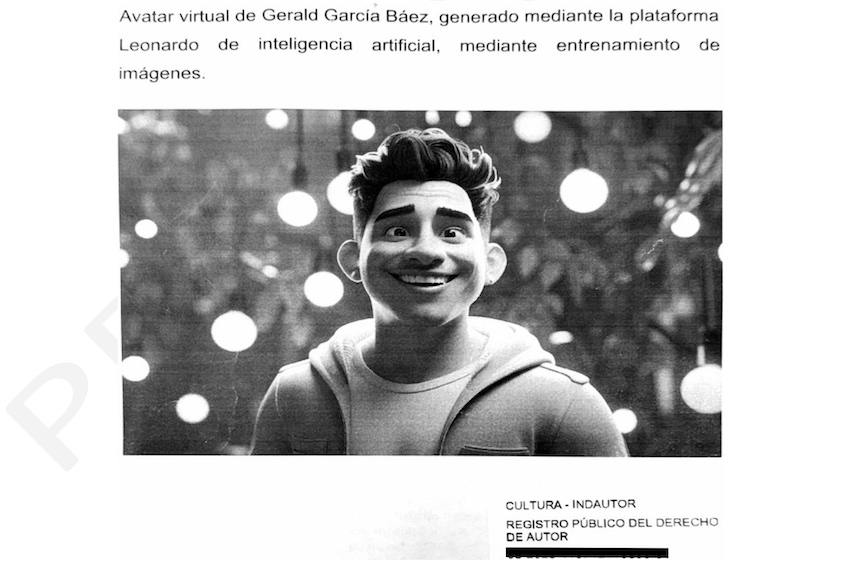
“Registration was rejected because the Federal Copyright Act (LFDA) requires the work to be human creation. It features originality as an expression of the author's personality and personality.”
The applicant fought for denial, arguing that creativity should not be limited to humans. In the defendant's opinion, except for works produced by AI, he violated international treaties, including equality, human rights, principles of international treaties, the United States, Mexico, Canada Agreement (USMCA), and the Bern Convention.
However, the Supreme Court has made it clear that such international treaties do not mandate Mexico to copyright non-human entities or to extend the author's concept beyond what is established in the LFDA.
Does the solution allow registration of AI-generated works?
Yes, if there is substantial and demonstrable human contribution. This means that works created in collaboration with AI will be subject to registration before the barn to directly select, edit or transform the results generated by AI until humans are blessed with originality and personal touch.
Intellectual Property Experts consulted with the newspaper L Economystagram He explained that it is important to document human interventions and submit creative processes in a way that is consistent with the LFDA to register creative work developed in collaboration with AI.
Mexican news everyday