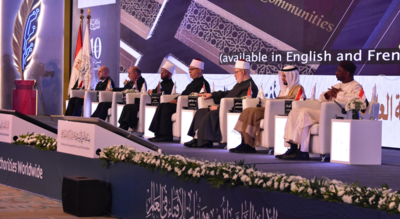
At a high-level international conference held in Cairo, the UAE Fatwa Council announced its efforts to incorporate artificial intelligence into the process of religious fatwa issuance. The event served as a platform for collaborating, innovation and reaffirming the role of medium-sized Islamic guidance in an era shaped by digital transformation.
The UAE's participation in the Cairo Conference
The UAE Fatwa Council took part in an international conference held in Cairo and organized by the president of the Fatwa authorities in Egypt, entitled “Creating a competent mufti in the age of artificial intelligence.” The focus of the event was at the intersection of religious scholarships and artificial intelligence, exploring how new technologies can support legal fatwa practices while maintaining Islamic values.The delegation representing the United Arab Emirates of Fatwa conveyed the greetings and his desire for a meeting of the Council Chairman Shaykh Abdullah bin Baiyah, and produced meaningful results in support of the legitimacy of religious domination.Council representatives include:
- Dr. Omar Habtoor Al Derei, Vice President
- Dr. Sabah Salem Al-Qaabhi, Secretary General
- Dr. Khalifa Mubarak Al Dhaheri, Member
- Dr. Ahmed Abdulaziz Al Haddad, Member
These representatives were actively involved in conference sessions and workshops and engaged in detailed discussions on:
- Potential and current applications of AI in religious contexts.
- Coordinating AI technology to legitimate Sharia principles and national priorities
- Institutional methods to strengthen the fatwa process rather than strengthening AI
Key themes and messages provided by the United Arab Emirates Council
During the session, speakers from the UAE Council emphasized the following importance:
- Protects your Fatwa system from instability and misuse
- Predicting the challenges brought by AI with structured institutional strategies
- Maintain a legal constant and prevent the exploitation of religious domination for extremist or ideological purposes.
- Use technical expertise to develop safe and reliable databases to support FATWA work
Dr. Omar Al Derei emphasized that technological advances must be responsibly integrated, ensuring that Fatwa's publication remains robust and reliable.Dr. Sabah Al-Qaabi emphasized the value of the conference as a space for sharing experience and strategy among Islamic institutions around the world. He emphasized that the digital revolution requires moderately responsive methodologies that respond to global development, protecting the credibility and purpose of the Fatwa tradition.On the sidelines of the meeting, bilateral discussions reinforced the following importance:
- Strengthening cooperation in religious issues and AWQAF (donations)
- Promote Islamic values of tolerance, peace and coexistence
About the United Arab Emirates Parliament in Fatwa
Emirates Fatowa Council was established in 2018 under federal law number (3) and served as the sole authority to issue religious fattowas common within the United Arab Emirates. The Council operates with full legal personality, financial and administrative independence and reports directly to the Minister of the Presidential Court.The mission includes:
- Establishing fatwa practices that are consistent with the national identity of the United Arab Emirates, both locally and worldwide.
- Development of policies, directives and laws related to Fat Wash and its regulations
- Enhance positive fat in the Emirati society to enhance the country's global competitiveness
- Building a model of Fatowa's civilization that responds to modern development and actively contributes to the UAE's international reputation and humanitarian vision.
A vision of technically possible religious instruction
The Council's involvement in the Cairo Conference reflects its broad mission. It is to modernize the religious system while being fixed on a genuine Islamic scholarship. By engaging in dialogue about the role of AI in the publication of FATWA, the Council is working to ensure that.
- Religious guidance continues to be relevant and reliable
- Technical tools are used ethically and responsibly
- The United Arab Emirates continues to be considered a global leader in moderate religious discourse
The event concluded with a shared agreement between participating organizations to strengthen international cooperation, protect religious institutions from technological disruption, and promote moderate and comprehensive interpretation of Islam in the digital age.