AI-enabled interviews and job application intention
In the majority of AI-enabled interviews, a chatbot poses a set of predetermined questions to the interviewee, allowing them a brief timeframe to respond (Jaser and Petrakaki, 2023). During this process, the bot collects data pertaining to the candidate’s visual, verbal, and vocal cues, subsequently generating an automated prediction about their suitability for the job (Jaser and Petrakaki, 2023). In our study, we define such interviews as AI-enabled interviews. In contrast, traditional video interviews refer to online interviews conducted on a screen, involving participants who are physically separated yet present together virtually. While tele-communication technology is employed in these interviews, it does not encompass AI decision-making tools. To compare the impact of different interview formats, we categorized them into two scenarios: traditional video interviews and AI-enabled interviews. In this context, AI-enabled interviews denote virtual interviews conducted by AI-humanoid interviewers and analyzed by algorithms, capable of generating automatic decisions about candidates. Advanced technologies like AI-enabled interviews offer advantages to companies in terms of efficiency and cost (Wesche and Sonderegger, 2021). However, candidates have expressed concerns about the effects of AI-enabled interviews in terms of their ability to accurately assess applicants, potential algorithmic discrimination, and favorability among candidates (Suen et al. 2019; Vrontis et al. 2021).
First, there is skepticism regarding AI’s capability to identify truly suitable employees. AI-enabled hiring tools employ facial and body language recognition to generate insights into candidates’ personality traits, such as “conscientiousness” or “altruism” (Drage and Mackereth, 2022). However, Tippins et al. (2021) argue that AI-enabled interview systems are akin to digital snake oil, lacking a scientific foundation and relying on shallow measurements and arbitrary number crunching. This approach may penalize non-native speakers, visibly nervous interviewees, or anyone who deviates from a predetermined model of appearance and speech, rather than identifying the best fit for the job based on deeper qualities like proactivity and values. Since algorithms in AI-enabled interviews rely on large amounts of statistical data, the presence of manipulated or biased information could result in partial generalization, leading to missed opportunities for qualified candidates (Wang et al. 2020). If AI-enabled interviews fail to accurately and comprehensively analyze candidates’ competencies and personality traits, it becomes challenging for candidates to trust the assessment system. Moreover, a lack of trust in data accuracy and insufficient control over algorithmic candidate matching can breed reluctance to embrace AI-enabled interviews, potentially causing candidates to withdraw from the hiring process (Li et al. 2021).
Second, the presence of algorithmic bias and discrimination in AI-enabled interviews could undermine the job seekers’ trust in them. Concerns about trust remain prevalent in the use of AI technology. Research on judgmental systems, such as forecasting systems, indicates that humans are generally trusted more than computers (Dietvorst et al. 2015; Önkal et al. 2009). Particularly, Dietvorst et al. (2015) suggests that in tasks requiring social intelligence, trust in humans surpasses trust in AI. It is widely recognized that algorithmic decision-making in HRM can sometimes act unethically and even result in discriminatory outcomes (Köchling and Wehner, 2020). An example is Amazon’s biased recruiting tool mentioned above (De Cremer, 2021). Other studies have indicated that low reliability significantly diminishes trust, and rebuilding trust is challenging and time-consuming (Dietvorst et al. 2015; Dzindolet et al. 2003; Manzey et al. 2012). Therefore, errors in algorithms during AI-enabled interviews may lead to distrust and psychological resistance among job applicants.
Third, job seekers generally have a less positive view of AI-enabled interviews compared to traditional video interviews. Several studies have found that this perception is partly due to the limited human interaction in AI-enabled interviews (Acikgoz et al. 2020; Gonzalez et al. 2019; Lee, 2018; Mirowska and Mesnet, 2022). Job candidates expect respectful treatment and a positive experience from recruiters throughout the job-seeking process. It is important to note that the adoption of AI is not a simple “plug and play” model; it raises ethical concerns and emphasizes the human aspect of an organization (Sanders and Wood, 2019). Notably, current AI-enabled interviews primarily automate processes during the early stages, which eliminates human judgment and overlooks candidates’ desire for interpersonal interaction. Consequently, job candidates may prefer traditional video interviews that provide more personal contact and may feel less motivated to apply for positions that involve AI-enabled interview methods.
Moreover, the perception of AI plays a significant role in determining its acceptance and utilization (Del Giudice et al. 2023). The inherent apprehension towards uncertainty compels individuals to reject AI. The resistance to adopting AI arises due to a distorted and reduced understanding of its usability and benefits (Polites and Karahanna, 2012). Consequently, when it comes to AI recruitment, individual inertia explains why job seekers prefer to stick to the current practices, resulting in their reluctance to prioritize AI-assisted assessments over traditional human-dominated interviews. Particularly regarding the perceived ease of use, individuals with limited computer skills may experience AI anxiety and technophobia due to a lack of accessible learning resources for new AI products. This leads to a group of individuals who lag in adopting AI technology and are less inclined to utilize AI-enabled interviews during the job application process. We thus anticipate that job applicants will display a greater inclination towards traditional video interviews in comparison to AI-enabled interviews. We propose the following hypothesis:
H1: Applicants are more likely to express a greater intention to apply for positions that utilize traditional video interviews compared to AI-enabled interviews.
The interactive effect of interview format and industry type on job application intention
According to Pan et al. (2022), the success of AI-enabled interviews relies on various contextual elements. These factors include the broader environmental context (e.g., industry and regulations), the organizational context (e.g., company size and technology competence), and the technical context (e.g., relative advantage and complexity of AI systems). The particular focus of this study is on the influence of industry. The type of industry in which a company operates has a substantial impact on its innovation practices (Oliveira and Martins, 2010) and human resource strategies (Malik et al. 2021). To explore the interaction between industry and interview format, we draw on the capability-personalization framework (Qin et al. 2024, 2025). The framework posits that individuals’ reactions to AI systems hinge on two psychological appraisals: their perception of AI’s evaluative capability and their perceived need for personalized human-like interaction (Qin et al. 2024, 2025). Applying this framework to the job-application context, we argue that applicants’ perceptions in different industries vary systematically on both dimensions, yielding an interactive effect of industry type and interview format on job application intention.
In terms of capability, on the one hand, high-tech sectors (e.g., information technology) possess extensive experience with information technologies (Bughin et al. 2017; Ransbotham et al. 2017) and substantial technical resources for AI adoption (Yu et al. 2023). High-tech industries thus demonstrate established norms of AI integration (Alsheibani et al. 2018) and greater readiness for emerging technologies (Richey et al. 2007). On the other hand, applicants from these industries tend to be technically literate (e.g., understand AI assessment logic and metrics), believe that AI can more objectively evaluate the role-specific skills (e.g., coding ability and analytical thinking), and feel confident in performing well in a structured, logic-driven assessment environment, which AI interviews tend to provide. Collectively, these organizational and personal factors contribute to high-tech applicants’ perceptions of AI’s capability.
In terms of the necessity of personalization, first, high-tech industry applicants are likely to expect less interpersonal warmth or relational depth in evaluative settings. Second, they place lower importance on rapport-building, social chemistry, or personalized feedback, which are disadvantages of an AI interview. Third, they are more comfortable with depersonalized or automated interactions, given the norms and culture of tech-driven environments in the high-tech industry. Together with their stronger perceptions of AI’s capability, these lower personalization needs translate into greater AI appreciation—not merely tolerance, but a belief that AI may be more reliable or even advantageous compared to subjective human judgment in hiring processes.
In contrast, low-tech industries generally display lower technological maturity, and their applicants may doubt both their employers’ ability to implement AI effectively and their own capacity to “play by AI’s rules” due to limited familiarity with such systems (i.e., low capability perception). Moreover, these applicants place a high value on human‐to‐human interaction, particularly for roles requiring interpersonal skills, emotional labor, or relational fit (i.e., high personalization needs). Together, these factors explain why high‐tech industry applicants view AI interviews as more procedurally acceptable and better aligned with organizational practices—experiencing lower AI aversion—whereas low-tech‐industry applicants may feel discomfort, perceive AI systems as unfair or misaligned, and demonstrate lower application intentions under AI‐enabled interview formats. We thus propose the following:
H2: Interview format and industry type interactively influence applicants’ intention to apply for jobs. Specifically, candidates are more inclined to apply for jobs with AI-enabled interviews in high-tech industries than in low-tech industries.
The mediating role of perceived procedural justice
The connection between different aspects of selection practices and how applicants react is influenced by their perceptions of fairness (Gilliland, 1993; Hausknecht et al. 2004; Ryan and Ployhart, 2000). According to McCarthy et al. (2017), the perceived procedural justice of job seekers significantly impacts their attitude towards the company. Combining fairness heuristic theory (Lind, 2001) and the capacity-personality framework (Qin et al. 2024, 2025), candidates may perceive AI-enabled selection as unfair due to the technological limitations of AI hiring products and their lack of cognitive and psychological readiness to interact with AI.
To begin with, AI-enabled interviewing products with flaws may lead to the continued underrepresentation of minority groups due to a reliance on technological solutions. This can result in increased unfair treatment. Despite marketing themselves as promoting fairness, AI-enabled hiring tools are facing growing scrutiny regarding their algorithmic bias, operational processes, and potential to diminish workforce diversity. Machine learning used in AI-enabled interviews can perpetuate human biases due to inadequate data or flawed algorithms (Caliskan et al. 2017), which participants report to be even more unfair than human interviews (Acikgoz et al. 2020). AI-enabled interviews can inaccurately categorize and evaluate applicants based on image recognition. While AI recruitment tool companies propose debiasing solutions such as an anonymous mode, which lets hiring managers easily activate or deactivate filters to remove gender or racial identifiers, job candidates are skeptical of these tools. This skepticism arises because AI-enabled interviews fail to address recruiters’ individual biases or the deeply entrenched structural injustices within the companies they represent, potentially leading to further underrepresentation in the workforce (Drage and Mackereth, 2022). As previously mentioned, the operational methods of AI-enabled interviews have sparked controversy, highlighting concerns that AI is not equipped to eliminate bias or avoid perpetuating injustice.
In addition to the technical limitations of AI interview systems, applicants’ lack of cognitive and psychological readiness to interact with AI significantly contributes to their reduced perceptions of procedural justice. The capability–personalization framework (Qin et al. 2024, 2025), which posits that applicants’ acceptance of AI-based processes is shaped by their perceived capability of AI and their perceived need for personalization, offers an appropriate lens to explain why AI interviews are often perceived as less fair. In interview contexts where personalization is expected, applicants may view AI interviews as unfair not solely because of concerns about algorithmic limitations, but because they feel ill-equipped to present themselves effectively or unable to access the same opportunities for self-expression that human-led interviews afford (Kaibel et al. 2019; Lee, 2018). Self-expression—also conceptualized as impression management (Bolino et al. 2016)—is the primary means through which applicants convey their qualifications during interviews. In traditional human-led interviews, applicants engage in various impression management strategies, both honest (e.g., highlighting relevant skills or enthusiasm) and deceptive (e.g., exaggerating experience), to demonstrate their suitability for the role. From this perspective, interviews are not merely assessments of fixed traits, but performative interactions in which applicants actively construct their image through strategic behavior.
As AI-enabled interviewing technologies advance—and as media coverage and emerging research highlight their capabilities—many applicants have come to believe that AI interviewers are more adept than human interviewers at detecting human behaviors. For instance, AI systems are often designed to analyze nonverbal micro-expressions, head movements, vocal tone, and eye movements—cues that are both extremely subtle and difficult for applicants to consciously regulate (Suen et al. 2024). Although applicants may acknowledge the higher detection accuracy of AI systems, they often lack understanding of the algorithms’ inner workings or the specific criteria used to evaluate their responses (Johnson and Verdicchio, 2017). This creates a perceived asymmetry of control: applicants feel scrutinized at a granular level but lack the knowledge to effectively respond or optimize their performance (Kaibel et al. 2019; Lee, 2018). Unlike human interviewers—whose evaluations may be influenced by interpersonal rapport, conversational flow, or expressions of confidence—AI systems “see” more but “signal” less, making applicants harder to anticipate or influence through traditional impression management tactics (e.g., strategic self-promotion, feigned enthusiasm, or social mirroring). This perceived inability to control the interaction may contribute to feelings of procedural injustice—not necessarily because the AI is biased, but because applicants lack the expressive means and feedback loops needed to perform effectively. Relatedly, Suen and Hung (2024) found that when AI interview systems become more transparent—such that applicants understand which behaviors are rewarded or penalized—they tend to adopt more deceptive impression management strategies, tailoring their responses to align with known evaluation criteria. This insight from impression management reinforces the capability–personalization framework (Qin et al. 2024, 2025), suggesting that AI interviews may inadvertently constrain the behavioral space through which applicants signal their value, thereby eliciting perceptions of unfairness—even when the system is technically consistent or unbiased. In other words, when applicants feel that AI systems do not provide them with sufficient means to perform or express their capabilities (i.e., to manage impressions), they are more likely to experience the process as procedurally unfair. In short, applicants perceive AI-enabled interviews as less fair due to a mismatch between their needs for personalized interaction and the standardized, impersonal nature of AI systems, as well as a capability gap, wherein applicants lack the confidence, experience, or skills to perform effectively in unfamiliar, AI-enabled interviews.
Furthermore, Gilliland (1993) suggested that the relationship between human resource policies, adherence to procedural justice rules, and the perceived fairness of selection systems has an impact on various outcomes such as job choice. Empirical evidence supports the idea that the perceived fairness of selection procedures is closely linked to job application intentions during the selection process (Crant and Bateman, 1990; Ployhart and Ryan, 1998; Smither et al. 1993). Applicants who perceive the selection process as unfair are more likely to have lower intentions to accept the job offer (Uggerslev et al. 2012). In contrast to traditional video interviews, AI-enabled interviews may reduce candidates’ perception of procedural justice. Since the perceived fairness of the process is directly associated with outcomes like candidates’ intentions to apply for a job, we propose the following:
H3: Perceived procedural justice mediates the relationship between interview format and job application intention. That is, candidates perceive AI-enabled interviews as less fair, which has a negative impact on their intention to apply for jobs.
During the initial stages of the selection process, the perception of job-relatedness plays a significant role in determining fairness perceptions and subsequently influencing job application intentions (Zibarras and Patterson, 2015). This perception of job-relatedness is a context-specific aspect of the selection process that is influenced not only by the nature of the selection tool itself but also by the specific context in which it is used (Elkins and Phillips, 2000). In the case of AI-enabled interviews, the perceived fairness is tied to industry types. Applicants may view AI-enabled interviews as less job-related because they may find it challenging to assess certain “soft skills” like interpersonal abilities, which can strongly influence interviewer evaluations (Huffcutt et al. 2001). Particularly in cases where technology is not central to the job opening, applicants who are less technologically inclined may perceive technologically proficient individuals as having an unfair advantage with AI-enabled interviews. This mismatch between the industry type and the interview format could potentially discourage job seekers from applying for such jobs. Additionally, according to Gilliland (1993), the job-relatedness of a selection technique (such as interviews or paper-and-pencil tests) significantly influences perceptions of procedural justice, which has been supported by various studies across different occupations and assessment methods (Bauer et al. 2001; Macan et al. 1994; Schmitt et al. 2004; Truxillo et al. 2001; Patterson et al. 2009). In low-tech industries, applicants perceive AI-enabled technology as potentially undermining the validity of the interview (i.e., less job-related) and impeding their ability to perform well during the interview (i.e., less chance to perform, less selection information). Consequently, we argue that job applicants perceive it as fairer for high-tech industries to use AI-enabled interviews as a screening method compared to low-tech industries, leading to a more positive intention to apply for jobs. Based on this understanding, we propose the following:
H4: The interactive influence of interview format and industry type on candidates’ job application intention is mediated by their perceived procedural justice.
The mediating role of organizational attractiveness
The initial attraction of candidates to companies is often influenced by factors that are not part of the conventional recruitment process and occur prior to formal recruitment (Lievens and Highhouse, 2003). Candidates perceive various recruitment-related activities and information (Collins and Stevens, 2002), as well as the characteristics and behavior of recruiters (Rynes et al. 1991; Turban et al. 1998), as indicators of organizational qualities, which may explain the appeal of the organization. In our study, we utilize signaling theory (Rynes et al. 1991) to elucidate how candidate attraction to a recruiting organization can be influenced by signals that emerge during AI-enabled interview processes.
From a strategic signaling perspective, applicants may view AI interviews not merely as a selection tool but as a symbol of the organization’s broader HR philosophy and managerial logic (Acikgoz et al., 2020; Rynes et al. 1991). Specifically, candidates may infer that the use of AI interviews signals a data-centric, standardization-oriented approach prevailing in organizations—potentially at the expense of flexibility and human judgment. They may also assume that AI will be employed beyond hiring—for example, in performance appraisals, career development, and promotion decisions—raising concerns about the recognition of unique strengths or context-specific contributions. Furthermore, applicants might anticipate a work culture that offers limited mentorship, discretion, or opportunities for individualized growth, thereby undermining perceived person–organization fit. In this light, organizational attractiveness is diminished because candidates foresee a future in which they may struggle to thrive or differentiate themselves under an AI-driven management regime. This interpretation also complements Qin et al.’s (2024, 2025) capability–personalization framework: if applicants believe that their unique capabilities cannot be adequately showcased, valued, or fostered within an employer’s AI-enabled systems, their attraction to that employer will decline.
An applicant’s positive and pleasant attitude towards the organization significantly influences their intention to apply. This influence stems from the impact it has on the organizational attractiveness (Gomes and Neves, 2011; Highhouse et al. 2003; Reeve and Schultz, 2004). Job seekers’ perceptions of organizational attractiveness play a crucial role in predicting their intentions to pursue a particular job (Saks et al. 1995). When applicants perceive organizations as attractive during the recruitment process, they are more likely to actively participate and complete the application process (Holm, 2014). However, the increasing use of highly automated AI-enabled interviews may lead to a decrease in organizational attractiveness for applicants, compared to traditional video interviews. Given the strong connection between applicants’ perceptions of organizational attractiveness and their job choice decisions, we propose the following:
H5: Organizational attractiveness mediates the relationship between interview format and job application intention. That is, candidates perceive AI-enabled interviews as less attractive to the organization, which has a negative impact on their intention to apply for jobs.
Viewing the job interview as a signal of how attractive the organization is, job applicants will judge organizational images from selection tools, and make trait inferences about organizations (Slaughter et al. 2004). One critical dimension of individuals’ perceptions of organizations’ personality traits is innovativeness, and companies higher on the innovativeness dimension are perceived to be more interesting, exciting, unique, creative, and original (Slaughter et al. 2004). The level of innovativeness varies depending on the industry, so we aim to investigate the impact of AI-enabled interviews on applicant reactions in both high-tech and low-tech industries. Certain individuals, such as those who are open to new experiences and thrive in dynamic environments, are more drawn to innovative high-tech companies because the company’s traits align with their self-concept and enhance their self-esteem (Dutton et al. 1994; Shamir, 1991; Slaughter and Greguras, 2009). They may also believe that innovative selection methods reflect what the future job at that organization will be like (Langer et al. 2020). However, there are cases where applicants’ perceptions of an organization’s image and the applied selection procedures differ (Gatewood et al. 1993). In contrast to high-tech industries, low-tech organizations are often seen as stable and well-established (Slaughter and Greguras, 2009). Applicants seeking a stable environment may be unsettled by an innovative selection process, which goes against their expectations and negatively affects the organizational attractiveness (Langer et al. 2020). Therefore, we propose that AI-enabled interviews may be more readily accepted in the selection processes of high-tech industries. As job seekers’ inferences about an organization’s traits are linked to organizational attractiveness (Lievens and Highhouse, 2003; Tom, 1971) and job pursuit intentions (Slaughter and Greguras, 2009), they are attracted to organizations where they perceive a good fit with their own characteristics (Chapman et al. 2005). Based on that, we propose:
H6: The interactive influence of interview format and industry type on candidates’ intention to apply for jobs is mediated by organizational attractiveness.
Our conceptual model is presented in Fig. 1.
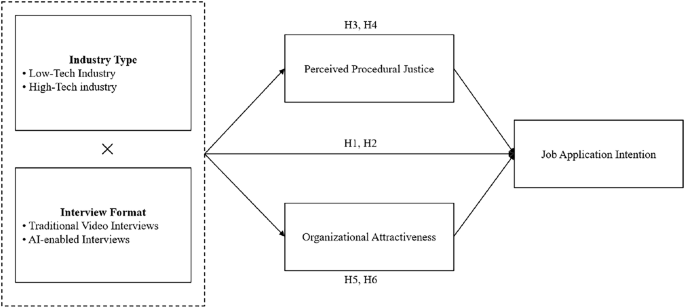
Source: Created by authors.