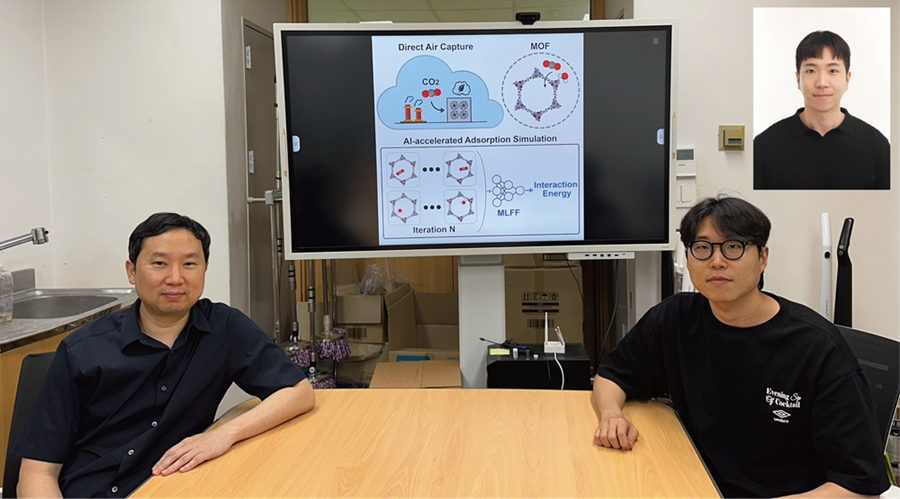
<写真1。(左から)ジハン・キム教授博士候補者のユンズン・リムと化学および生体分子工学部のヒュンスー・パーク博士>
In order to prevent the climate crisis, it is essential to actively reduce CO2, which has already been released. Therefore, direct air capture (DAC) – a technique that extracts directly from the air only – is attracting attention. However, effectively trapping pure CO2 is not easy due to the water vapor (H2O) present in the air. Kaist researchers use AI-driven machine learning technology to identify the most promising joint capture materials in the Metal Organic Framework (MOF), an important class of materials being studied for this technology.
On June 29, Kaist (President Kwang Hyung Lee) announced that in collaboration with the team at Imperial College London, a research team led by Professor Jihan Kim of the Faculty of Chemistry and Biomolecular Engineering has developed a machine learning-based simulation method that allows for quick and accurate screening of MOFS, the best choice for atmospheric co-capture.
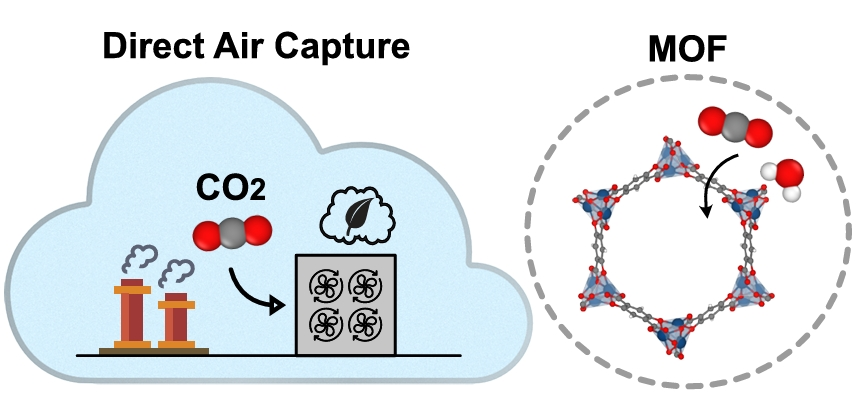
<図1。金属有機フレームワーク(MOF)を使用した直接空気捕獲(DAC)テクノロジーと炭素捕獲の概念図。 MOFは、大気から二酸化炭素を捕獲することができる多孔質材料を有望であり、DACテクノロジーのコア材料として注意を引いています。 >
To overcome the difficulty of discovering high-performance materials due to structural complexity and limitations to predicting intermolecular interactions, the researchers have developed a Machine Learning Power Field (MLFF) that can accurately predict interactions between Co₂, water (H₂O), and MOFS. This new method allows calculations of MOF adsorption properties to be calculated at a quantum mechanics level accuracy at a much faster rate than before.
Using this system, the team screened over 8,000 experimentally synthesized MOF structures and identified over 100 promising candidates for CO₂ capture. In particular, this included new candidates that have not been revealed by traditional force field-based simulations. The team also analyzed the relationship between MOF chemical structure and adsorption performance and proposed seven important chemical features that will be useful in the design of new materials in DACs.
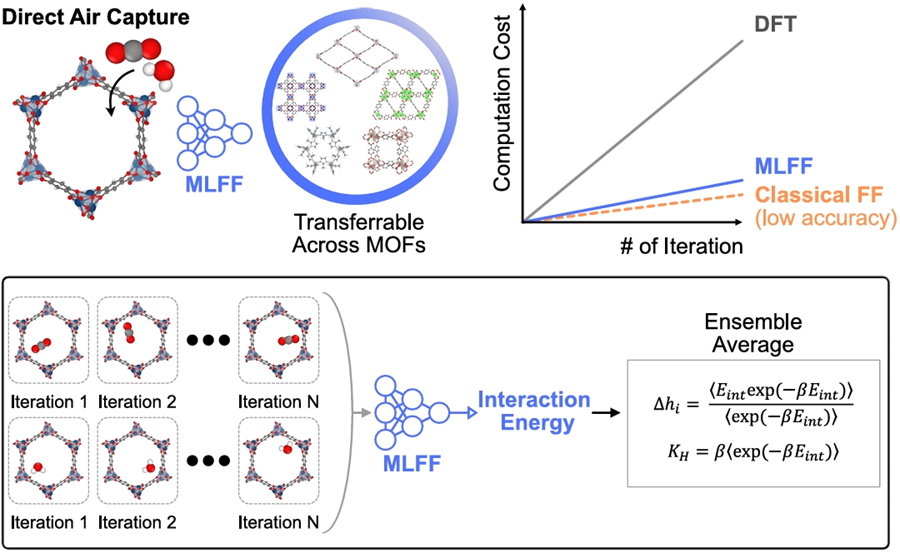
<図2。機械学習力フィールド(MLFF)を使用した吸着シミュレーションの概念図。開発されたMLFFは、さまざまなMOF構造に適用でき、反復的なウィドム挿入シミュレーション中に相互作用エネルギーを予測することにより、吸着特性の正確な計算を可能にします。従来の古典的な力場と比較して、同時に高精度と低い計算コストを達成することを特徴としています。 >
This study is recognized as a significant advance in the DAC field by accurately predicting MOF-Co₂ and MoF-H oO interactions, significantly enhancing material design and simulation.
The results candidates for this study, Yunzun Lim and Dr Hyunsu Park of Kaist, were published in International Academic Journal Affairs on June 12th.
*Paper title: Acceleration of CO₂ direct air capture screening for metal organic frameworks with mobile machine learning power fields
doi: 10.1016/j.matt.2025.102203
This study was supported by the Saudi Arabia Aramcokaist Core Management Centre and the Ministry of Global Clean Projects of Science and ICT.
/Public release. This material of the Organization of Origin/Author is a point-in-time nature and may be edited for clarity, style and length. Mirage.news does not take any institutional position or aspect, and all views, positions and conclusions expressed here are the views of the authors alone.