

Each month, AI-generated content becomes difficult to distinguish from human-made materials. Google's latest video maker is one example. The newly released VEO 3 model is a step up from a realism perspective. Also, for the first time you add audio, you can add synced dialogs, natural sounds, and other audio effects.
Google has promised that the new VEO 3 model has a better understanding of real physics and will be smarter to turn text prompts into video clips. These clips are currently capped at a resolution of 720p in 8 seconds. This is probably due to the high demand for computing (and the environment) to generate these videos.
Like the AI upgrade standards, Google won't talk about energy use or the training of these models, but it's seeking the help of filmmakers Dave Clark, Henry Daubrez and Junie Lau to promote the capabilities of the Veo 3. The short film has already been made.
At the same time, Google has also announced an online video editor called Flow. This allows you to piece together the scenes and take a more structured approach using AI. If you don't want to create anything but want to see what these tools are capable of, then stop Flow TV in your browser and watch.
So, how does VEO 3 affect the state of AI video making? It's obvious that you'll see more deepfakes than ever before, and it'll be even more difficult to distinguish between real videos from AI videos. And, as you can see from the examples collected below, you can create a completely new range of AI videos.
What people are making
There's no need to look far away at examples where VEO 3 is used. Perhaps Google's show reels are a good place to start. You can see feathers floating in the air, animated characters in the forest, detectives interrogating rubber ducks, and violinists playing music.
These clips show some of the forward leaps the VEO 3 has made, especially in terms of video quality and the audio that comes with it. Overall, the music and dialogue match perfectly well with the video, adding to the overall effect. It looks like the real actor is talking about the actual lines.

But even Google's handpicked collection of clips is not perfect. Physics is often unstable and the completed results are not used, so there is no way to know how closely it adheres to the text prompt used. Creating realistic AI videos is one thing, but following the instructions in the text provided is another thing.
Following the misuse of the unfortunate Stormtrooper called Greg, the Veo 3 series is a video blog on Instagram for Stormtrooper. This series is a clever way to maintain consistency across multiple videos and scenes. Of course, all the stormtroopers look the same, but again show the high level of video quality possible with the VEO 3.

The AI video generator has also proven popular for producing Vox Pop videos where people are interviewed on the streets. See, for example, the Clip Endless Line in NYC. If you look closely enough, there are inconsistencies and errors, but it is a compelling, artificial spoofing of real life interviews you find on YouTube.
One of the reasons why these AI interviews look so realistic is that VEO 3 is extensively trained with videos like those. Note that camera angles tend to be the same all the time, and people always seem pretty common. When it comes to creating more ambiguous content, the lack of drawing data in VEO 3 means it's not that great.
How to use VEO 3
Currently, you will need to sign up for the Google AI Ultra plan (a whopping $250 a month, $250). To get the most out of your VEO 3. Still, there are usage restrictions, but these are not specified (limits generally depend on how much pressure Google's AI infrastructure is putting on at a certain time).
If you're using a more modest monthly Google AI Pro plan, you'll get 3 credits per day for what's called “Veo 3 Fast.” Google doesn't have much depth in the difference between VEO 3 and VEO 3, but it's a faster, lower quality, energy-intensive version of VEO 3, faster and less energy-intensive version. Over time, these allowances can change around.
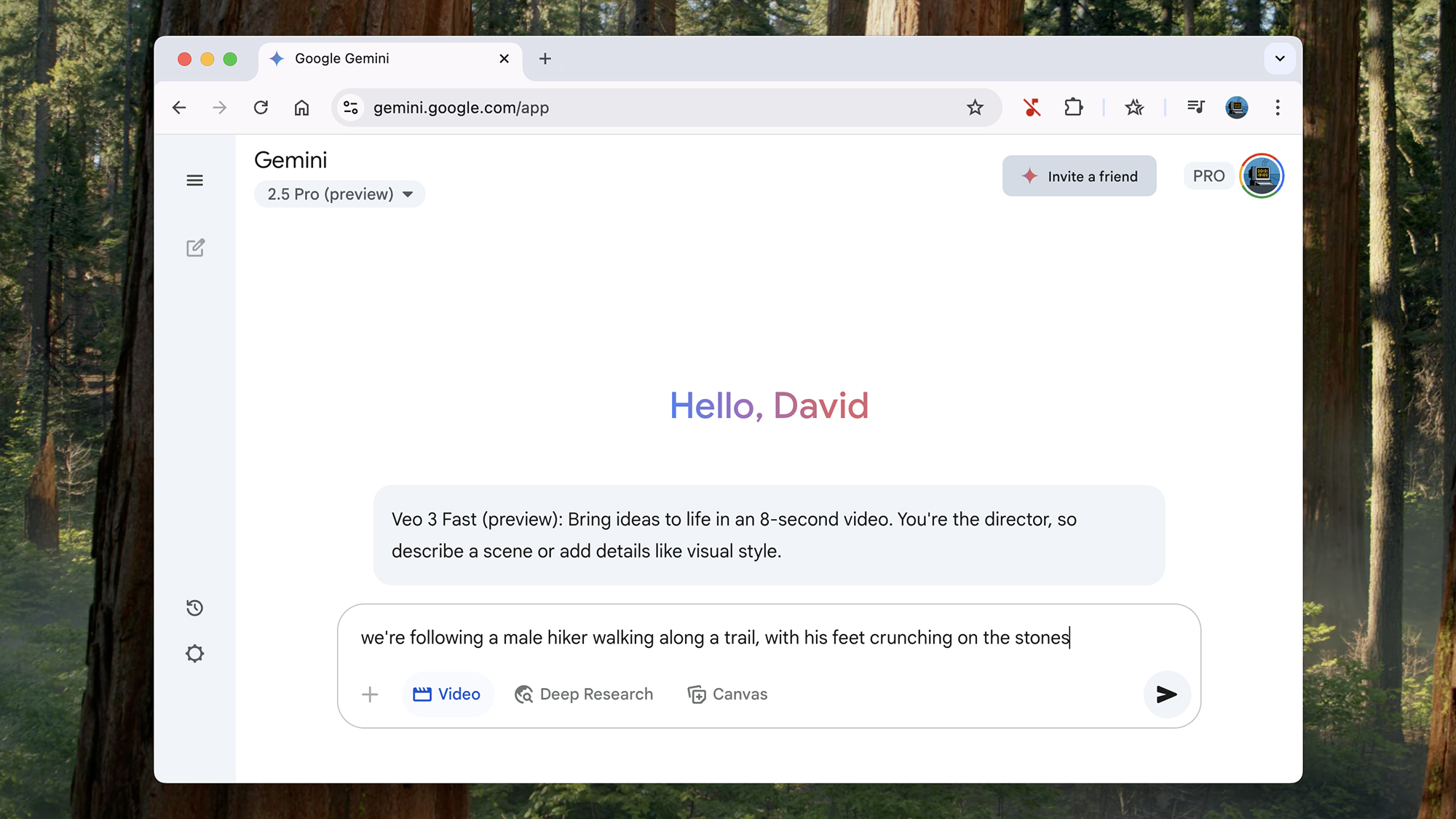
Those of you with AI Pro or AI Ultra Plans can head to Gemini on the web to start creating your video (Google says that mobile app access is still unfolding, so it may also show up there). Click in the prompt box at the bottom of the screen video To tell you which app you want to create a video, enter a description of what you want to view.
Remember, I only have 8 seconds here. Therefore, you cannot interfere with the direction of the scene and the plot. Specify as much as possible about the angle and movement of the camera, what you want to see in the scene, and sound effects. When you're ready, click on the arrow on the right to work the AI.

In general, it helps you to be as specific as possible when creating VEO 3 videos. Anything you don't mention is invented by AI (and it doesn't always follow your instructions either). The above is my efforts to create a summer hiking scene. Once you've exhausted your VEO 3 credit allocation, go back to your old VEO 2 AI model.
These videos may be surreal overall, but they still don't match the actual filmmaking. There are far too many contradictions, physics issues and deviations from the prompt, not to mention the generic output issues. This means that a lot of content is similar. However, there is no doubt that Veo 4 is already in progress.
Other deals, reviews, and purchase guides


