

Spreadsheets have been used for a very long time when it comes to driving decisions, generating insights, performing calculations, and organizing data. However, as datasets grow, large-scale calculations and tasks in spreadsheets become more complex. As your data grows, traditional spreadsheets can feel slow and manual calculations can become a headache. Here is AI for seats We can do the tedious work for you. AI can transform spreadsheets from passive data stores to active analytical engines that can automate, predict, summarize, and even generate insights on demand.
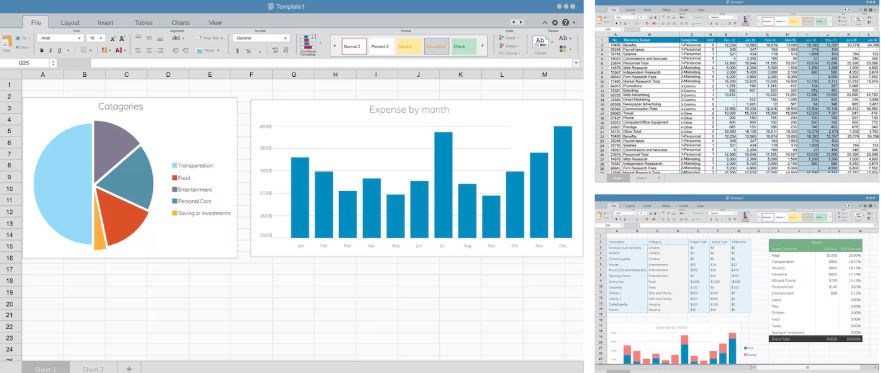
Whether you’re a financial planner, business owner, marketer, or data analyst, the AI-powered spreadsheets on this list will help you work smarter and faster. If you want to integrate AI into your sheets, consider the best tools below.
1. GPT for work
GPT for Works is ideal for universal AI assistance across documents and spreadsheets.
GPT for Work is your one-stop AI assistant. This platform brings the power of large language models such as spreadsheets to your workflows. Rather than manually navigating menus or writing formulas, simply ask the platform to generate calculations, organize data in spreadsheets, and even extract insights.
Why it’s a great addition to your sheet
This tool is a great choice for non-technical users who want powerful AI without coding. Works with Google Sheets, Excel, and other document tools. This tool can generate summaries, explain complex data, and highlight trends. Natural language prompts you enter into this tool are automatically converted into spreadsheet formulas.
Have you ever wondered if spreadsheets can answer your queries? If so, AI for Sheets from GPT for Work can do the work for you.
2.Zapier table
Zapier Tables is perfect for enriching your AI data and automating workflows in Excel.
Zapier Tables takes spreadsheet-style sheets and adds automation and AI-powered workflows. This platform allows you to automatically pull data into your spreadsheets from applications like Trello, Gmail, and Stripe. AI can then be used to clean or classify the data.
Main features
This platform is designed for operations and business automation teams. With it, you get real-time updates and integrations. Smart classification and tagging using AI is possible. It also helps automate drag-and-drop between tables and apps.
With Zapier Tables, your spreadsheets are more than just grids. It is a connected part of the automation ecosystem.
3. Microsoft Excel and Copilot
This tool is perfect for using enterprise AI directly within Excel.
Microsoft is building Copilot AI into Excel, which lets you generate formulas, build pivot tables, and explain trends in your data using simple natural language prompts. Copilot accepts questions and outputs results directly to a spreadsheet.
highlights
This tool has built-in anomaly detection and data insights. This tool allows you to create AI-guided predictions and graphs. Understand what your data shows in plain text and instantly turn text prompts into formulas.
This tool is ideal if you use Excel as part of Microsoft 365. You can also use this tool if you want to bake AI directly into your spreadsheets.
4. Arc type
This AI for Sheets is ideal for collaborative spreadsheet development using AI.
Arctype combines the ease of use of spreadsheets with the database capabilities and layers of AI to help you query, visualize, and clean up your data faster. You can think of it as a spreadsheet that gives you insight into the structure of your data.
What can this tool do for you?
Helps with automated data insights and organization. Arctype provides hassle-free connectivity to SQL databases. The platform allows you to generate queries with AI assistance. Additionally, the platform offers version history and real-time collaboration.
When workflows involve team collaboration or large datasets, this platform enables smart AI that was not traditionally possible with spreadsheets.
5. SheetAI Helper Tool (Open Source)
This tool provides customizable AI add-ons for advanced users.
Do not confuse this tool with the excluded “SheetAI” platform. You’ll find a wide range of open source AI tools developed by the community that plug into your spreadsheets using APIs like OpenAI. These tools are not tied to a single brand. Rather, it allows advanced users to customize AI workflows to suit their requirements.
What can you do with this tool?
This tool allows you to integrate AI alerts and triggers. You can use this to build custom prompt functions. It also helps in automatic detection of data quality issues. Additionally, you can use it to generate contextual summaries of rows.
This tool is characterized by its flexibility. With this tool, you can design your own AI sheet logic without vendor lock-in.
6. Notion Database + AI Block
This platform is ideal for data-driven databases with AI insights.
When you combine Notion’s AI blocks with Notion Table, you can power your spreadsheet-like data. Notion can extract insights, create formulas, generate summaries from your database, and create new entries based on prompts.
What does it add?
Works seamlessly with documents and notes. Provide insight cards and action suggestions. You can get AI-generated calculations and filters, and the platform allows you to use natural language for database commands.
This platform is perfect for teams who want to document and evaluate in one place. This tool allows you to easily combine data and insights.
Why choose GPT for your work?
Among these AI for Sheets tools, GPT for Work is the best. The reason is that it is multifunctional and easy to use. Additionally, it provides tight integration between productivity platforms. Compared to tools that focus solely on database-style functionality or automation, GPT for Work turns spreadsheets into true AI assistants that understand natural language and generate complex formulas in an instant. We can explain trends in your data in plain English and help you clean and transform datasets without the need for technical expertise.
The platform bridges the gap between advanced AI capabilities and everyday spreadsheet users, giving business owners, analysts, finance teams, and marketers alike access to powerful analytics. Rather than forcing users to adapt to a rigid workflow, GPT for Work adapts to the way users already work, making it a tool that doesn’t just enhance spreadsheets, but doubles the productivity of your overall workflow.


