Most people wake up expecting the world to move. The light will turn on. The plane is landing. The hospital is run. Supply chain provides. What may appear seamless on the surface is powered by a vast network of systems, data, and business processes that work in sync behind the scenes.
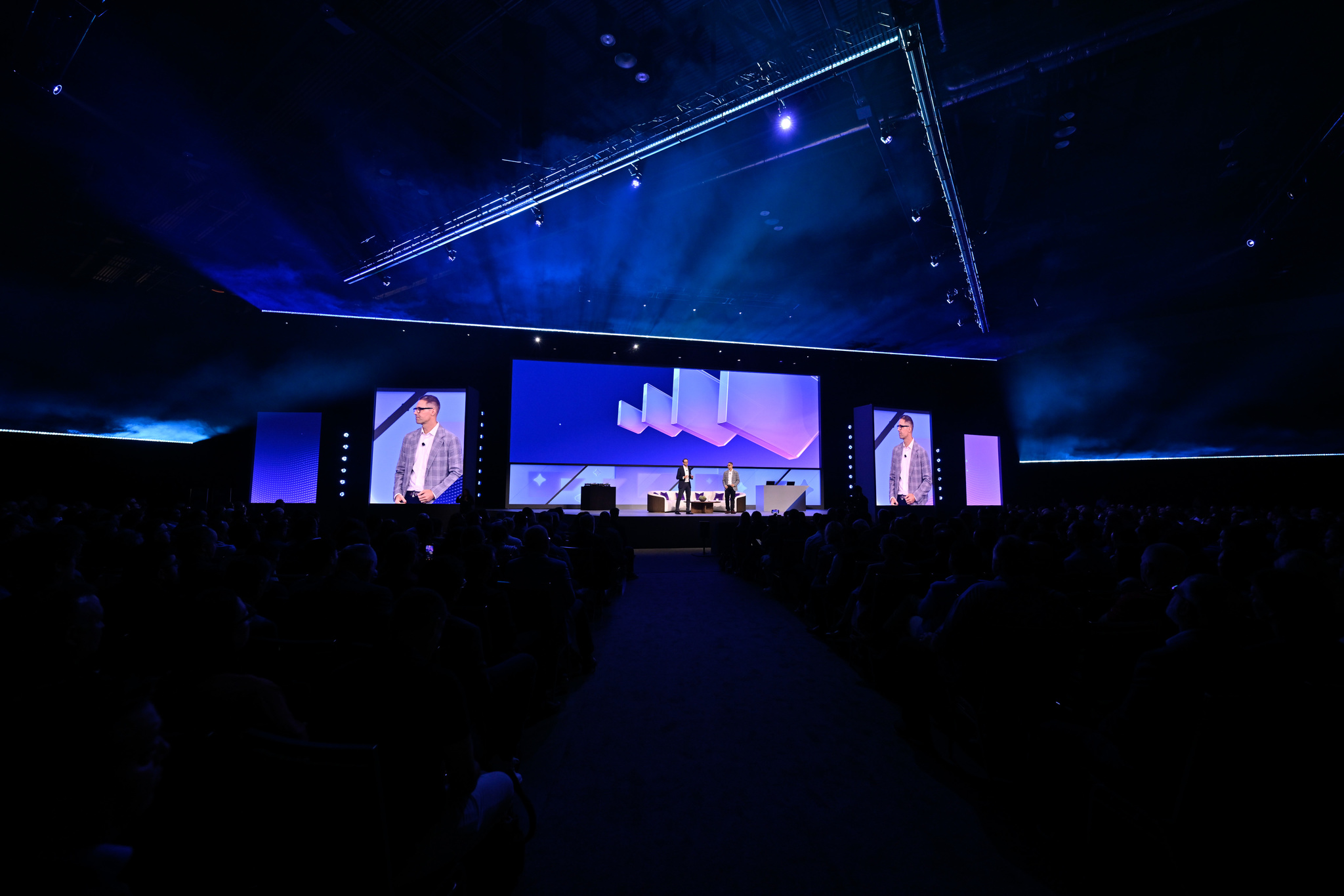
This idea formed the framework for the keynote at SAP Sapphire in Orlando. There, Thomas Saueressig, Chief Customer Officer and member of the SAP SE Executive Board, and Jan Gilg, Global President of Customer Success & Americas and member of the Extended Board of Directors of SAP SE, explained the company’s case for the autonomous enterprise.
Their message was clear. As AI moves from promise to practice, customers are no longer asking if it matters. They’re looking for ways to drive tangible results across their business.
“Every day, billions of people wake up and believe that the world is just moving,” Saueressig said.
However, achieving this is by no means easy. Saueressig pointed to the complexities hidden behind everyday operations, from power grids that balance supply and demand in real time to global supply chains that move goods across countries and continents. Business operations, he argued, are the invisible backbone of modern life, even if most people never see them.
Gilg picked up that thread by focusing on the pressures customers currently face as they seek to turn their AI ambitions into business value. Excitement is high, he said, but so is the urgency.
Customers want to extend AI across the enterprise and connect it to core processes where it can have a measurable impact. But Gilg says the real obstacle isn’t the AI itself. It’s the corporate landscape that surrounds it.
“The elephant in the room: AI in the enterprise is complex,” he said, pointing to the disconnected applications and fragmented data that many organizations are still grappling with.
This challenge led directly to SAP’s vision for an autonomous enterprise. In the autonomous enterprise, AI is embedded in business processes, connected through trusted data, and managed in a way that enables reliability at scale.


Vision of the autonomous enterprise
“The need for reliable, seamless integration led to our vision of an autonomous enterprise,” says Gilg.
He presented this not as a futuristic concept, but as a practical operating model where AI drives end-to-end execution and humans maintain control within a trusted governance framework.
Saueressig positioned SAP’s role as helping customers get there: “Our goal is to help our customers become autonomous enterprises, step by step. … Today, we are making the value of AI a reality.”
He combined that approach with RISE with SAP, SAP’s AI products, SAP services and support portfolio, and success plans to help customers put innovation to productive use. He said the focus is on creating value through the transformation process.
“As our customers commit to RISE with SAP, we are committed to supporting them every step of the way,” said Saueressig. That commitment extends to even the most complex and hybrid environments, he said, stressing that customers will not be left behind.
Lockheed Martin: Preparing for change in high-stakes environments
This customer-first approach set up the next part of the keynote. There, customers took to the stage to share first-hand how they are transforming their businesses in the real world. There was no theory or abstract concepts, just practical experience.
At the start of the customer round, Lockheed Martin positioned transformation not as the end goal, but as staying ready in one of the world’s most demanding environments.
“Transformation is not the goal. For us, it’s readiness,” said Maria Demarie, Lockheed Martin’s senior vice president and chief information officer, stressing that when systems support national defense and allied missions, the risk is “to humans.” Readiness, she explained, means the ability to act “with speed, clarity and confidence across the enterprise.”
Through the largest transformational investment in the company’s history, Lockheed Martin is redesigning processes end-to-end, connecting fragmented systems, and incorporating AI into a model-based enterprise built on SAP.
Operating in a highly regulated environment with strict security and data requirements, the company focuses on reducing cycle times and increasing responsiveness. “Transformation doesn’t start with technology. We need to rethink processes,” Demarie emphasized. He said SAP’s role has evolved from a vendor to a trusted partner that understands Lockheed Martin’s business and the environment in which it works.
Aeropuertos Argentina: From reactive winter operations to proactive AI-driven control
Aeropuertos Argentina made history by becoming the first Latin American customer to present at the SAP Sapphire keynote. The company used the spotlight to share practices rooted in operational urgency, demonstrating how a clean core and focused innovation can drive results quickly.
The airline, which manages 90% of Argentina’s commercial flights, must keep its airports open during harsh winter weather. This has traditionally relied on manual, piecemeal processes, increasing costs, safety risks, and environmental impact. To address this, the company has developed an AI agent called Smart Network for Operative Winter (SNOW) to coordinate weather data, runway sensors, maintenance processes, and operational procedures.
“We have moved from a reactive model to a proactive model,” said Gustavo Sabato, Chief Information Officer of Aeropuertos Argentinas, highlighting the expected benefits, including 16% cost savings and reduced CO₂ emissions. Fast time to value, from idea to operation in 12 weeks, with rollout beginning at two airports and expanding to six additional airports this winter.
A key enabler was upgrading from SAP R/3 to SAP S/4HANA in 2023 and building the solution on SAP Business Technology Platform. Integrating multiple non-standard data sources was difficult, but as a result, the company now operates with “one version of the truth” and requires minimal manual intervention, Sabato said. The company plans to extend this approach beyond Argentina to processes at other airports it manages, reinforcing that a strong technical foundation is essential to turning AI into real operational outcomes.
ExxonMobil: A clean core and a strong data foundation
ExxonMobil is rethinking how its operations can stay nimble and nimble amid the rapid changes caused by the global transition to new energy sources.
Bill Kaylor, vice president of ExxonMobil Global Services Company, said the energy giant has embarked on a business-driven transformation to simplify processes and free up data that has become fragmented after decades of customization. “Our goal is not short-term optimization, but long-term agility: standardization based on industry best practices, establishing a clean core, and stabilizing upgrades,” he said.
He emphasized that both the transformation and the company’s AI ambitions depend on a strong foundation. “If we don’t get this foundation right, we’re going to continue to pay the price,” he says.
Keillor concluded with three pieces of advice for any transformation. It’s about clarifying the strategy and aligning the leadership behind it. Implement strong governance to enable fast and consistent decision-making. And choose a partner who will challenge you and be committed for the long term.
Lévi Strauss: AI at scale
As Levi Strauss accelerates its transition to a direct-to-consumer business, it recognizes that it needs a lean technology environment to gain speed and scale. Jason Gowans, chief digital and technology officer, said the company started by consolidating nine ERP systems into a single global foundation on RISE with SAP, standardizing processes and establishing a clean core.
This integrated backbone now supports Levi’s ambitious AI strategy, with over 1,000 AI agents already in operation across the company. The impact is already visible. One example is wholesale order processing. While 80% of orders are already made automatically, the remaining 20%, which smaller customers often send via handwritten notes, emails, or unstructured documents, previously took 2-5 days to process manually.
“Currently, with agents built on SAP, that process takes 20 to 30 minutes,” Gowans says. For Levi Strauss, the lesson is clear. Standardization does not limit agility. It becomes possible.
AI-powered migration
These customer examples demonstrate that transformation typically follows a shared path: modernizing the core, moving to the cloud, and innovating along the way.
Next, SAP demonstrated how its AI-powered agents can help customers accelerate their efforts through a more integrated, AI-driven approach to large-scale transformation. Announced at the Global Keynote, the Migration and Modernization Assistant is designed to analyze systems, data, custom code, configuration, testing, and deployment as part of one connected process. By replacing fragmented manual tasks with coordinated automation, activities that once took weeks can now be completed in a single weekend, from landscape analysis to custom code evaluation.
Change doesn’t destroy the world
So Gilg broadened his perspective, arguing that every major technology wave brings uncertainty. But each of these waves has actually made the world a better place, creating more jobs, new business models, and new sources of income than people could have imagined before. Similarly, enterprise software will become even more essential thanks to AI, he argued.
That’s because the core needs of businesses remain the same: systems that work, people who care, and teams that work together. In Gilg’s framework, AI will not replace enterprise software. It exists within it and is embedded in the processes that keep the company running.
Saueressig returned to the image that started his keynote speech: a world where people trust and function. He argued that in times of rapid change and unprecedented disruption, resilience is more important than ever.
“Change doesn’t destroy the world,” he said. “When change moves faster than resilience, problems arise, and that’s where SAP comes in.” He emphasized the importance of people in times of change, emphasizing that beyond technology and AI, transformation remains deeply human and shaped by the people who build and use it. “The future will not be written by AI. It will be written by us,” he said.