Healthcare systems are facing increased data volumes, staff shortages, and rising expectations for personalized care. Generative AI is emerging as a key solution by synthesizing unstructured medical data, such as clinical notes, imaging reports, and patient histories, into insights for clinicians and administrators.
Explore how generative AI is applied across healthcare delivery, administration, and population health management, along with the challenges and future directions shaping its adoption.
|
Area |
Use Cases |
Examples |
|---|---|---|
|
Synthetic medical imaging |
– GANs for synthetic X-rays, |
|
|
Healthcare Administration |
Claim pricing |
– GPT-4 in EHRs |
|
Data synthesis |
– Diagnostic Robotics predictive analytics to reduce ED visits, increase ROI, and personalize care strategies. |
|
|
Public Health Initiatives |
Targeted campaigns |
– AI-guided breast cancer screening |
|
Supporting medical research |
– Google Research AI co-scientist for biomedical research support |
Improving healthcare delivery
1. Create new medical images
Generative AI, especially Generative Adversarial Networks (GANs), can be trained to generate synthetic medical images that mimic real-world X-rays, MRIs, and CT scans. These synthetic images have several important applications in healthcare:
- Medical training & education: AI-generated images can be used to train healthcare professionals by creating diverse datasets of rare diseases, anomalies, or normal variants that may not always be present in real-world cases.
- Data augmentation for AI models: Training AI systems to diagnose medical conditions requires large datasets. Generative AI can produce synthetic images to augment limited datasets, thereby improving the accuracy of diagnostic models without compromising privacy.
- Simulation and research: Synthetic images can help researchers simulate various scenarios (such as how a disease might progress) or test AI algorithms without waiting for new patient data. This process can support accelerating medical research.
- De-identification of data: By generating synthetic images that preserve key clinical features while not representing real patients, healthcare systems can share data without violating privacy laws such as HIPAA.
Research has shown the effectiveness of synthetic images in medical imaging analysis. For example, a study in Nature Biomedical Engineering demonstrated that GAN-generated synthetic retinal images were just as effective as real images in training a deep learning model for diabetic retinopathy detection.
Another example is from the MAISI (Medical AI for Synthetic Imaging) study, which utilized diffusion models to generate high-resolution synthetic 3D CT images.
The experimental findings demonstrate that MAISI can generate lifelike, anatomically precise images across various body regions and conditions (See the image below).
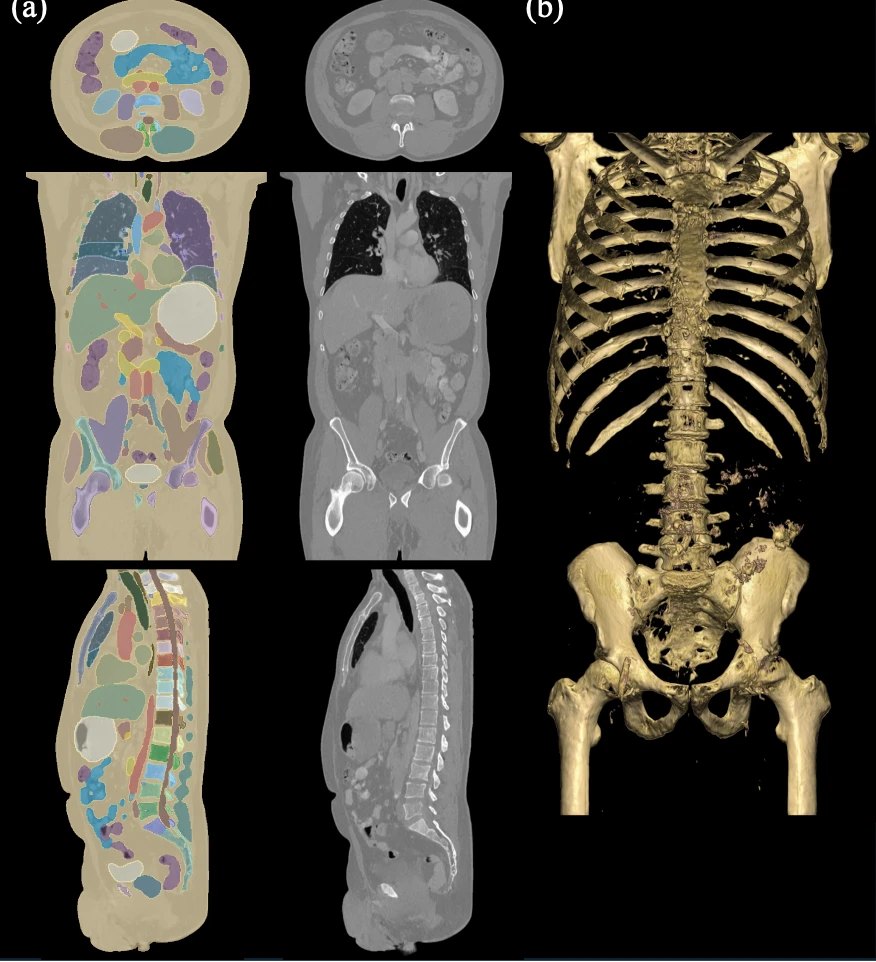
Figure 1: (a) A high-resolution CT scan generated by MAISI with its segmentation overlay, shown in axial, sagittal, and coronal views. (b) A 3D rendering focused on bone structures, highlighting the realism of the generated scan.
Another study on creating new medical images with generative AI models focused on X-Diffusion, a novel approach that reconstructs full 3D MRI scans using just one or a few 2D slices, greatly accelerating scan times and reducing costs.
Unlike traditional methods that rely on complete 3D data or treat MRIs as separate 2D slices, X-Diffusion learns from entire 3D volumes during training (See the image below). It outperforms existing techniques in image quality and accuracy, preserves critical anatomical details, and even generalizes to new body regions it wasn’t trained on.
This development is expected to make high-resolution MRI imaging faster, more affordable, and more widely accessible.
Figure 2: A comparison between traditional MRI reconstruction vs X-Diffusion.
2. Generate personalized treatment plans
Generative AI models can analyze a patient’s comprehensive medical history, genetic profile, lifestyle factors, and even real-time health data (e.g., from wearables such as smartwatches) to create personalized treatment plans. Here’s how this works:
- Patient analysis: AI systems can identify patterns in a patient’s history, such as past diagnoses, treatment responses, and genetic predispositions. Generative AI tools can then generate a treatment plan tailored to the patient’s unique circumstances.
- Integrating real-time data: AI can pull in data from sources such as wearable devices, lab tests, and continuous monitoring systems. Based on this data, the system can adjust or generate new treatment recommendations to ensure the patient is always on the most effective course of treatment.
- Predictive treatment: By generating models that simulate how a patient might respond to various treatments, generative AI tools can suggest options that maximize the likelihood of success. For example, if a patient has a specific genetic mutation associated with a poor response to a drug, these tools could suggest alternatives beforehand.
- Automating complex decision-making: Complex conditions such as cancer often require multi-modal treatments involving surgery, chemotherapy, and targeted therapies. Generative AI tools can assist by creating treatment schedules, predicting side effects, and coordinating multi-disciplinary care tailored to the patient’s evolving condition.
- Personalized medication: AI can recommend personalized dosages or medication types based on the patient’s metabolic profile, reducing the risk of adverse drug reactions or inefficient treatments.
Real-life example:
In collaboration with Google, the Princess Máxima Center for Pediatric Oncology in the Netherlands is developing an AI system called Capricorn.
Powered by Gemini models, the tool helps physicians identify personalized cancer treatment options by analyzing large volumes of public medical data alongside de-identified patient data.
Capricorn quickly produces summaries of relevant therapies and scientific literature, enabling clinicians to engage in more informed and detailed treatment discussions. Watch the video below to learn more about Capricorn:
Video explaining the Capricorn AI tool for personalized cancer treatments.
Real-life example:
In 2024, Mayo Clinic partnered with Cerebras Systems to develop AI models that analyze genomic data from over 100,000 patients. These models aim to predict individual responses to treatments, such as assessing the efficacy of methotrexate in rheumatoid arthritis patients, enabling more tailored therapeutic strategies.
Supporting healthcare administration
Generative AI tools play a crucial role in managing various administrative functions within healthcare. These technologies can be applied across multiple areas to enhance efficiency, accuracy, and overall healthcare delivery.
3. Claim pricing
Generative AI technologies can support claim pricing in the insurance and healthcare sectors by automating the review of complex contracts.
Traditionally, determining the appropriate pricing for claims requires detailed analysis of various contractual terms, conditions, and coverage details, which can be prone to manual errors and inefficiencies. AI models can quickly and accurately process these documents, cross-reference relevant policy information, and calculate claim prices.
This process leads to faster, more accurate claim settlements while minimizing disputes and improving operational efficiency and the customer experience in healthcare delivery.
4. Clinical guidelines navigation
Generative AI in healthcare enables providers to compare patient data with clinical guidelines, thereby enhancing diagnostic accuracy and improving healthcare outcomes. These AI tools support clinical decision-making by leveraging natural language processing to analyze electronic health records (EHRs).
Real-life example:
Microsoft’s Sequential Diagnosis Benchmark (SD Bench) uses 304 complex cases from the New England Journal of Medicine to test how AI and physicians navigate diagnostic challenges, ask questions, order tests, and manage costs.
Central to this is the Microsoft AI Diagnostic Orchestrator (MAI-DxO), which coordinates multiple large language models (like GPT, Llama, Claude, Gemini, Grok, and DeepSeek) as a virtual team of doctors to deliver accurate, cost-aware diagnoses.
MAI-DxO, paired with OpenAI’s o3, achieved over 85% accuracy, far surpassing the physicians’ 20% average, while reducing unnecessary testing costs.
The system combines breadth and depth of medical expertise, offering the potential to reduce healthcare waste and empower clinicians and patients.
Figure 3: The graph illustrating multi-agent orchestration in SDBench shows how the Gatekeeper, Diagnostic, and Judge agents collaborate to handle diagnostic questions and evaluate final diagnoses against NEJM case records.
Real-life example:
In 2024, Epic integrated GPT-4 into its Electronic Health Records (EHR) system through a partnership with Microsoft. This integration assists clinicians by providing AI-generated responses to patient messages and suggesting relevant clinical guidelines, thereby enhancing decision-making and patient communication.
5. Fraud detection
AI models powered by machine learning can identify patterns in claims and patient data to improve fraud detection. These tools analyze medical images, discharge summaries, and lab results to support the healthcare sector’s ability to mitigate fraud while addressing data privacy concerns.
6. Medical record analysis
Generative AI models in healthcare settings can extract insights from unstructured clinical documentation, such as EHRs and CT scans. This improves diagnostic accuracy and healthcare providers’ ability to make informed decisions.
The technology also holds promise in analyzing medical conditions and clinical trials by using training data to fine-tune models in a controlled environment.
7. Increase administrative efficiency
Generative AI tools can help reduce administrative burden in the healthcare industry by automating tasks such as clinical documentation and data collection.
AI in healthcare helps medical professionals focus on patient care, enabling efficient healthcare delivery and improving health outcomes.
Real-life example:
The U.S. Food and Drug Administration (FDA) has launched Elsa, a generative AI tool designed to boost efficiency across the agency, from scientific reviews to inspections.
Developed in a secure GovCloud environment, Elsa ensures sensitive industry data remains protected while helping staff summarize adverse events, accelerate clinical protocol evaluations, compare labels, generate code, and prioritize inspections.
While leaders highlight its potential to speed drug approvals and support healthcare operations, employees report frequent “hallucinations,” misrepresented studies, and unreliable outputs that require time-consuming double-checking.
Elsa cannot access industry submissions, limiting its use for critical drug and device reviews, and adoption across the agency remains uneven. Officials stress it is optional, most valuable for organizational tasks, and still evolving, but critics warn that without federal AI safeguards, deploying such tools in health regulation risks outpacing oversight.
Real-life example:
Stanford Health Care has adopted Nuance’s DAX Copilot, an AI-powered tool by Microsoft, to automate clinical documentation during patient visits. This technology reduces administrative burdens, helping address physician burnout while improving access to care and documentation quality.
Using ambient and generative AI, DAX Copilot generates clinical notes from exam conversations, enabling doctors to spend more time with patients. Early results show strong physician satisfaction and time savings.
Real-life example:
Oscar Health integrates generative AI, specifically o1-preview, across multiple administrative functions to improve efficiency and accuracy. It automates claim pricing by reviewing complex contracts, assists clinicians by comparing patient data to clinical guidelines, and enhances fraud detection by identifying anomalies in claims.
Moreover, Oscar AI extracts valuable insights from unstructured clinical data, such as EHRs, improving diagnostic precision.
By automating administrative tasks such as clinical documentation, Oscar AI reduces the burden on healthcare providers, allowing them to focus more on patient care and improving healthcare delivery.
Population health management
Generative AI can significantly enhance population health management by providing deeper insights into demographic trends and enabling the design of tailored interventions:
8. Access to more detailed demographic information
By synthesizing data from multiple sources, such as electronic health records (EHRs), insurance claims, social determinants of health, and public health databases, AI provides a comprehensive view of population health dynamics.
In areas with sparse healthcare data (e.g., rural or underserved communities), generative AI can also generate realistic synthetic data to fill gaps, providing a more comprehensive picture of population health and informing intervention strategies.
9. Predicting health trends
AI models can forecast health trends across different demographic groups, predicting the likelihood of chronic diseases or outbreaks. This allows policymakers to anticipate healthcare needs and allocate resources effectively.
10. Segmentation and personalization
AI-generated profiles of different population segments help identify high-risk groups or communities that require specialized attention. This insight can help target interventions based on factors such as age, ethnicity, income, or geography.
Real-life example:
Diagnostic Robotics’ AI-powered population health management platform enables value-based care by identifying patients at risk of preventable conditions. Predictive analytics enables pinpointing care gaps and proactive intervention.
It also integrates with health plans to enhance care management workflows, reduce costs, and improve ROI, achieving a 2.9x return. The platform supports improved health outcomes, such as a 25% reduction in emergency department event rates.
Designing targeted public health initiatives
Generative AI can also help design more effective and targeted public health campaigns tailored to the specific needs of underserved or vulnerable communities:
11. Customized campaigns
AI can analyze demographic and cultural factors to create personalized public health messages for campaigns such as smoking cessation, vaccination, and disease prevention, ensuring they resonate with different populations.
12. Optimizing resource allocation
By simulating various public health scenarios, AI helps policymakers evaluate the impact of different interventions and allocate resources where they are most needed, particularly in hard-to-reach areas.
13. Addressing health disparities and increasing healthcare access
AI can identify hidden health disparities by analyzing how social determinants of health (such as income, education, or housing) affect various populations. This insight can guide initiatives to reduce disparities and improve access to preventive care.
AI tools can also identify areas most in need of healthcare infrastructure, guiding the placement of clinics, telemedicine services, or mobile health units.
14. Tailoring preventive care programs
AI-driven analysis can design preventive care programs, such as screenings for chronic conditions, targeting at-risk populations, leading to earlier interventions and reduced long-term healthcare costs.
15. Enhancing health education and awareness
Generative AI can simulate different approaches to delivering health education, helping develop culturally sensitive strategies that are well-received across communities.
Real-life example:
Google Health is conducting a study with Northwestern Medicine to assess the effectiveness of AI in breast cancer screening. The AI model flags high-risk mammograms for immediate radiologist review, potentially speeding up diagnosis. Women flagged by AI may receive same-day additional imaging, which is expected to shorten the typical waiting period.
This approach shows AI’s ability to match or exceed clinician accuracy in analyzing mammograms and create personalized treatment plans accordingly.
Research & development
16. Supporting medical research
Generative AI supports medical research in healthcare by assisting researchers in generating hypotheses, synthesizing large volumes of scientific literature, designing experiments, and identifying potential therapeutic targets or drug repurposing opportunities.
By augmenting human expertise with computational reasoning and iterative analysis, generative AI tools can accelerate discovery processes while enabling researchers to focus on interpretation, validation, and clinical relevance.
Real-life example:
Google Research introduced an AI co-scientist, a multi-agent artificial intelligence system built on the Gemini 2.0 model to serve as a virtual research collaborator for scientists.
The system is intended to support the scientific process by helping researchers generate novel hypotheses, create detailed research plans, and propose experimental approaches tailored to specific goals.
The AI co-scientist uses a coalition of specialized agents to iteratively generate, evaluate, and refine ideas, mirroring aspects of the scientific method, and can integrate tools such as web search and expert feedback to improve outputs.
Early experiments demonstrate its utility for biomedical tasks, including drug repurposing, identifying treatment targets, and elucidating mechanisms of antimicrobial resistance. This suggests that the system may accelerate certain aspects of research while remaining a collaborative tool rather than an automated replacement for human scientists.
Figure 4: Image showing the components of the AI co-scientist multi-agent system and the structure of its interactions with the scientist.
17. Drug discovery and development
Generative AI enhances researchers’ ability to explore and interpret complex biological systems, which helps contribute to drug discovery.
It can generate hypotheses about disease mechanisms, predict molecular behavior, and support the design and prioritization of drug candidates. By combining traditional laboratory and computational methods, generative AI helps reduce experimentation cycles and supports more efficient development of novel therapeutics.
Real-life example:
Google Cloud and Ginkgo Bioworks have collaborated to launch a new protein large language model (LLM) and a supporting API, designed to support the drug discovery process.
Built on Google Cloud’s Vertex AI platform, these tools utilize Ginkgo’s biological data to help researchers analyze protein structures and interactions. This approach allows pharmaceutical and biotech companies to accelerate the identification of therapeutic targets while improving the development of new medicines.
What are some potential challenges of generative AI healthcare?
While there are many potential benefits to using generative AI in healthcare, there are also some possible challenges and drawbacks. Some examples include:
- Privacy and security: Patient privacy is strictly regulated. The use of generative AI in healthcare also raises concerns about protecting patient privacy and sensitive medical data, as well as the potential for misuse or unauthorized access to healthcare data.
- Bias and discrimination: Generative AI algorithms can be prone to bias and discrimination, especially when trained on healthcare data that is not representative of the population they are intended to serve. This can result in unfair or inaccurate medical diagnoses or treatment plans for underprivileged groups, such as women or non-white races.
- Misuse and over-reliance: If generative AI algorithms are misused or over-relied on, they can lead to incorrect or harmful medical decisions. Additionally, there is a risk that healthcare providers may become overly reliant on these algorithms, losing the ability to make independent judgments.
- Ethical considerations: The use of generative AI in healthcare raises several ethical concerns, including potential impacts on employment in the healthcare sector.
The future of generative AI and its impact on healthcare
The future of generative AI in healthcare is likely to be highly significant as the technology continues to advance and become more widely adopted. Some potential future developments include:
- More sophisticated algorithms: Machine learning algorithms are likely to become increasingly refined over time, with enhanced ability to analyze large amounts of healthcare data and identify patterns and trends. This will enable healthcare providers to make more accurate and personalized diagnoses and treatment plans.
- Better integration with other technologies: Generative AI will likely be integrated with other technologies (e.g., medical imaging and wearable health devices) to provide more comprehensive and personalized patient care.
- Increased collaboration: Collaboration between healthcare providers, researchers, and technology companies to develop and implement generative AI algorithms in healthcare settings is expected to increase.
FAQ
Generative AI algorithms use deep learning techniques/machine learning models to learn from large amounts of data and generate new content similar to the input data.
Generative AI in healthcare works by using advanced AI models, such as large language models and foundation models, trained on extensive datasets from electronic health records (EHRs), medical images, and other clinical data.
These generative AI models analyze patient data, apply natural language processing to extract insights, and assist in clinical decision-making.
They help improve diagnostic accuracy, streamline administrative tasks, and enhance healthcare delivery by automating clinical documentation and reducing the administrative burden on medical professionals.
They also support drug development and clinical trials by analyzing proprietary data.
For successful implementation, healthcare organizations must ensure that AI applications, data availability, and compliance with privacy laws are upheld to gain consumer trust and widespread adoption across the healthcare sector.
Principal Analyst

Cem Dilmegani
Principal Analyst
Cem’s work has been cited by leading global publications including Business Insider, Forbes, Washington Post, global firms like Deloitte, HPE and NGOs like World Economic Forum and supranational organizations like European Commission. You can see more reputable companies and resources that referenced AIMultiple.
Throughout his career, Cem served as a tech consultant, tech buyer and tech entrepreneur. He advised enterprises on their technology decisions at McKinsey & Company and Altman Solon for more than a decade. He also published a McKinsey report on digitalization.
He led technology strategy and procurement of a telco while reporting to the CEO. He has also led commercial growth of deep tech company Hypatos that reached a 7 digit annual recurring revenue and a 9 digit valuation from 0 within 2 years. Cem’s work in Hypatos was covered by leading technology publications like TechCrunch and Business Insider.
Cem regularly speaks at international technology conferences. He graduated from Bogazici University as a computer engineer and holds an MBA from Columbia Business School.
View Full Profile
Researched by

Sıla Ermut
Industry Analyst
Sıla Ermut is an industry analyst at AIMultiple focused on email marketing and sales videos. She previously worked as a recruiter in project management and consulting firms. Sıla holds a Master of Science degree in Social Psychology and a Bachelor of Arts degree in International Relations.
View Full Profile