


In the ever-evolving field of machine learning, developing models that predict and explain inferences is becoming increasingly important. As these models become more complex, they become less transparent and resemble “black boxes” that obscure the decision-making process. This opacity is particularly problematic in fields such as healthcare and finance, where understanding the rationale for decisions is as important as understanding the decisions themselves.
One of the fundamental problems with complex models is their lack of transparency, making them difficult to implement in environments where accountability is important. Traditionally, methods to increase model transparency have included various feature attribution techniques that explain predictions by evaluating the importance of input variables. However, these methods are often contradictory. For example, running the same model on the same data can yield very different results.
Researchers have developed gradient-based imputation methods to address these discrepancies, but these also have limitations. These methods can provide different explanations for the same input under different conditions, undermining their reliability and the user's confidence in the model they are trying to elucidate.
Researchers from the University of São Paulo (ICMC-USP), New York University, and Capital One; T-explainer. This framework focuses on locally additive explanations based on the robust mathematical principles of Taylor expansions. We aim to maintain a high degree of accuracy and consistency in our explanations. Unlike other methods where explanation output can vary, T-Explainer works through a deterministic process that ensures stability and reproducibility of results.
T-Explainer not only pinpoints which features of the model influence predictions, it does so with precision that enables deeper insight into the decision-making process. Through a series of benchmark tests, T-Explainer has been demonstrated to outperform established methods such as SHAP and LIME in terms of stability and reliability. For example, in comparative evaluations, T-Explainer consistently demonstrated the ability to maintain explanatory accuracy across multiple evaluations and outperformed others on stability metrics such as relative input stability (RIS) and relative output stability (ROS). surpassed that of

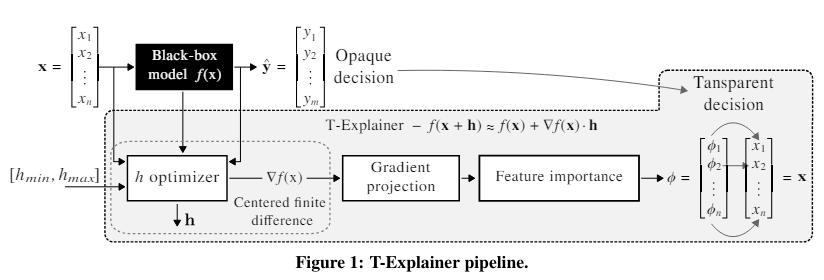
T-Explainer seamlessly integrates with existing frameworks, increasing their utility. It has been effectively applied to a variety of model types, demonstrating flexibility not necessarily present in other explanatory frameworks. The ability to provide consistent, easy-to-understand explanations increases trust in AI systems and facilitates a more informed decision-making process, which can be invaluable in critical applications.


In conclusion, T-Explainer emerges as a powerful solution to a wide range of opacity problems in machine learning models. By leveraging Taylor extensions, this innovative framework provides a deterministic and stable description that exceeds existing methods such as SHAP and LIME in terms of consistency and reliability. Results from various benchmark tests confirm T-Explainer's excellent performance, significantly improving the transparency and reliability of AI applications. T-Explainer therefore addresses the critical need for clarity in AI decision-making processes, sets a new standard for explainability, and paves the way for more accountable and interpretable AI systems. .
Please check paper. All credit for this research goes to the researchers of this project.Don't forget to follow us twitter.Please join us telegram channel, Discord channeland linkedin groupsHmm.
If you like what we do, you'll love Newsletter..
Don't forget to join us 40,000+ ML subreddits


Sana Hassan, a consulting intern at Marktechpost and a dual degree student at IIT Madras, is passionate about applying technology and AI to address real-world challenges. With a keen interest in solving practical problems, he brings a new perspective to the intersection of AI and real-world solutions.


