


Automation in modern industry often involves repetitive tasks, but challenges arise when tasks require flexibility and autonomous decision-making. Traditional robotic process automation (RPA) systems are designed for static, routine activities and fall short when unpredictable events occur. These systems are typically limited to predefined workflows and have limited ability to handle tasks that deviate from standard procedures or require immediate adaptation.
Dynamic workflow automation is important in many sectors, especially financial services. Traditional approaches cannot effectively manage non-standard tasks that require high levels of security and adaptability. This problem is most noticeable in environments where data integrity and confidentiality are paramount.
Previous research on robotic process automation (RPA) has focused on rules-based systems such as UiPath and Blue Prism that automate routine tasks such as data entry and customer service. The rise of Large Language Models (LLMs), such as OpenAI's Generative Pretrained Transformer (GPT) series, has extended capabilities to dynamic code generation. Frameworks such as Langchain and HuggingFace's Transformer Agent further integrate his LLM with external data for adaptive responses. At the same time, AutoGPT addresses limited problem-solving scenarios and highlights the need for more robust and flexible automation solutions in data-sensitive fields such as finance.

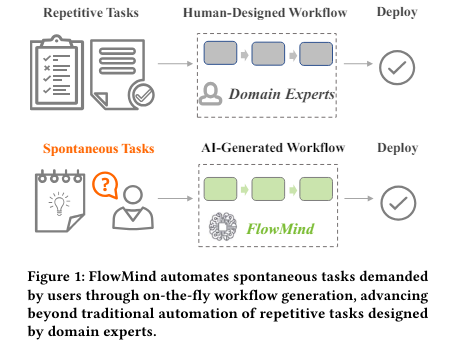
Introduced by researchers at JP Morgan AI Research flow mind, a system that dynamically automates workflows using LLM, specifically Generative Pretrained Transformers (GPT). This innovation stands out in that it incorporates a “lecture recipe” that prepares the LLM before tackling a task, ensuring that the context of the task and API functionality is understood. This methodology significantly increases the model's ability to handle complex real-world tasks securely and efficiently without directly interacting with sensitive data.

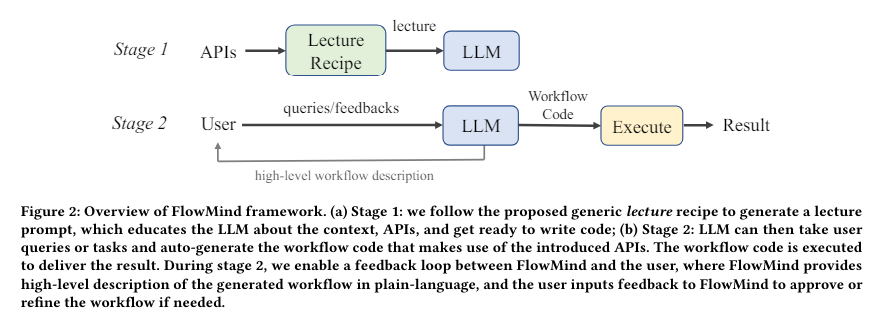
FlowMind works through a structured two-stage framework. First, the system educates the LLM about the task-specific API through a detailed lecture phase and prepares the model with the necessary contextual information and technical details. During the workflow generation phase, LLM applies this knowledge to dynamically generate and execute code based on user input. This methodology utilizes the NCEN-QA dataset, which is specifically designed for financial workflows. This dataset contains various question and answer pairs based on his N-CEN report on funds. This dataset tests the LLM's ability to effectively handle real-world financial queries. User feedback is integrated into the process, allowing you to continually refine your workflows to ensure relevance and accuracy.
FlowMind demonstrated robust performance in automatic workflow generation and achieved excellent accuracy rates across a variety of tests. Specifically, on the NCEN-QA dataset, FlowMind achieved an excellent accuracy of 99.5% for simple tasks and 96.0% for more complex scenarios, significantly outperforming traditional RPA systems. These impressive results demonstrate the effectiveness of lecture-based preparation and API integration. Further improvements were made by incorporating user feedback into the workflow, allowing the system's output to be refined and adapted to user-specific requirements, ultimately increasing the accuracy and applicability of the final generated workflow. .


In conclusion, this study introduced FlowMind developed by JP Morgan AI Research. Leverage LLM, specifically GPT, to dynamically automate complex workflows. The system uniquely integrates structured API interactions and user feedback into his two-stage framework, enhancing security and adaptability. This methodology has been proven to be effective, achieving up to 100% accuracy in realistic financial scenarios through the NCEN-QA dataset. FlowMind's innovative approach represents a significant advancement in RPA, providing a scalable and efficient solution that directly addresses the needs of industries that require robust and flexible automation systems.
Please check paper. All credit for this study goes to the researchers of this project.Don't forget to follow us twitter.Please join us telegram channel, Discord channeland linkedin groupsHmm.
If you like what we do, you'll love Newsletter..
Don't forget to join us 40,000+ ML subreddits


Nikhil is an intern consultant at Marktechpost. He is pursuing an integrated dual degree in materials from the Indian Institute of Technology, Kharagpur. Nikhil is an AI/ML enthusiast and is constantly researching applications in areas such as biomaterials and biomedicine. With a strong background in materials science, he explores new advances and creates opportunities to contribute.


