

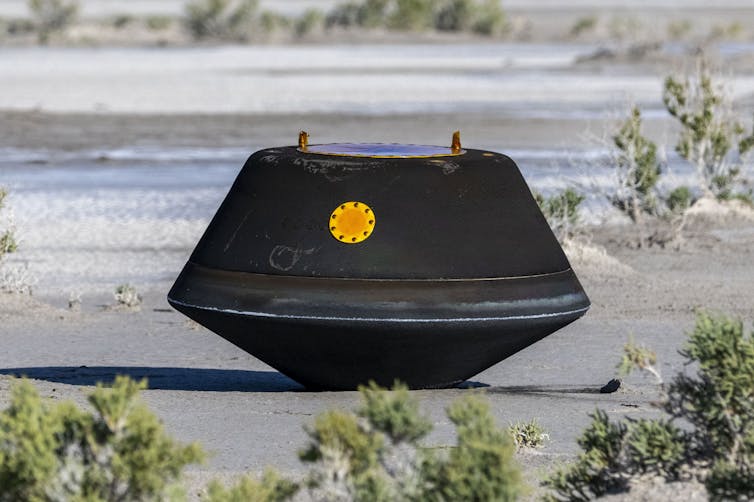
When NASA scientists opened the sample return canister from the OSIRIS-REx asteroid sample mission in late 2023, they discovered something surprising.
The dust and rocks collected from the asteroid Bennu contained many of the building blocks of life, including all five nucleobases used in DNA and RNA, 14 of the 20 amino acids found in proteins, and a rich collection of other organic molecules. They are made primarily from carbon and hydrogen and often form the backbone of life's chemistry.
For decades, scientists had predicted that early asteroids might have delivered the ingredients for life to Earth, and these discoveries seemed like promising evidence.
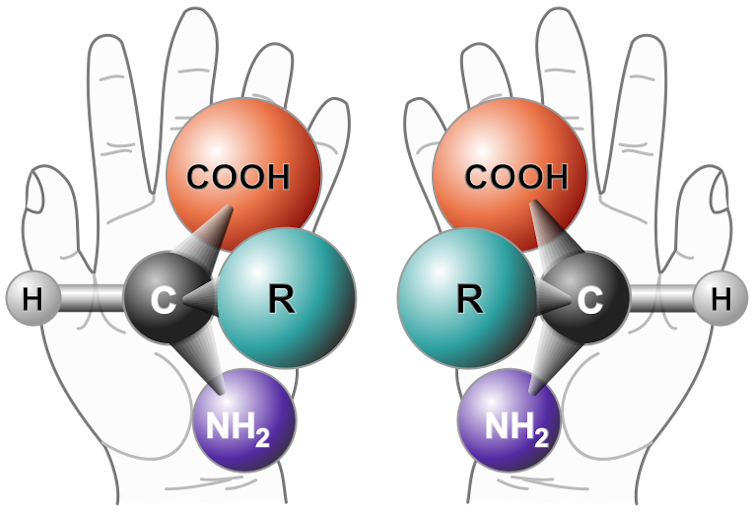
Even more surprising, these amino acids from Bennu were almost evenly divided into “left-handed” and “right-handed” forms. Amino acids have two mirror-image structures called chiral forms, just like our left and right hands.
Almost every biology on Earth requires a left-handed version. If scientists had discovered a strong left-handed excess in Bennu, it would have suggested that life's molecular asymmetry may have been inherited directly from space. Rather, the nearly equal mixtures tell a different story. In other words, life's left-handed preference was likely not imprinted in material transported by the asteroid, but instead emerged later through processes on Earth.
NASA
If space rocks contain familiar ingredients but no chemical “signatures” left behind by life, identifying the true signature of biology becomes extremely complicated.
These findings raise deeper questions. It's becoming more urgent as new missions target Mars, its moons, and the solar system's oceanic worlds. How will researchers detect life when chemistry begins to look like the only “living form”? If inanimate objects can produce rich, organized mixtures of organic molecules, the traditional labels we use to recognize biology may no longer be sufficient.
As a computational scientist who studies biological signatures, I face this challenge firsthand. My astrobiology research asks how, when exploring other planets, we determine whether a collection of molecules was formed by complex geochemistry or by extraterrestrial biology.
In a new study published in the PNAS Nexus journal, my colleagues and I developed a framework called LifeTracer to answer this question. Rather than looking for a single molecule or structure that proves the existence of biology, the researchers looked at the complete chemical patterns of mixtures of compounds preserved in rocks and meteorites to sort out how likely those mixtures contained traces of life.
Identification of potential biosignatures
The key idea behind our framework is that life produces molecules with a purpose, but inanimate chemistry is purposeless. Cells need to store energy, build membranes, and transmit information. Abiotic chemistry, produced by nonliving chemical processes, even if abundant, follows different rules because it is not formed by metabolism or evolution.
Traditional biosignature approaches focus on searching for specific compounds, such as specific amino acids or lipid structures, or chiral preferences, such as left-handedness.
These signals are powerful, but they are based entirely on the molecular patterns used by life on Earth. Assuming that extraterrestrial life forms use the same chemistry, we run the risk of missing biology that is similar to, but not identical to, ours, or of mistaking inanimate chemistry for signs of life.
Bennu's results highlight this issue. Although the asteroid samples contained molecules familiar to life, there did not appear to be anything living inside them.
To reduce the risk of assuming that these molecules represent life, we have constructed a unique dataset of organic materials that lie at the border between life and non-life. We used eight carbon-rich meteorite samples that preserve the abiotic chemistry of the early solar system, and ten samples of Earth's soils and sediments that contain the degraded remains of biomolecules from past or present life forms. Each sample contained tens of thousands of organic molecules, many in low abundance and many whose structures could not be fully determined.
At NASA's Goddard Space Flight Center, a team of scientists crushed each sample, added a solvent, and heated it to extract the organic matter. This process is like brewing tea. The extracted organic-containing “tea” was then passed through two filtration columns to separate the complex mixture of organic molecules. The organic matter was then forced into a chamber and bombarded with electrons until it broke into smaller pieces.
Traditionally, chemists used fragments of these chunks as puzzle pieces to reconstruct the structure of each molecule, but the challenge was that each sample contained tens of thousands of compounds.
life tracer
LifeTracer is a unique approach to data analysis. Rather than reconstructing each structure, it works by taking fragmented puzzle pieces and analyzing them to find specific patterns.
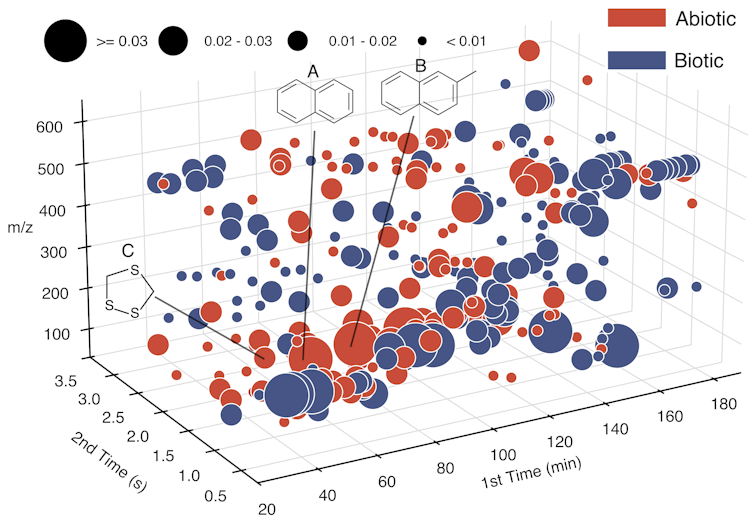
These puzzle pieces are characterized by mass and two other chemical properties and organized into a large matrix that describes the set of molecules present in each sample. A machine learning model is then trained to distinguish between meteorites and terrestrial material on Earth's surface based on the types of molecules present in each.
One of the most common forms of machine learning is called supervised learning. We will take many input-output pairs as examples and learn the rules for proceeding from input to output. Even though there were only 18 samples in these examples, LifeTracer performed very well. It consistently separated abiotic from biological sources.
What mattered most to LifeTracer was not the presence of specific molecules, but the overall distribution of chemical fingerprints found in each sample. Meteorite samples tend to contain more volatile compounds, which evaporate or break down more easily. This reflects the type of chemistry most common in the cold environment of the universe.
Saeedi et al., 2025, CC BY-NC-ND
Several types of molecules called polycyclic aromatic hydrocarbons were present in both groups, but they had unique structural differences that the model could resolve. The sulfur-containing compound 1,2,4-trithiolane emerged as a powerful marker for abiotic samples, whereas terrestrial materials contained products formed by biological processes.
These findings suggest that the contrast between life and non-life is not defined by a single chemical cue, but by how a whole set of organic molecules is organized. By focusing on patterns rather than assumptions about which molecules life “should” use, approaches like LifeTracer open up new possibilities for evaluating samples returned from missions to Mars, its moons Phobos and Deimos, Jupiter's moon Europa, and Saturn's moon Enceladus.
Keegan Barber/NASA (via AP)
Future samples may contain a mixture of organic matter from multiple sources, both biological and non-biological. Rather than relying only on a few well-known molecules, we can now assess whether the entire chemical landscape is closer to biology or more like random geochemistry.
LifeTracer is not a universal life detector. Rather, it provides a basis for interpreting complex organic mixtures. Bennu's discovery reminds us that while life-friendly chemistry may be pervasive throughout the solar system, chemistry alone is not equivalent to biology.
To tell the difference, scientists need all the tools we can build. We need not only better spacecraft and equipment, but also smarter ways to read the stories written in the molecules scientists bring back.


