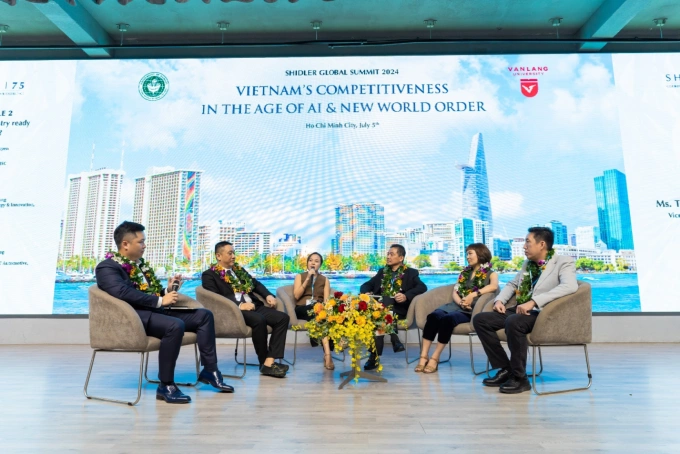
Earlier this month, the Shidler School of Business at the University of Hawaii at Manoa hosted the Shidler Global Leadership Summit at Van Lang University in Ho Chi Minh City, with the theme “Vietnam Competitiveness and the New World Order in the Era of AI.”
Dr. Vance Lawrie, Dean of the Shidler College of Business at the University of Hawaii, discussed advances in AI and its impact on Vietnam's future development with over 120 business CEOs and technology leaders from some of the world's leading companies who are alumni of the Shidler Vietnam Executive MBA (VEMBA) program.
Tung Bui, a professor at Shidler School of Business, said Vietnam may not have the capacity to build an AI machine like ChatGPT due to funding issues.
“We pay OpenAI hundreds of thousands of dollars per day to run our AI models, but the good news is that there's a lot of open AI source code that we can leverage,” he said.
 |
|
University of Hawaii professor Tung Bui speaks at an event on July 5. Photo courtesy of Shidler College of Business. |
According to Tung, the biggest opportunity for Vietnamese enterprises in this era is to find and apply suitable AI models to their systems to improve their competitiveness and save operational costs.
When it comes to GenAI, there are three main components to consider: the user interface, the machine learning model, and the AI training data.
“Without data, there is no AI, and data is the biggest competitive asset for Vietnamese companies that OpenAI and other international companies don't have,” he said.
He believes disruptions to global supply chains are creating new opportunities for Vietnam.
However, multinational companies still have concerns about the quality of the production chain and the skills of the workforce.
If Vietnamese enterprises can use AI to reduce their weaknesses and enhance their strengths, multinational companies will be more confident in choosing Vietnam as their new base.
In the AI era, the competition is centered on producing the best intelligence.
It's also a race against time, as companies that don't embrace new technologies risk falling behind. Vietnam has a strong technology drive and appears poised to adopt AI.
Nguyen Thi Thuy Duong, chief revenue officer of FPT Automotive, said it took the company 25 years to make $1 billion in revenue from software exports.
But with AI, it might only take two to three years to hit the next billion-dollar milestone.
Duong believes AI is “fascinating and frightening at the same time.”
“However, if enterprises are bold enough to adopt it and find the right formula, they will develop very fast. FPT leaders have proven this through the rapid development of the Long Chau Pharmacy chain,” she said.
“From the outside, Long Chau looks like a pharmaceutical company, but behind it is a team of highly skilled engineers. We use AI not only in training our employees, but also in logistics, sales, analysing customer needs and taking action,” Duong said.
At the forum, CEOs and managers of global companies assessed that the dynamic transformation of the science and technology revolution and strengthening competitiveness in the AI era will bring many great benefits to Vietnam.
 |
|
Professor Tung Bui, VEMBA Dean at the Shidler College of Business at the University of Hawaii at Manoa and Chair of Global Business at Matson Navigation Company, attended the AI Summit on July 5. Photo courtesy of Shidler College of Business. |
Nguyen Thi Tra My, co-founder and group CEO of PAN Group, said AI is impacting every aspect of life.
Traditional industries such as agriculture are also vulnerable to this trend.
AI has the potential to deliver automation, increase productivity, and efficiently manage resources.
“If we know how to collect and organize data, we can train AI based on farmers' knowledge and experience, helping to preserve traditional techniques and pass them on to future generations,” she said.
Tra My also said the combination could create a sustainable and efficient agricultural model suited to Vietnam's current environment.
This not only helps to increase productivity and product quality but also helps to protect and develop natural resources and biodiversity.
Regarding the application of AI in manufacturing, Professor Tung Bui pointed out that users need to have a clear approach before implementing AI.
Know what you have and what you need, and avoid dependency on machines.
He emphasized that AI will mark a major turning point for society, as for the first time in history, humans will be able to interact with computers using their own natural language, rather than programming software.
But AI has flaws, and among the billions of pieces of information there is still some misinformation.
Users should be cautious when using this tool and careful consideration should be given when applying this technology, especially with regards to “AI ethics.”
The gathering of VEMBA alumni aims to identify how AI can be used to bring the most value to Vietnam and prepare the country for the future.
AI should be used to benefit society in a fair and ethical way.
The Vietnam Executive MBA (VEMBA) program at the University of Hawaii Shidler College of Business offers unparalleled opportunities for career advancement. The AACSB-accredited program combines rigorous academic coursework with practical, on-the-job learning experiences designed specifically for full-time executives.
Since its inception in 2001, VEMBA has provided a unique platform for networking and collaboration with 1,007 diverse professionals from over 20 countries. The program's flexible hybrid format, combining face-to-face and online sessions, allows participants to manage their professional commitments while pursuing their MBA.
With faculty from prestigious schools and a strong alumni network, VEMBA stands out as a top choice for those aspiring to leadership and excellence in the global business sector.