Have you heard of palynomorphs, the ubiquitous and abundant “microfossils”? Palynomorphs are tiny fossils found in sedimentary rocks around the world, and they're invaluable to geologists and paleontologists studying Earth's evolutionary history. But because of their small size and sheer numbers, they can be difficult to work with. So researchers have developed a new machine learning technique to make this daunting task more tractable.
Palynomorphs are really tiny, ranging in size from 5 to 500 micrometers. When you consider that the diameter of a human hair is 17 to 181 micrometers, you get an idea of how tiny palynomorphs are. Even pollen grains tend to be larger than the smallest palynomorphs.
These tiny fragments are made of sporopollenin, gynosporin, or similar compounds that make them highly resistant to most forms of decay. They formed anywhere from a few million years ago to more than 500 million years ago, making them invaluable to researchers trying to reconstruct lost environments, such as dating rock layers and whether they formed underwater or were terrestrial features.
Analysing these variations can tell us a lot about how the Earth has changed over time and can also provide insight into past climatic conditions and geological events.
Until now, scientists have spent hours peering through microscopes and manually classifying these microfossils, examining billions of samples across multiple slides. It's a painstaking and frustrating process, but new advances in AI-assisted technology could make the job a lot easier.
Researchers led by a team from the University of Tromsø in Norway have implemented a two-stage, AI-driven system to detect and classify microfossils from microscopic images.
“We propose an automated pipeline for extracting and classifying microfossils from raw micrographs, a method that is fast, efficient, and does not require intensive computational power,” the team writes.
“We show that our approach improves the state of the art in fossil extraction. Identifying individual species through machine learning is new and promising.”
The team achieved this in stages. First, they used YOLOv5, a pre-trained object detection model, to examine, identify, and extract individual palynomorphs from slide images. This process created visible bounding boxes around each microfossil, saving dozens of hours of work.
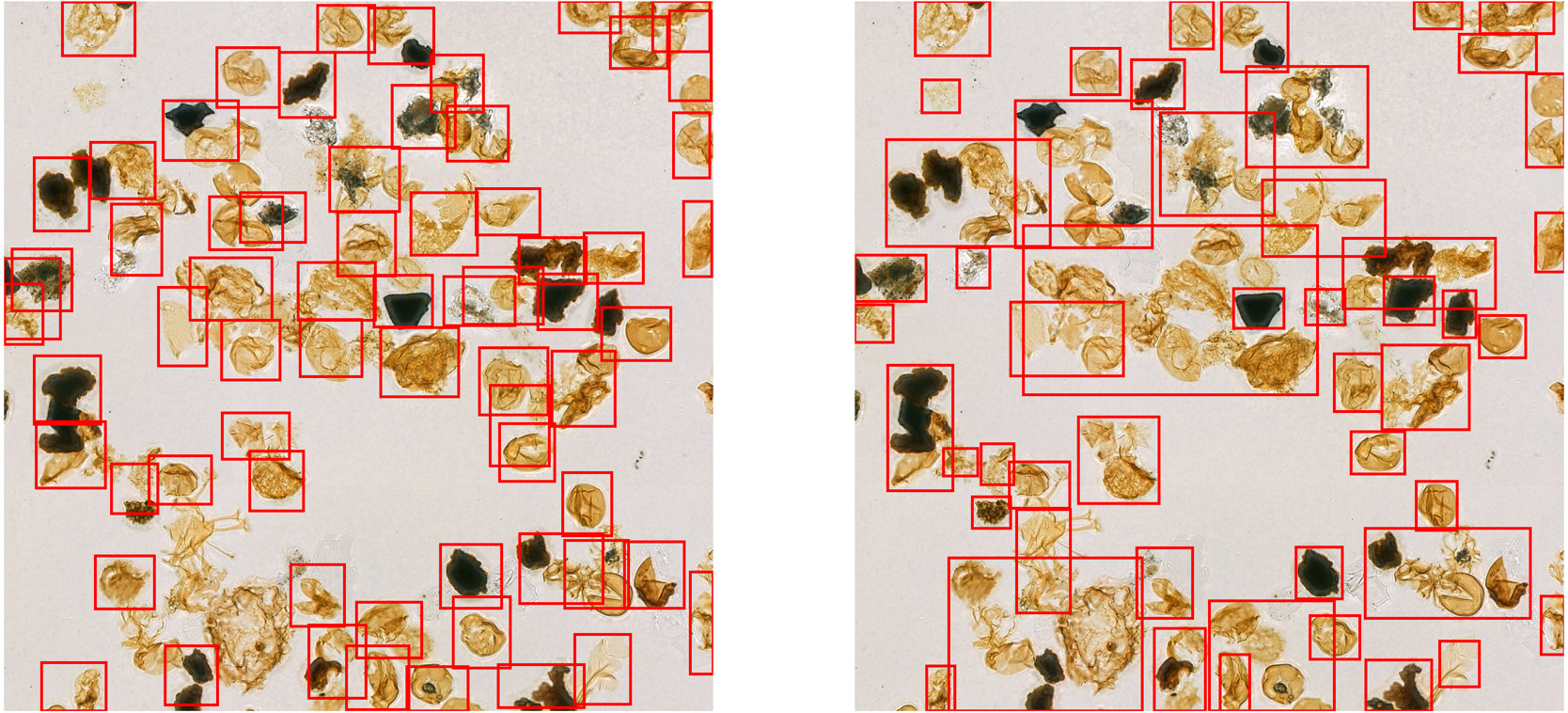
The image on the left is the result of the machine learning techniques we implemented in this study, which outperforms the image on the right, which was produced using a standard image processing pipeline.
Then, in the second stage, the research team used self-supervised learning systems (SSL), a relatively new learning paradigm that is becoming increasingly popular. This technique essentially can be trained to extract specific features from the samples it processes. It leverages self-supervised models to generate implicit labels from unstructured data.
In this study, the team compared two SSL frameworks, SimCLR and DINO, both of which proved to be invaluable tools for speeding up the classification process.
“This study shows that there is great potential for using AI in this field,” Ivar Martinsen, lead and co-corresponding author of the study, said in a statement. “Using AI to automatically detect and recognize fossils may give geologists a tool to better utilize the vast amount of information that well samples provide.”
The team used data obtained from the Norwegian continental shelf by the Norwegian Offshore Authority to detect palynomorphs with AI. To test accuracy, the team tested their model by classifying hundreds of previously classified fossils from the same well.
“We are very pleased with the results. Our model exceeds the benchmarks available so far. We hope that this work will be useful for geologists in both industry and academia,” Martinsen added.
The paper is published in Artificial Intelligence in Geosciences.