In today's 3D printing news bulletin, we start with Desktop Metal's new PureSinter furnace, then we cover research on variable binder volume algorithms and adaptive slicing, a 3D printing robot using AI machine learning, and a 3D bioprinted liver model to evaluate toxicity effects. Finally, WASP showcased 3D printed ceramic structures for the Flower Show's sensory garden, and NUMO showcased 3D printed hard hats and helmets in patriotic colors.
Desktop Metal Unveils PureSinter Furnace at RAPID+TCT

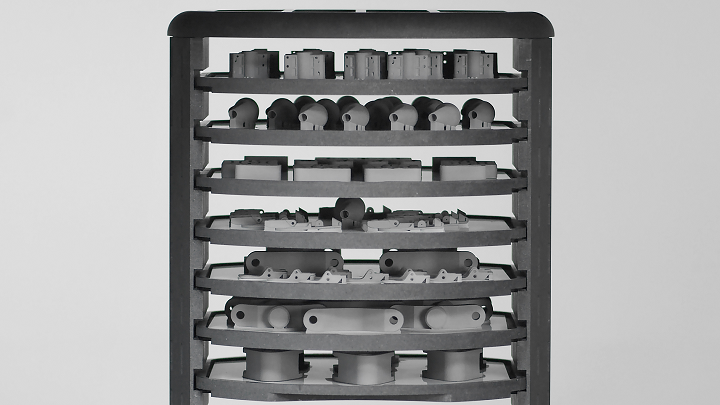
The PureSinter furnace level shelf system is made from high purity graphite and features seven shelves within a 15.8 L retort.
At RAPID+TCT 2024 in Los Angeles this week, Desktop Metal made the world debut of its new PureSinter, a high-purity vacuum furnace that can debind and sinter powder metal parts in one go. The company has been developing the machine for five years to address the challenge of sintering furnaces being easily contaminated by hydrocarbons and other waste products released from powder metal parts. PureSinter was designed for reliability, ease of use, high performance, and low cost of operation. The patent-pending design features more than 17 fans and pop-out ceiling vents to cool from 1,420°C to 200°C in less than four hours without the need for expensive water walls. PureSinter also features an efficient footprint, ToughScreen control, automatic thermal hood lift, and excellent visibility inside the 15.8L retort. The system delivers parts per billion levels of purity, is compatible with both traditional and additive manufacturing methods, and is already installed at FreeFORM Technologies.
“Instead of simply mitigating the factors that lead to poor performance in integrated debinding and sintering furnaces, we've eliminated them with an innovative, all-new design. This is Desktop Metal's first product targeted at manufacturers using both additive and traditional manufacturing methods,” said Rick Fulop, founder and CEO of Desktop Metal.
“We tested PureSinter for an extended period of time to rigorously validate our new design, and it has exceeded our expectations. PureSinter is a great example of the innovation that Desktop Metal and our engineers pride themselves on. We are confident that this furnace will revolutionize sinter-based AM and the traditional furnace industry.”
Standard shipments of the PureSinter furnace, currently validated with 14 metal powder and binder combinations, are expected to begin in Q3 2024.
Turkish researchers work to optimize surface roughness in binder jetting
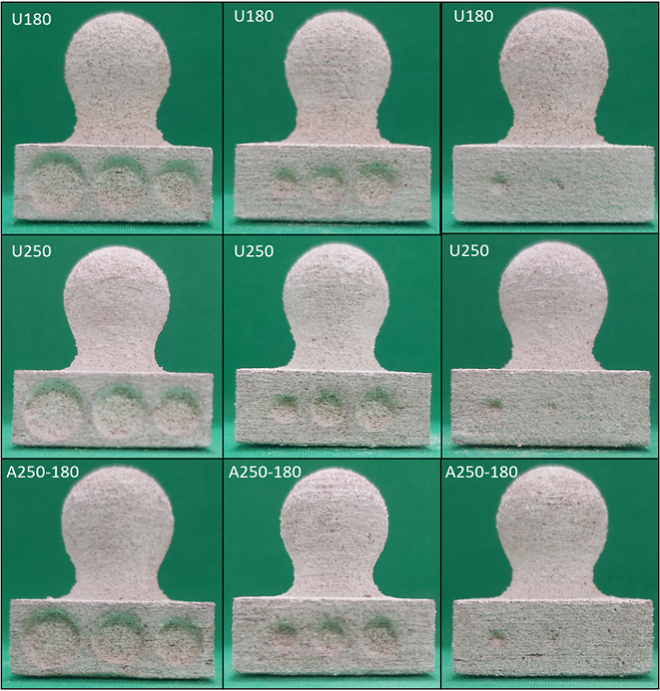

Last year, a research team from Ondokuz Mais University in Turkey published work on increasing the production speed of binder jet 3D printing through the use of an adaptive slicing method and a variable binder amount algorithm. As postdoctoral researcher Hasan Baş explained in an email, their findings showed clear improvements in both surface quality and production time optimization. Baş got in touch again recently to let us know that the team has advanced their initial research, which focused on optimizing surface roughness using Taguchi methods and image processing techniques. Adaptive slicing was also used again to increase production speed, and the team “demonstrated that these methods are applicable to industrial binder jet printers.”
“To increase the production speed of binder jetting, we used adaptive slicing and a variable binder amount algorithm (VBAA). To optimize the layer thickness and saturation rate of VBAA, we used the Taguchi method. Following the Taguchi experimental design, we produced 27 samples in nine different conditions, three times each. We measured the width of the samples in the green state. Afterwards, the samples were sintered at 1,500 °C for two hours. After sintering, surface roughness and density tests were performed. Thus, the method used proved to be successful. Furthermore, we investigated the possibility of measurement by image processing to make surface roughness measurement more accessible and more economical,” the researchers wrote in the new study.
Autonomous 3D Printing Robot with AI Machine Learning

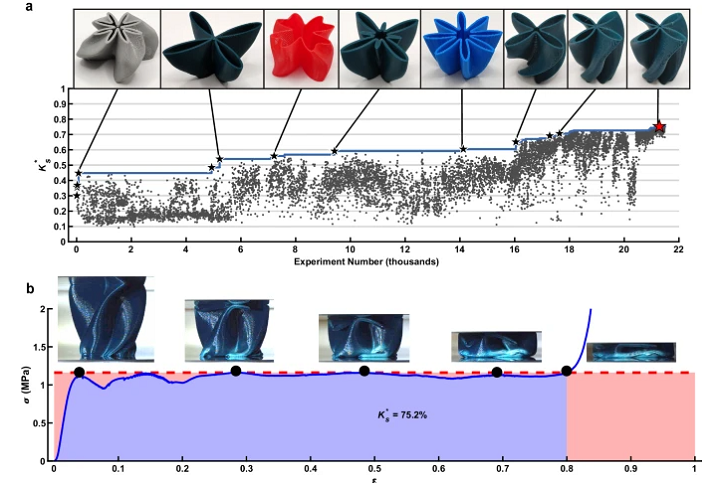
Figure 2: a) Maximum energy absorption efficiency Ks* measured for each of the first 21,500 runs. The image highlights notable components (black stars) and the best performing structures (red stars). A larger version of the image is included in Figure S11. The color of the components shown in the image indicates the material used, with green for PLA, blue for PETG, and red/grey for different types of TPU. The solid blue line shows the highest Ks* observed during the run. b) Effective medium stress σ vs. effective medium strain ε for run 21,285 (Palm), resulting in Ks* = 75.2%. The inset photo shows the state of the components at the various points indicated on the curve (images have been enhanced for clarity; original is shown in Figure S12). The shading indicates the area used to calculate Ks*, as described in Figure 1a.
Since 2021, Boston University's KABlab has been hosting automated experiments led by ENG Associate Professor of Mechanical Engineering Keith Brown and his team. An autonomous robotic arm called MAMA BEAR (Mechanics of Additively Manufactured Architectures Bayesian Experimental Autonomous Researcher) continuously 3D prints small plastic parts, records their size and shape, and moves them to a flat metal plate to crush them. It measures and records the amount of energy absorbed by the structure and the change in shape, then drops it into a box on the floor, cleans the plate, and prints another part that is slightly different from the previous one. MAMA BEAR does all this with AI machine learning, and each time the structure becomes better at absorbing the impact of the crushing force. Recently, the team observed the robot break a record of 71%, 3D printing a 3D printed structure with four petal-shaped points that is taller and narrower than the initial design, reaching 75% efficiency.
“Here, we use the Self-Driving Lab (SDL) to investigate the energy absorption efficiency of additively manufactured polymer structures by performing over 25,000 physical experiments on generalized cylindrical shells. Using a collaborative human-SDL approach, we use Bayesian optimization to select experiments from over trillions of candidates in an 11-dimensional parameter space, running them automatically while a human team monitors progress and periodically modifies aspects of the system. This human-SDL campaign resulted in the discovery of a structure with an energy absorption efficiency of 75.2% and a library of experimental data that reveals transferable principles for designing resilient structures,” the researchers wrote in the abstract of the published paper.
Some team members are now working with the U.S. Army to use the data to help design new helmet padding for soldiers.
3D bioprinted cellular liver model for measuring toxic effects

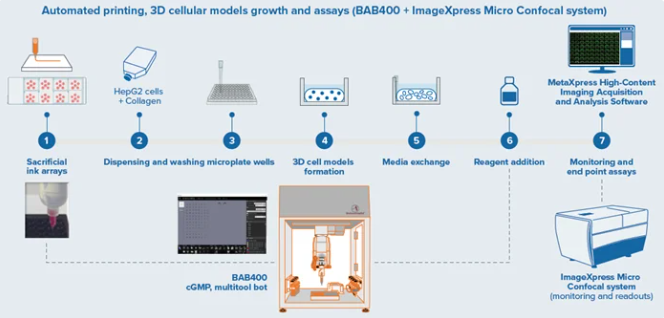
Figure 1. BAB400 3D printing and dispensing workflow integrated with Imager for endpoint assays. Image courtesy of Molecular Devices UK Ltd
Speaking of robots, Advanced Solutions and Molecular Devices collaborated to develop a method for the automated generation of 3D cellular liver models to test and evaluate the toxic effects of various compounds. This was accomplished using the BioAssemblyBot 400 (BAB400), a cGMP-certified, multi-tool bioprinting robotic device with liquid handling capabilities. The BAB400 designed the 3D structures for bioprinting using Tissue Structure Information Modeling (TSIM) software, and the robot also automated the dispensing, imaging, and maintenance of the 3D models. To acquire transmitted light (TL) and fluorescence images, an ImageXpress Micro Confocal HighContent Imaging System was used. The system's confocal mode was used to acquire Z-stack images of hepatocytes in a collagen matrix with a 4x or 10x objective for the liver tissue model.
Ultimately, BAB400 and TSIM software allowed us to develop 3D HepG2 human liver cancer cell models in a 96-well format that could be cultured and monitored daily. After 4 days, some well plates were treated with multiple drugs for 48 hours, and the cells were stained and analyzed. These were compared to 2D HepG2 liver cancer cell models. After comparing the 2D and 3D HepG2 assays, the combined effect was found at lower concentrations in the 2D system than in the 3D. This result shows that it is beneficial to use an automated method like BAB400 for the formation of liver 3D bioprinted models. It also highlights the benefits of using imaging and data analysis methods and descriptors to learn more about the complex combined effects in both types of cell models.
3D Printed Sensory Ceramic Garden for World Childhood Cancer Society UK


Giulio Giorgi WASP at the RHS Chelsea Flower Show. Image courtesy of Telegraph, Guy Bell/Alamy.
Italian landscape designer and gardener Giulio Giorgi wanted to create something special for the 2024 RHS Chelsea Flower Show. Working with World Child Cancer UK and WASP, and with funding from Project Giving Back, he built the “Nurturing Garden for World Child Cancer” – a 3D printed ceramic sensory garden that supports the mental wellbeing of young cancer patients and their families. Giorgi wanted a garden that could be easily replicated and adapted to different environments and climates so that it could be replicated in other hospitals. Giorgi and Professor Giuseppe Fallacara from the Politecnico di Bari designed stackable ceramic modules for the ultimate in customization, and WASP's clay 3D printing farm used their automated WASP 40100 production system to print numerous modules with personalized designs. Once these were complete, Landesigns Ltd assembled the garden, which also won the RHS Chelsea Flower Show's Gold Medal for Sustainability.
Malcolm Anderson, sustainability officer at the Royal Horticultural Society, said: “The garden has been created entirely using earth and wood-based products, and no power tools were used in its construction, only hand tools, making it an excellent example of how gardens can be designed and built in a more sustainable way in future.”

NUMO 3D Printed Helmets and Urban Helmets
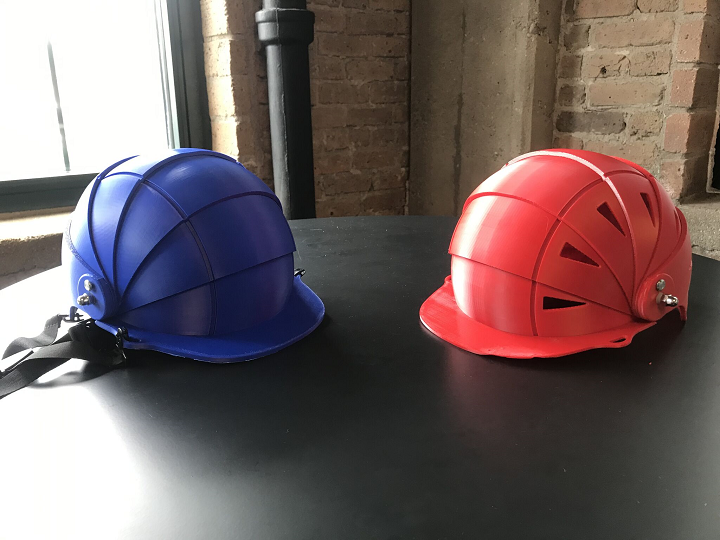

Finally, on Memorial Day in the United States, Numorpho Cybernetic Systems (NUMO) unveiled a red and blue 3D printed helmet and urban helmet to pay tribute to “the countless frontline soldiers whose lives have made our country free and safe.” Founded in Chicago's mHUB, the company develops smart, connected and sustainable products that enhance current capabilities, enable life beyond constraints, and ultimately even evolve capabilities that make systems more aware, collaborative, and intelligent. The blue helmet was printed using ABS, which is stronger and more impact resistant, while the red helmet was printed using PETG, which is more flexible and less likely to break. In one of the comments on the LinkedIn post, NUMO founder and CEO Nitin Uchil said that the helmets will be customizable, and the company is looking into how to take point cloud data from head scans and “translate it into the 42 control points needed to define a custom shape so it can fit anyone.”
“When we impact test helmets, we look not only at the strength of the material, but also at how it cushions the impact and prevents or minimizes head injury,” Ucille wrote on LinkedIn. “Also, foam/flex padding, the fit of the retainers and suspension, and the chin strap that prevents the helmet from dislodging upon impact are also important safety factors. We also perform digital simulations of impact tests to see if the infill lattice structure can be modified to create areas of different density to meet the needs of withstanding the impact while optimizing the helmet's weight.”
The company plans to soon move to the next stage of the helmet's commercialization: small-batch production and testing for safety certification.