

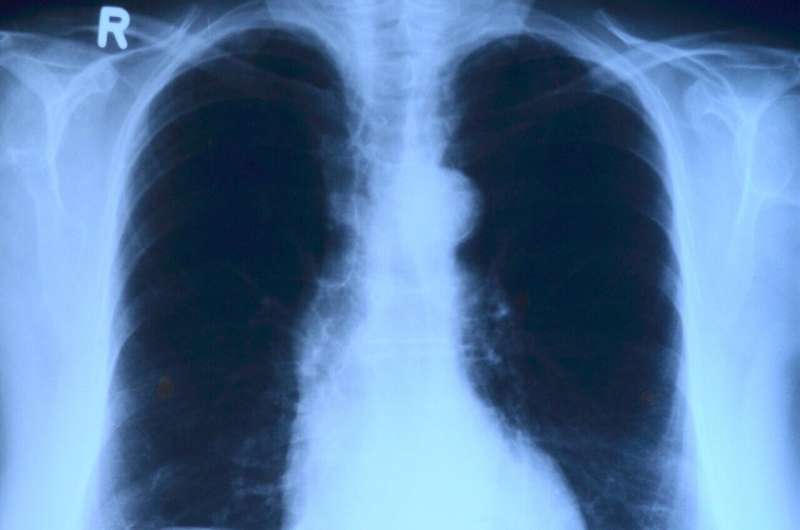
Credit: Pixabay/CC0 Public Domain
As lung cancer patients live longer, the risk of long-term cardiac side effects from radiation therapy is increasing, despite advances in technology that reduce radiation dose to the heart. A new study uses machine learning to mine data from standard lung cancer scans to predict which patients are most likely to suffer cardiac damage from radiation therapy later in life. If confirmed in future tests, the approach could identify at-risk patients and ensure appropriate monitoring before their condition worsens.
Along with chemotherapy, radiation therapy remains the definitive and standard of care for advanced lung cancer. During treatment, patients undergo regular PET/CT scans to monitor the progress of their cancer. In a recent study, Jefferson researcher and lead author Wook-jin Choi, PhD, reanalyzed these PET/CT images and developed an artificial intelligence algorithm that could accurately predict which patients had advanced cardiac inflammation, which is often a precursor to long-term damage.
The study has been published in the journal JCO Clinical Cancer Informatics.
“This is the first application of functional radiomics, an algorithm that extracts quantifiable information from medical images, to predict future cardiac toxicity,” said lead author Yevgeniy Vinogradskiy, PhD.
The researchers were careful to avoid some of the common pitfalls of artificial intelligence, such as bias and unclear conclusions. First, they trained the algorithm on data from three sources to diversify the patient picture and reduce the possibility of bias. Second, rather than using pre-made or “black box” algorithms, Dr. Choi wrote his own code to narrow down the predictive capabilities to nine characteristics.
“With nine, it's much easier to troubleshoot, and we know what features to look for, so we're confident it will be clinically meaningful,” he says.
“The beauty of this approach is that it provides important additional diagnostic information without additional scans, avoiding extra cost and radiation exposure for patients,” said Adam Dicker, MD, chief of the Department of Radiation Oncology.
For more information:
Wookjin Choi et al. “Novel functional radiomics for predicting cardiac positron emission tomography affinity in lung cancer radiotherapy” JCO Clinical Cancer Informatics (2024). DOI: 10.1200/CCI.23.00241
Courtesy of Thomas Jefferson University
Quote: Machine Learning Uses Lung Cancer Scans to Predict Heart Damage (June 27, 2024) Retrieved June 27, 2024 from https://medicalxpress.com/news/2024-06-machine-lung-cancer-scans-heart.html
This document is subject to copyright. It may not be reproduced without written permission, except for fair dealing for the purposes of personal study or research. The content is provided for informational purposes only.


