

The groundbreaking research project was made public in a peer-reviewed paper published in the Chinese-language journal Common Control & Simulation in May. The team, led by senior engineer Jia Chenxing, said that AI technology holds both potential and risks for military applications, but that the project offered a “viable” solution to a growing challenge.
In China, the military must strictly adhere to the principle that “the Party controls the guns.” Only the Central Military Commission of the Communist Party of China has the authority to mobilize the People's Liberation Army.
Operational-level military simulations often require the participation of human commanders to respond to unexpected events and make on-the-fly decisions, but the number and availability of senior PLA commanders is very limited, making it impossible for them to participate in a large number of war simulations.
“Current joint operational simulation systems lack a joint battle-level command entity, resulting in poor results in simulation experiments,” the researchers said.
03:12
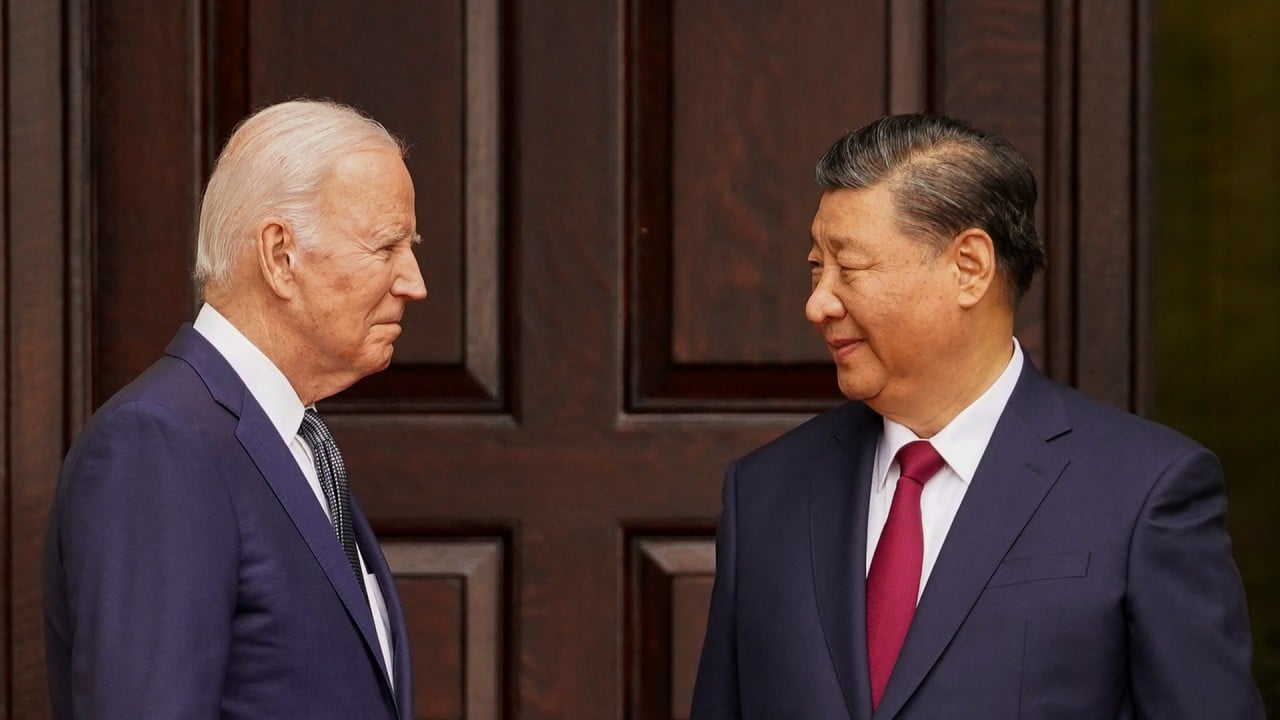
Xi Jinping and Joe Biden meet on the sidelines of APEC summit, easing tense U.S.-China relations
Xi Jinping and Joe Biden meet on the sidelines of APEC summit, easing tense U.S.-China relations
The AI commander can assume command authority when a human commander is unable to participate in large-scale virtual battles or is unable to exercise command authority, and is free to exercise its powers without human interference within the confines of the laboratory.
Meanwhile, General Lin Biao, famous for his victories over the Japanese and Nationalists, was risk-averse and boasted a meticulous decision-making style similar to that of British Field Marshal Bernard Law Montgomery.
Jia's team said the AI commander's initial configuration reflects an experienced and skilled strategist, “with a sound mentality, a calm and steadfast personality, able to calmly analyze and judge situations, not make emotional or impulsive decisions, and able to recall similar decision-making scenarios from memory and quickly devise practical plans.”
However, this setting is not absolutely fixed.
“The virtual commander's personality can be tweaked if deemed necessary,” they added.
Jia's team said that under great pressure, humans “struggle to formulate a fully rational decision-making framework within tight deadlines.”
.jpg?itok=uZeCoEdY)
03:28
Singapore researchers use AI to read minds through brain scans
Singapore researchers use AI to read minds through brain scans
Instead of using pure analysis, the AI commander will rely more on empirical knowledge for combat decisions, searching for satisfactory solutions, retrieving similar scenarios from memory, and quickly formulating viable plans.
But humans can also be forgetful. To simulate this key weakness, the scientists also imposed a size limit on the AI commander's decision-making knowledge base: when the memory limit is reached, some knowledge units are dumped.
All of this is done without human intervention, “boasting advantages such as ease of implementation, high efficiency, and support for repeated experimentation,” Jia's team said.
Countries around the world are entering a race to apply AI to military applications, with China and the United States taking the lead.


