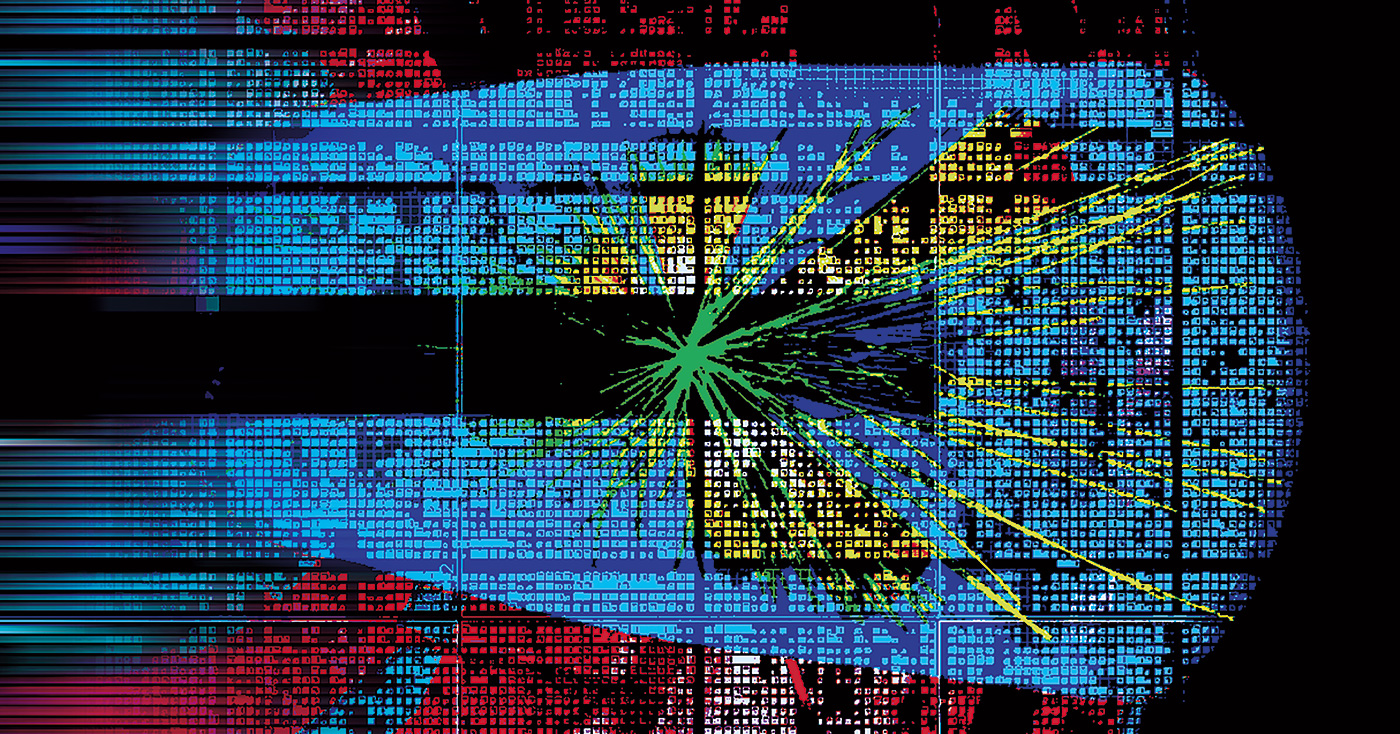
(Image: S Sioni/CMS-PHO-EVENTS-2021-004-2/M Rayner)
One of the primary goals of the LHC experiments is to look for signs of new particles that could explain many of physics' unsolved mysteries. Often, searches for new physics are designed to look for one specific type of new particle at a time, using theoretical predictions as a guide. But what if you want to look for new, unpredicted, unexpected particles? Looking through the billions of collisions that will occur in the LHC experiments without knowing exactly what to look for would be an enormous task for physicists. So instead of sifting through the data looking for anomalies, the ATLAS and CMS collaboration is putting artificial intelligence (AI) to work for them.
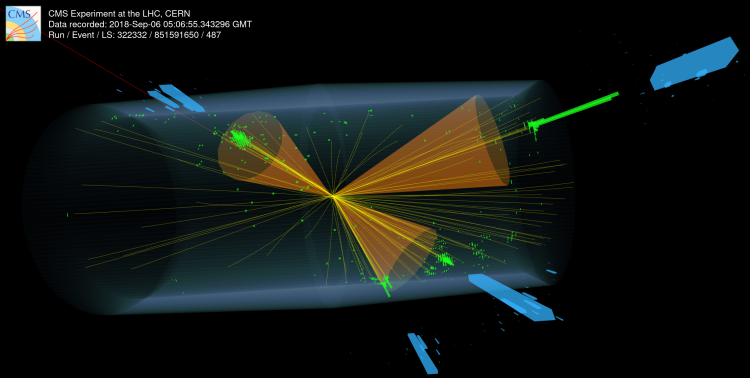
At the Morion conference on March 26, physicists from the CMS collaboration presented their latest results using a variety of machine learning techniques to search for pairs of “jets” – focused sprays of particles arising from strongly interacting quarks and gluons – that are particularly difficult to analyze but may hide new physics.
ATLAS and CMS researchers are using several strategies to train AI algorithms in the search for jets. By studying the shape of the complex energy signature, scientists can identify the particle that produced the jet. Using real collision data, physicists from both experiments are training the AI to recognize the characteristics of jets that arise from known particles. The AI can then distinguish between these jets and atypical jet signatures that may suggest new interactions. These appear in the data set as atypical jet accumulations.
Another approach is to instruct the AI algorithm to consider the entire collision event and look for unusual features in the different particles detected. These unusual features could indicate the presence of new particles. This technique was demonstrated in a paper published by ATLAS in July 2023, which showcased one of the first uses of unsupervised machine learning on LHC results. In another approach at CMS, physicists create simulated examples of potential new signals and instruct the AI to identify collisions in the real data that differ from normal jets but resemble the simulations.
In the latest results published by CMS, each AI training method showed different sensitivity to different types of novel particles, with no single algorithm proving to be optimal. The CMS team was able to constrain the production rate of several different types of particles that create unusual jets. The AI-driven algorithm also showed significantly improved sensitivity to a wide range of particle signatures compared to traditional techniques.
These results show that machine learning is revolutionizing the search for new physics. “We already have ideas about how to improve the algorithm further and apply it to different parts of the data to search for different types of particles,” says Oz Amram from the CMS analytics team.
/Public Release. This material from the originating organization/author may be out of date and has been edited for clarity, style and length. Mirage.News does not take any organizational stance or position and all views, positions and conclusions expressed here are solely those of the authors. Read the full article here.