

Over 100 years ago, Alexander Graham Bell challenged National Geographic readers to do something bold and innovative: “Invent a new science.” Bell noted that a science based on measuring sound and light already existed. But the science of smell didn't. Bell challenged his readers to “measure smell.”
Today, the smartphone in most people's pockets is packed with impressive features based on the science of sound and light, like voice assistants, facial recognition, and photo enhancement. The science of smell has nothing comparable. But that's about to change, as advances in machine olfaction (also known as “digitized smell”) are finally answering Bell's call to action.
Research into machine olfaction is challenging due to the complexity of the human sense of smell: whereas human vision relies primarily on receptor cells in the retina (rod cells and three types of cone cells), the sense of smell is sensed through approximately 400 different types of receptor cells in the nose.
Machine olfaction begins with sensors that detect and identify molecules in the air. These sensors function similarly to receptors in the human nose.
But to be useful to humans, machine olfaction needs to go a step further: the system needs to know what a particular molecule or set of molecules smells like to a human. To do that, machine olfaction needs machine learning.
Applying machine learning to smell
Machine learning, particularly the kind known as deep learning, is at the heart of incredible advances like voice assistants and facial recognition apps.
Machine learning is also important in digitizing smells because it can learn how to map the molecular structures of odor-causing compounds to textual odor descriptors. Machine learning models learn words that humans tend to use, such as “sweet” or “dessert,” to describe what humans feel when they encounter a particular odor-causing compound, such as vanillin.
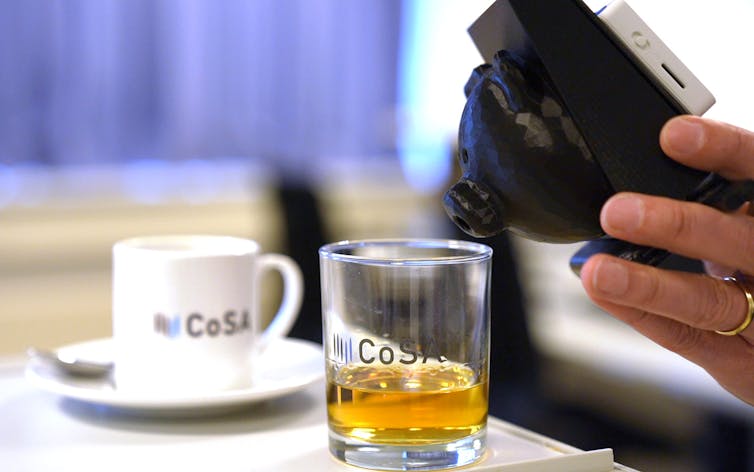
Marcus Brandt/Picture Alliance via Getty Images
But machine learning requires large datasets. The web has an unimaginably huge amount of audio, image, and video content that can be used to train artificial intelligence systems to recognize sounds and images. But machine olfaction has long faced a data shortage problem, in part because most people cannot describe smells in words as easily and recognizably as they can describe sight or hearing. Without access to web-scale datasets, researchers have been unable to train truly powerful machine learning models.
But that began to change in 2015 when researchers launched the DREAM Olfaction Prediction Competition. In this competition, biologists Andreas Keller and Leslie Fauchard, who study the sense of smell, made public the data they had collected and invited teams from around the world to submit machine learning models. The models had to predict odor labels, such as “sweet,” “floral,” or “fruity,” for odor-causing compounds based on their molecular structure.
The best-performing model was published in a paper in Science journal in 2017. The winner was a classic machine learning technique called random forest, which combines the output of multiple decision tree flowcharts.
I am a machine learning researcher with a long-standing interest in the application of machine learning to chemistry and psychiatry. The DREAM Challenge piqued my interest. I also felt a personal connection to olfaction. My family roots are in Kannauj, a small town in North India that is the perfume capital of India. Furthermore, my father is a chemist who spent most of his career analyzing geological samples. Therefore, machine olfaction offered a fascinating opportunity at the intersection of perfume, culture, chemistry and machine learning.
After the DREAM Challenge ended, progress in machine olfaction began to accelerate. During the COVID-19 pandemic, numerous cases of olfactory agnosia, or anosmia, were reported. The sense of smell, which is usually a secondary concern, was elevated in the public consciousness. In addition, the research project Pyrfume Project made many more large datasets publicly available.
Sniff deeply
By 2019, the largest datasets had grown from fewer than 500 molecules in the DREAM Challenge to nearly 5,000 molecules. A Google Research team led by Alexander Wiltschko was finally able to bring the deep learning revolution to machine olfaction. Their models, based on a form of deep learning called graph neural networks, have established state-of-the-art results in machine olfaction. Wiltschko is now the founder and CEO of Osmo, whose mission is to “give computers a sense of smell.”
Recently, Wiltschko and his team used graph neural networks to create a “dominant odor map,” which places perceptually similar odors closer to each other than dissimilar odors. This is not an easy task, because small changes in molecular structure can lead to big changes in olfactory perception. Conversely, two molecules with very different molecular structures can smell nearly the same.
These advances in cracking the code of smell are not only intellectually stimulating, but also have very promising applications, such as personalized perfumes and fragrances, better insect repellents, new chemical sensors, earlier disease detection, and more realistic augmented reality experiences. The future of machine olfaction looks bright, and we can look forward to smelling good again.


