Paweł Krzemiński, Creative Director at TELEVISOR, shares more about the company's latest AI project.
Q> Tell us a bit about your role at the studio and what Televisor does, what your job entails and what excites you most about your job?
Paweł> As Creative Director at TELEVSOR, I am responsible for guiding and choosing the tools, both stylistic and technical, that will best help the agency and our directors realize their vision.
My role is a deep creative contribution to the production process. I work closely with my team to develop innovative concepts and visual styles. I refine ideas and strive to ensure each project has a unique and compelling aesthetic. This involves continuous research and experimentation with new technologies and techniques to push the boundaries of what's possible. What excites me most about this job is having the opportunity to bring imaginative ideas to life and see them resonate with audiences in impactful ways.
Q> Can you tell us a bit about how this project started and where the idea came from?
Paweł> Music videos based on famous Polish songs are a traditional marketing initiative for the Tymbark brand. Each time, top Polish artists are invited to perform the songs. However, this production stands out for its use of artificial intelligence (AI). The literal translation of the song's title is “Everything Tells Me It Loves Me”, but it was slightly changed to be more accurate to the project's specifications. This innovative project was realised thanks to the pioneering approach of DDB agency and director Krzysztof Grajper, who had great trust in TELEVISOR Studio.
Q> It's a beautiful and nostalgic song. What does it mean?
Paweł> It's about how you feel when love appears in your life. Everything seems beautiful and magical. Do you know what I mean? Haha.
Q> AI – what are your thoughts on this, it's a big topic at the moment being covered in many forums by many agencies and clients, but does it come up often in the briefs you receive?
Paweł> I am cautiously optimistic about AI in our industry. It is certainly a hot topic, frequently discussed on various platforms and increasingly featured in briefs we receive from agencies and clients.
AI tools are becoming valuable assets in the creative process, even in the early stages of design. However, while AI can increase efficiency and provide new insights, it can't replace the element of human creativity that's essential to our work. Our team's unique artistic vision, emotional depth, and innovative thinking are invaluable to each project.
In our studio, we integrate AI in a way that complements our creative endeavors, using it to handle repetitive tasks and generate initial concepts that can later be refined and given a human touch. This allows us to focus more on the creative aspects that truly define the final deliverable. That balance between leveraging the strengths of AI and preserving the integrity of human creativity is what we aim to achieve in our projects.
Q> What was the creative process like? How did you develop the idea and the script?
Paweł> The idea of using AI in the project came entirely from the agency. This put us in a very advantageous position, allowing us to focus on selecting the best visual aspects of AI currently available. We didn't have to convince the client, as the agency was already in favor of using these new technologies. This allowed us to immediately get to work researching and implementing cutting-edge AI tools to enhance the visual appeal of the project.
Q> Tell us what the collaboration process with the agency/client was like in this case?
Paweł> Even if the visual style and overall tone of the project is what you want, creating a video with AI is a continuous creative process. Once you feed the AI software enough data for the expected result, it returns a ton of content. Our team of artists and CG supervisors then have to process it – select the material and adapt it to the video. This process usually takes several cycles to reach the final desired result.
Q> Which tool did you choose to generate content with AI and why?
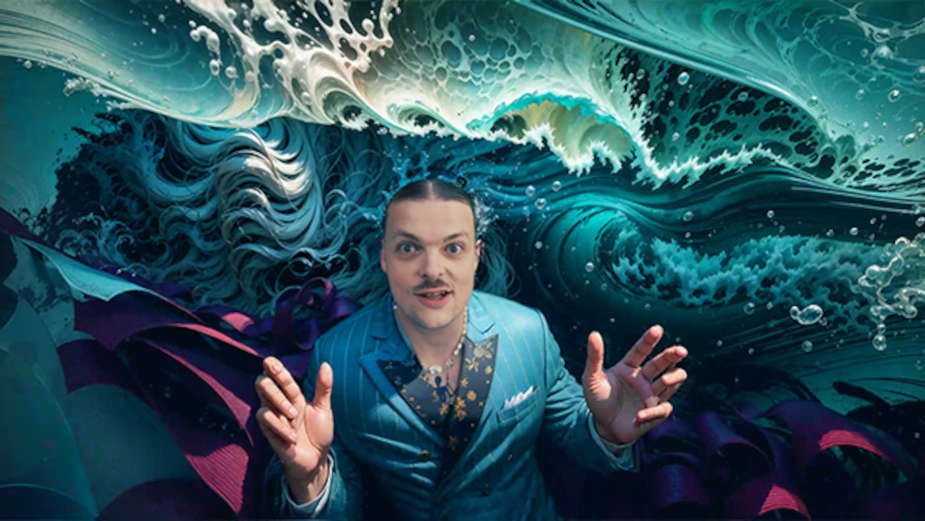
Paweł> We created the video using an exciting fusion of Al (Stable Diffusion) and NeRF (Neuro-Radiance Field) technologies. This combination not only provides great entertainment but also opens a new chapter in the future of visual art. The Stable Diffusion software allows us to precisely control the often chaotic results of Al using specific tools and video materials; whereas NeRF allows us to scan the 3D space after capturing the shot and transform the data into a glitchy holographic vision. This innovative crossover of technologies allowed us to unleash our creative imagination and create authentic, eclectic and fascinating representations of each artist.
Q> How would you most simply explain what Nerf is?
Paweł> Simply put, NeRF (Neural Radiance Fields) is a technology that uses artificial intelligence to create detailed 3D scenes from just a few 2D photos. Imagine you take several photos of an object from different angles. NeRF uses those photos to generate a 3D model that can be viewed from angles that weren't originally taken. It's the magic that turns a flat image into a fully exploreable 3D world.
Q> What has new technology brought to this implementation?
Paweł> NeRF allows you to animate the camera independent of its original recording position. This allows for smooth and dynamic camera movements throughout a scene, enabling unique perspectives and cinematic shots that were not possible with traditional methods. Representing a scene in 3D allows you to explore different moments and perspectives within the same timeline, providing a more flexible and comprehensive understanding of the action.
Q> Is it now possible to do anything that wasn't possible before?
Paweł> Creative exploration at a fraction of the cost. Stable Diffusion allows you to explore multiple creative paths from a single text prompt. For example, a prompt describing a “future city” can lead to multiple interpretations, each with their own architectural style, lighting conditions, and atmosphere. This allows creators to explore a wide range of visual ideas and choose the one that appeals to them most.
Q> What were the technical challenges?
Paweł> The technical challenges ranged from ensuring the quality of input data to optimizing model training. Integrating AI dramatically changed our post-production process. Instead of traditionally editing after shooting, we created basic moving mockups before shooting. The AI generated a ton of footage and provided multiple solutions for each scene. We chose the best version and cut the clips to the desired length. This hybrid approach maximized creativity and efficiency, resulting in high-quality visual content.
Q> Given your experience implementing AI in your projects, how do you see the future as a studio in terms of its presence?
Paweł> Creating a video with the help of Al may seem like a shortcut. I don't think so at all. Al offers new possibilities and a completely different approach, but it doesn't mean less work. Creating a video with Al is not a shortcut, it's a powerful conversion tool for idea creation and production. To create a truly unique video you need a team of experts, their knowledge and skills. I'm an optimist. I don't see it as a threat, but as an opportunity, a completely new challenge for the industry.