

Over the past decade, companies have built vast repositories of information on everything from business processes to inventory statistics. This was the big data revolution.
But for organizations to get the most value from all that information, it's not enough to simply store and manage big data. As companies master big data management, leading companies are applying increasingly intelligent or advanced forms of big data analytics to extract even more value from that information. In particular, we are applying machine learning that can identify patterns and provide cognitive capabilities across large amounts of data, enabling these organizations to apply the next level of analysis needed to extract value from their data. Masu.
How are AI and big data related?
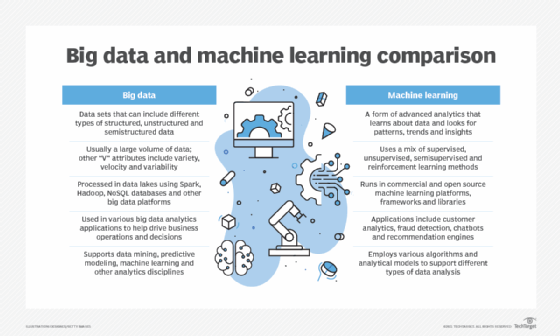
Using big data machine learning algorithms is a natural step for companies looking to exploit the full potential of big data. Machine learning systems use data-driven algorithms and statistical models to analyze data and find patterns. This differs from traditional rule-based approaches that follow explicit instructions. Big data provides the raw material for machine learning systems to derive insights. Many organizations are now realizing the benefits of combining big data and machine learning. However, for companies to fully leverage the power of both big data and machine learning, it is important to understand what each can do independently.
Understand big data
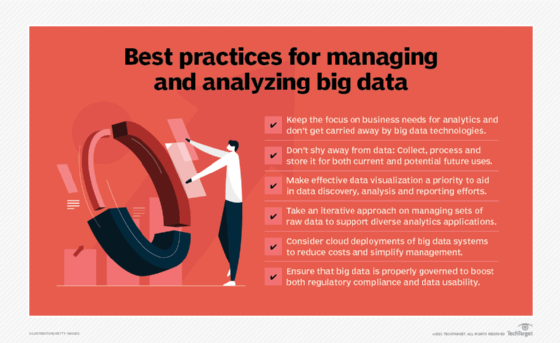
Big data embodies the concept of extracting and analyzing information from large amounts of data. However, the amount of data, or volume, is only one consideration when working with big data. Big data has many other important “Vs” that businesses need to address, including velocity, variety, veracity, validity, visualization, and value.
Understand machine learning
Machine learning, the foundation of modern AI applications, provides tremendous value to big data applications by deriving higher-level insights from big data. Machine learning systems can learn and adapt over time without following explicit instructions or programmed code. These machine learning systems use statistical models to analyze patterns in data and draw inferences from it. In the past, companies built complex rules-based systems to address a wide range of reporting needs, but these solutions proved brittle and unable to accommodate continuous change. Now, with the power of machine learning and deep learning, companies can train their systems with big data to improve decision-making, business intelligence, and predictive analytics over time.
What benefits does AI bring to big data?
Combined with big data, AI is impacting businesses across sectors and industries. Benefits include:
- 360 degree view of your customers. Our digital footprint is growing at an alarming rate, and businesses are using this to their advantage to provide deeper insights about each individual. Traditionally, companies moved data to and from data warehouses and created static reports that took time to generate and even longer to modify. Today, smart organizations rely on decentralized, automated, and intelligent analytical tools that sit on top of data lakes designed to collect and synthesize data from disparate sources all at once. This is changing the way businesses understand their customers.
- Improved forecasting and price optimization. Traditionally, companies estimated this year's sales based on data from the previous year. However, various factors such as changing trends, global pandemics, and other hard-to-predict factors can make forecasting and price optimization very difficult with traditional approaches. Big data allows organizations to discover patterns and trends early and learn how those trends will impact future performance. We help organizations make better decisions by providing them with more information about what is likely to happen in the future. Companies, especially those in the retail industry, using big data and AI-based approaches can improve seasonal forecasts and reduce errors by up to 50%.
- Improved customer acquisition and retention. Big data and AI allow organizations to better understand what their customers are interested in, how their products and services are used, and why customers stop buying or using their products. . Through big data applications, companies can better identify what customers really want and observe customer behavior patterns. You can then apply those patterns to improve your products, generate better conversions, increase brand loyalty, spot trends early, and add more to improve overall customer satisfaction. You can find out how.
- Cybersecurity and fraud prevention. Tackling fraud is a never-ending battle for businesses of all shapes and sizes. Organizations that use big data-powered analytics to identify patterns of fraud can detect anomalies in system behavior and thwart malicious actors. Big data systems have the ability to sift through extremely large amounts of data from transactional and log data, databases, and files to identify, prevent, detect, and mitigate potential fraud. These systems can also combine different data types, including both internal and external data, to alert businesses to cybersecurity threats that have not yet appeared on their systems. This would not be possible without big data processing and analysis capabilities.
- Identify and mitigate potential risks. Anticipating, planning and responding to constant change and risk is critical to business longevity. Big data has proven its value in the field of risk management, helping provide early visibility into potential risks, quantifying risk exposure and potential losses, and speeding changes. Big data-powered models can help organizations identify and address challenges arising from customer and market risks as well as unforeseen events such as natural disasters. By digesting and integrating information from disparate data sources, companies can increase situational awareness and understand how to allocate talent and resources to address emerging threats. Masu.
How can AI improve insights into data?
Big data and machine learning are not actually competing concepts, but together they offer an opportunity to produce great results. New big data approaches give organizations powerful ways to store, manage, process, and understand their data. Machine learning systems learn from that data. In fact, navigating the different “Vs” of big data can help make machine learning models more accurate and powerful. Machine learning models learn from data and use these insights to improve business operations. Similarly, big data management approaches improve machine learning systems by providing models with the large amounts of high-quality, relevant data they need to build.
The amount of data being generated continues to grow at an alarming rate. IDC predicts that by 2025, the world's data will increase by 61% to 175 zettabytes, with 75% of the world's population using data every day. As businesses continue to store vast amounts of data, the only way they can make sense of it is with the help of machine learning. Machine learning processes will rely heavily on big data, and companies that don't leverage machine learning will be left behind.
Examples of AI and big data
Many organizations are discovering the power of big data analytics powered by machine learning and harnessing the power of big data and AI in a variety of ways.
- Netflix uses machine learning algorithms to better understand individual users and provide more personalized recommendations. This keeps users on the platform longer and creates a more positive customer experience overall.
- Google uses machine learning to deliver high-value, personalized experiences to users. The company uses machine learning in a variety of products, including providing predictive text in emails and providing optimized directions to users who want to go to a specified location.
- Starbucks harnesses the power of big data, AI, and natural language processing to deliver personalized emails using customers' past purchase data. Rather than creating dozens of emails each month with offers for the broader Starbucks audience, Starbucks used an AI-enabled “digital flywheel” to feature different promotions and offers. We generate over 400,000 personalized emails every week.
Companies will continue to combine the power of machine learning, big data, visualization tools, and analytics to support business decision-making through analysis of raw data. Without big data, none of these more personalized experiences are possible. It's no wonder that companies that don't combine big data and AI will struggle to meet their digital transformation needs and be left behind in the coming years.


