We are on the brink of a technological revolution that has the potential to dramatically increase productivity, drive global growth and increase incomes around the world. However, it also has the potential to destroy jobs and deepen inequality.
Rapid advances in artificial intelligence are captivating the world, causing both excitement and alarm, and raising important questions about its potential impact on the global economy. AI will ripple through the economy in complex ways, making it difficult to predict its ultimate impact. What we can say with some confidence is that we need to come up with a set of policies that safely harness the vast potential of AI for the benefit of humanity.
Reshaping the nature of work
In a new analysis, IMF staff examines the potential impact of AI on global labor markets. Many studies predict that jobs may be replaced by AI. But we do know that in many cases, AI is likely to complement human work. The IMF analysis captures both of these forces.
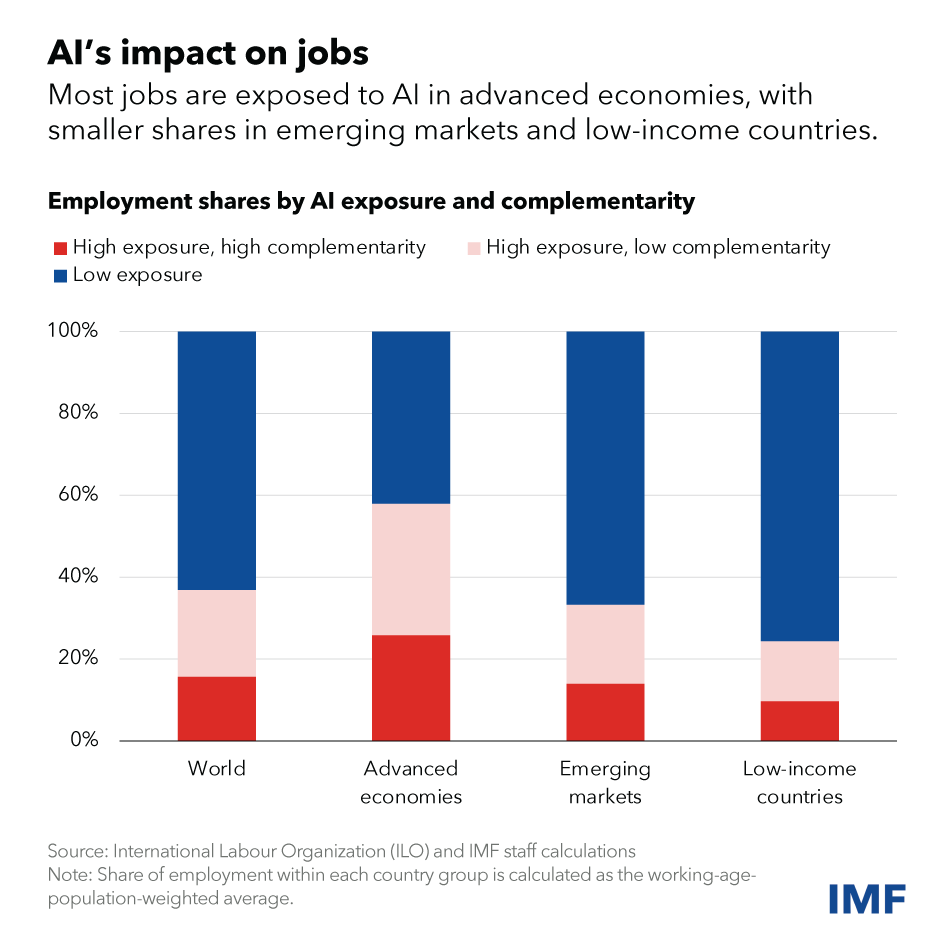
The findings are surprising: almost 40% of global jobs are exposed to AI. Historically, automation and information technology have tended to impact everyday tasks, but one thing that sets AI apart is its ability to impact highly skilled jobs. As a result, developed countries face greater risks from AI than emerging market and developing countries, but they also have more opportunities to leverage its benefits.
In developed countries, around 60% of jobs could be affected by AI. Approximately half of exposed jobs could benefit from AI integration and increase productivity. For the other half, AI applications could perform key tasks currently performed by humans, which could reduce demand for labor and lead to lower wages and fewer jobs. In the most extreme cases, some of these jobs may disappear.
In contrast, emerging markets and low-income countries are expected to have 40% and 26% exposure to AI, respectively. These findings suggest that emerging market and developing countries face less imminent disruption from AI. At the same time, many of these countries lack the infrastructure and skilled workforce to harness the benefits of AI, increasing the risk that the technology will exacerbate inequalities between countries over time.
AI could also impact income and wealth inequality within countries. Workers who are able to take advantage of AI will see increased productivity and wages, while those who are not will be unable to keep up, potentially increasing polarization within income groups. Research shows that AI can help less experienced employees become more productive faster. While younger workers may find it easier to take advantage of opportunities, older workers may struggle to adapt.
The impact on labor income will depend largely on the extent to which AI complements higher-income workers. If AI significantly complements high-income workers, it could lead to a disproportionate increase in their labor income. Furthermore, the productivity improvements made by companies that implement AI are likely to increase their return on capital, potentially favoring high-income earners. Both of these phenomena can exacerbate inequality.
In most scenarios, AI is likely to exacerbate overall inequality, and policymakers need to proactively address this issue to prevent the technology from further escalating social tensions. It is important for countries to establish comprehensive social safety nets and provide retraining programs for vulnerable workers. Doing so can make the transition to AI more inclusive, protect livelihoods, and limit inequality.
An inclusive AI-driven world
AI is being integrated into businesses around the world at an alarming rate, highlighting the need for policymakers to take action.
To help countries develop the right policies, the IMF has developed an AI Readiness Index that measures readiness in areas such as digital infrastructure, human capital and labor market policies, innovation and economic integration, and regulation and ethics. did.
For example, the human capital and labor market policy component assesses factors such as years of schooling, job market mobility, and the proportion of the population covered by social safety nets. The regulatory and ethics component assesses the adaptability of a country's legal framework to digital business models and the existence of strong governance for effective enforcement.
IMF staff used this index to assess the preparedness of 125 countries. The findings reveal that richer economies, including developed countries and some emerging market countries, tend to be better equipped to deploy AI than lower-income countries, although there is considerable variation across countries. ing. Singapore, the United States and Denmark had the highest scores in the index based on strong results in all four categories tracked.
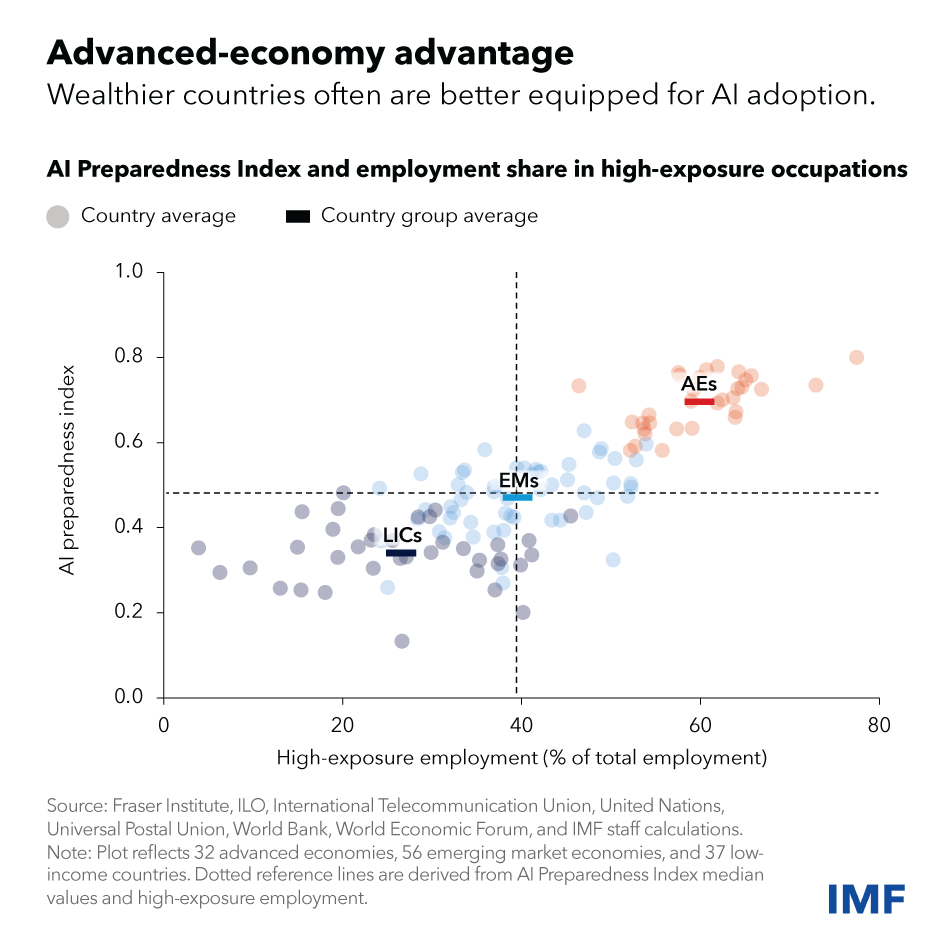
Based on the insights of the AI Preparedness Index, developed countries should prioritize AI innovation and integration while building robust regulatory frameworks. This approach helps foster a safe and responsible AI environment and maintain public trust. For emerging market and developing countries, building a strong foundation through investment in digital infrastructure and a digitally capable workforce should be a priority.
The age of AI is upon us, but it is still within our power to ensure that AI brings prosperity to all.
—For more on artificial intelligence and the economy, read the December issue of the IMF's quarterly magazine Finance & Development.