Machine learning has become an important area contributing to the development of data-driven, adaptive, and intelligent platforms and products. AI systems help shape users, and users, in turn, shape these systems. A popular method, content recommender systems (CRS), interacts with viewers and creators to facilitate algorithmic curation and personalization. CRS interactions can influence downstream recommendations by shaping audience preferences and the content available on the platform. Its older design helps users navigate songs and videos on email lists, but the massive online platform uses a modern design.
Although these AI systems are useful, their design and evaluation do not emphasize how these systems and users shape each other, and this problem is seen in multiple learning algorithms. For example, if a large static dataset is trained using a supervised learning setting, it cannot be proven how the AI system transforms the environment in which it operates. Additionally, the introduction of AI systems can have large-scale negative impacts on performance and society through changes in distribution. Another problem arises from reinforcement learning (RL), which fails to capture important interactions and dynamics between the AI system and the user. This paper solved all these shortcomings of AI systems.
Researchers from Cornell University, the University of California, Princeton University, and the University of Texas at Austin proposed the Formal Interaction Model (FIM). This mathematical model formalizes how AI and users shape each other. FIM is a coupled dynamic system between AI systems and users that enhances the design and evaluation of AI systems. This includes four main use cases: (a) specifying interactions for implementation, (b) monitoring interactions using empirical analysis, and (c) using counterfactual analysis. and (d) control social influence through intervention. Design dimensions such as style, granularity, mathematical complexity, and measurability are carefully considered when designing the model.
FIM can help create new metrics that capture these social influences leading to benefits in goal design. These new metrics can be optimized through supervised learning or RL-based algorithms to control their impact on society. Although few social impacts can be directly assessed using a single parameter in FIM, other impacts can occur as complex combinations of multiple parameters. For example, metric suggestions should focus on measuring value rather than engagement. This paper describes leveraging tools from mechanism design to recommender system design to optimize downstream user welfare and ecosystem health.
Researchers performed analyzes and resolved various limitations, mainly focusing on predicting social impacts and controlling social impacts. The model design used during analysis is fairly uniform within each interaction type, with large gaps between viewer and author interactions. Furthermore, dynamic models can be used because they create a feedback loop with viewer feedback input into the recommendation system about products used from the recommended content, and the viewer feedback is used to estimate the viewer's utility. It will not be.

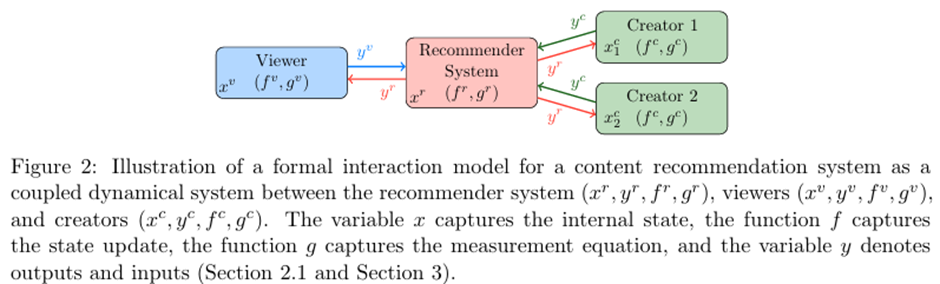
In conclusion, researchers from four universities proposed the Formal Interaction Model (FIM), a mathematical model that formalizes how AI and users shape each other. FIM is a coupled dynamic system between AI systems and users that enhances the design and evaluation of AI systems. This paper mentions his four main use cases of FIM and discusses the role of model style, granularity, mathematical complexity, and measurability. The researchers used a dynamic systems language to highlight the limitations of the use case for future research.
Please check paper. All credit for this study goes to the researchers of this project.Don't forget to follow us twitter.Please join us telegram channel, Discord channeland linkedin groupsHmm.
If you like what we do, you'll love Newsletter..
Don't forget to join us 40,000+ ML subreddits
Learn more about content partnerships here Please fill out the form here.


Sajjad Ansari is a final year undergraduate student at IIT Kharagpur. As a technology enthusiast, he focuses on understanding the impact of his AI technology and its impact on the real world, delving into practical applications of AI. He aims to explain complex AI concepts in a clear and accessible way.