

A crayfish writes…
This article provides an overview of China’s AI policy efforts, summarizes China’s AI development and the challenges facing China, explores investment trends, and discusses China’s AI market and China’s and UK’s AI business cooperation. Provides valuable insight into opportunities. .
Artificial Intelligence (AI) has emerged as a revolutionary technology that will have a tremendous impact on many areas of society. With an ambitious national strategy, China is fast becoming the forefront of the global AI race. This article provides an overview of China’s AI policy efforts, summarizes China’s AI development and challenges it faces, explores investment trends, and discusses China’s AI market and opportunities for cooperation between China and the UK’s AI businesses. provide valuable insight.
Government support and policies
China’s artificial intelligence (AI) industry is an integral part of its national strategy and receives significant government support to make it an important focus of international competition. The government has implemented policies such as the “Next Generation Artificial Intelligence Development Plan” and other industrial policies to support the long-term development of the AI industry. Financial resources, including the National AI Development Fund, are allocated for investment in AI research, development, and commercialization.
To create a favorable environment for AI development, the Chinese government has promoted data sharing, encouraged collaboration between academia and industry, and attracted foreign talent and investment. Governments have encouraged the integration of AI technology in many areas such as healthcare, transportation, and finance.
China’s rich data has played an important role in AI development. Governments have invested in digital infrastructure and data centers to support the collection, storage and processing of data. Initiatives such as the China National Institute for Big Data Analytics and Applications are promoting the use of big data in AI research.
China has driven the growth and competitiveness of its AI industry through its commitment to national policies, financial resources, data infrastructure, and supportive efforts.
Chinese AI development
China’s AI technology industry is driven by the desire for deep innovation and the demand for application. The focus is on building a globally competitive AI industrial cluster and establishing independent and controllable technology systems. Clusters are mainly located in major cities such as Beijing-Tianjin-Hebei, Yangtze River Delta, Pearl River Delta, Sichuan-Chongqing, but other cities are also showing signs of developing AI clusters. Key players in China’s AI industry include technology giants such as Baidu, Alibaba, Tencent, Huawei and iFlytech, as well as research institutes and universities.
China’s AI technology has been deployed in various fields such as healthcare, transportation, finance, and retail. The use of robots in assembly production lines and self-driving cars on urban roads demonstrate the expanding potential of AI applications. Government departments such as public security, traffic police, and traffic management are major customers in China’s AI market, especially in city governance and operations.
China’s AI industry capital is mainly concentrated in early-stage investment in AI companies. According to a Forward-Economist report, from 2014 to 2018, both the number and size of funding events for AI development showed continued growth. In 2018, the loan amount reached 136.6 billion yuan after 1,049 financing events. Lending events decreased from 2019 to 2020, but loan size increased. However, in 2021, AI capital markets experienced a new wave of growth due to the increased number and scale of investment and lending events. By October 2022, there will be 532 investment and financing events in the AI industry, reaching 100.8 billion yuan.
According to reports by ASKCI and Insight & Info, China’s core artificial intelligence industry will reach 508 billion yuan in 2022, with nearly 4,000 enterprises. It has become a new growth engine and forms a complete industrial system. The artificial intelligence market continues to attract investment, but capital tends to be more rational. The number of AI investment and financing events in China has been increasing overall, and in 2020 he peaked at 1,773 events. Lending volumes have declined over 2021-2022, but remain at high levels.
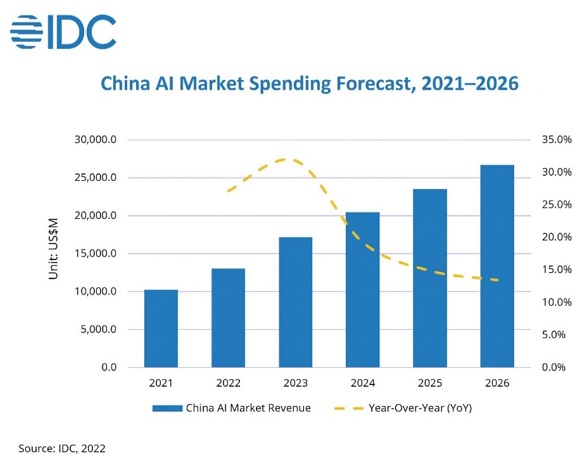
China’s AI industry spending is expected to reach $14.75 billion by the end of 2023, accounting for about 10% of the global total, according to the IDC report “World Artificial Intelligence Spending Guide.” This market is expected to reach $26.44 billion by 2026, with a compound annual growth rate of more than 20% from 2021 to 2026. The report highlights the importance of innovation and technological advancements in AI, highlighting the passionate demand for digital transformation in AI. China’s AI industry.
Challenges to China’s AI development
China’s AI development relies heavily on the collection and use of vast amounts of data. However, ensuring data quality, accuracy and reliability is a challenge. Data privacy concerns are also raised, as the use of personal data in AI applications raises questions about consent, security, and protection of individual privacy rights.
Despite China’s efforts to develop AI talent, there is still a shortage of skilled professionals in certain specialized fields. Demand for AI professionals is outstripping current supply, leading to fierce competition for talent. Retaining top talent and bridging the skills gap remains a major challenge.
As AI technology advances, ethical considerations become increasingly important. China faces challenges in addressing issues such as algorithmic transparency, fairness and bias. Ensuring the responsible and ethical deployment of AI systems is critical to maintaining public trust and mitigating potential negative impacts.
China has made impressive progress in domestic AI development, but stepping up international cooperation and standardization efforts is essential to meet global challenges and ensure interoperability. Harmonizing AI standards and frameworks across countries will foster cooperation and break down potential barriers.
Although China has made great strides in AI research and development, the maturity and adoption of AI technology in certain industries is still evolving. Practical implementation and scalability of AI solutions across sectors require continuous refinement and validation.
Strengthening intellectual property protection is also an issue for China’s AI development. To promote innovation and attract foreign investment, it is important to establish a strong legal framework and mechanisms to effectively protect intellectual property rights. As AI technology becomes more prevalent, ensuring transparency and accountability in the decision-making process is imperative. Addressing concerns about accountability, accountability, and potential bias in AI systems is essential to building trust and ensuring the ethical use of AI.
UK AI development and benefits
The UK has established itself as a global leader in AI development with a thriving ecosystem supported by research institutes, start-ups and government initiatives. The AI Sector Pact, launched by the UK government, aims to spur AI innovation through investment, research funding, skills development and regulatory support.
The recently concluded London Tech Week 2023 will focus on discussions on AI development and innovation, highlighting the importance of safety research, international cooperation, and collaboration with academia and AI companies. A thought-provoking conversation was held about UK Prime Minister Rishi Snak emphasizes the importance of safety research in UK AI policy and the importance of partnering with academia and AI companies to ensure the safe development, deployment and use of AI technologies across the economy emphasized. Sunak also announced a £100million Foundation AI task force to fund AI safety, said AI will cross borders, and international cooperation in establishing standards and regulations to govern AI. emphasized the need for The upcoming International AI Summit, which aims to foster international cooperation on AI, has been announced.
A conversation between Sunak and Google DeepMind co-founder Demis Hassabis during London Tech Week further emphasized cooperation, responsible regulation and ethical considerations in harnessing the potential of AI. His CEO of Microsoft UK introduced the concept of “AI CoPilots” and emphasized the importance of an ethical framework to guide AI adoption and collaboration in the technology industry.
The UK prioritizes ethical and responsible AI development, ensuring transparency, fairness and accountability. The country has applied AI technology to various fields such as healthcare, finance, robotics and automation, improving efficiency and decision-making in all areas. Attract an international talent pool, benefit from a diverse range of professionals, and facilitate knowledge exchange. The UK has a strong legal and regulatory framework that encourages innovation while upholding ethical standards. Cities such as London and Cambridge have vibrant startup ecosystems, both of which are engines of innovation and economic growth. Linkages between academia, industry and government will strengthen her AI industry in the UK, foster partnerships and accelerate the adoption of AI technologies.
Insights into China-UK cooperation in the AI industry
Both the UK and China are committed to the importance of AI in their national development, and there is potential for successful cooperation in the AI industry, which could lead to mutual benefits such as technological progress, economic growth and talent development. I have. Collaboration can come in many different fields and forms. Joint research projects and knowledge exchanges could accelerate the advancement of AI technology. Talent exchange programs can facilitate the transfer of expertise and contribute to the growth of the AI talent pool. A partnership between Chinese and British AI companies could lead to joint development of AI solutions and products. Collaborating on international standards and regulations may ensure ethical AI development. Investment and funding collaborations could support AI startups and initiatives. Collaboration in cross-border AI applications such as smart cities, healthcare, transportation, and finance could bring experience sharing and beneficial solutions for both countries.


