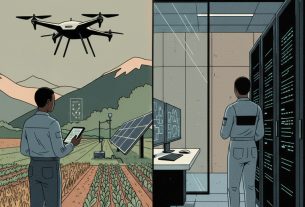
The first quarter of 2023 has been marked by artificial intelligence (AI) black boxes, evoking awe and fear that we are now on the brink of an endless technological revolution. Various models are appearing one after another. From the application of precancerous cells to medical imaging and autonomous vehicles, to AlphaGo mastering the centuries-old board game Go, to the chaos of education and industry in ChatGPT through the analysis and synthesis of human language. How can AI be leveraged to address a vicious problem of immense proportions, such as the illegal wildlife trade?
—
In March 2023, customs officials at Hai Phong Port, one of Vietnam’s busiest cargo ports, pried open a 6-meter-long metal container declared to contain peanuts, but found no peanuts anywhere. Not found. Instead, hundreds of long, cut pieces of ivory were piled up inside the container.
This is the third time this year that Haiphong Customs has seized illegal ivory shipments. The ivory weighed more than 7,000 kilograms, making it the largest seizure at Hai Phong port. A kilogram of raw ivory, a rival to cocaine, fetches varying prices. From $100 to $2,500.
Ivory is just the tip of the tusk. close neighbor, rhinoceros, culled for horns. When the international trade in elephants, rhinos and their parts was outlawed, not only did the trade continue unabated, but other species were drawn into the vortex. The red keratin shells of helmeted hornbills and the pearly bivalve shells of giant clams are marketed as “new” ivory, and both species are endangered.
Beyond ivory, the global trade in thousands of species ranging from large mammals to plants and fungi for traditional medicines, rare pets and fashion fuels a rampant black market.United Nations Environment Program and INTERPOL estimate The global illegal wildlife trade amounts to up to US$20 billion annually. But its true extent is difficult to gauge. The covert nature of the network means that it will always remain an elusive big elephant in the room.
Illegal wildlife trade networks, commonly associated with drug, arms and human trafficking, fall into three main stages: collection and harvesting in source countries, trafficking networks for processing and transportation, and sales and purchases in destination countries. depends. At each stage there are many clever tricks to avoid detection and capture.
The goods seized in Haiphong are said to have been transshipped in Singapore, with unusual wording and inaccurate entries being used in declarations to disguise the origin and route of the cargo.
In many cases, contraband doesn’t even need to be hidden. At customs ports, officials are often puzzled by seeds and their sources. It is almost impossible to determine whether a transboundary species was harvested legally or illegally and the country of origin. Also, without adequate manpower, knowledge, and a decidedly keen eye, it is impossible to know which species of shark the unattached fin belongs to, or which species are tablets or pulverized into trinkets, clothing, and pharmaceuticals. It is difficult to detect whether it is processed into products such as into powder. The proverbial cat-and-mouse game is further skewed as illegal products are increasingly being sold online on social media and e-commerce platforms. Merchants use code names, misspell words and letters, jump between applications, and hide their identities and locations. Techniques are constantly evolving, changing and adapting.
As algorithms improve and AI intersects our daily lives more regularly, this milestone may be the gateway for many in the conservation field to incorporate AI into their efforts. I have high hopes.
“To effectively prevent and disrupt this transaction, AI has been developed to automatically monitor and investigate large amounts of online data.” writes Professor Payal Arora, a digital anthropologist and professor of technology and social issues at Erasmus University Rotterdam. collaboration paper.
The paths between illegal wildlife trade and AI seem to be converging and intersecting. AI cameras and sensors are proliferating to identify and track different species in their natural habitat to monitor wildlife and their harvests. UK-based startup Archangel Imaging combines AI with cameras, motion detectors and satellite communications to Argonaut. This new camera replaces daily foot patrols to alert the nearest ranger of poaching activity.Developed by the University of Southern California Wildlife Security Assistant (PAWS) – Promoted as a “game-theoretical decision aid” that learns from past activity and terrain data and uses game theory to predict poaching hotspots and optimize patrol routes.
Further along the supply chain, AI algorithms are trained to recognize the characteristics of illegal wildlife products and assist forensic scientists with DNA analysis, detection at border crossings, and identification of product species and origin. becomes easier.Developed by the United Nations Food and Agriculture Organization (FAO) and the University of Vigo eye shark fin, software that learns from dorsal and pectoral fin shapes to identify species. Together with Conservation International, Singapore National Parks Commission, Microsoft and other partners, fin finder This app can generate shark types instantly. Marketplaces are using AI-powered tools, via natural language processing and image recognition technology, to monitor social media and e-commerce platforms for keywords and images associated with illegal wildlife trade activities. monitor what
When things happen in real life, every action can have unknown and unpredictable consequences. AI is currently in its infancy, but its burgeoning uses and endless possibilities It is an ethical and political minefield, with a persistent dilemma between open source and data privacy. this is getting worse Within the complex matrix of actors and activities in the illegal wildlife trade.
“Information hoarding can only be done as funds allow,” writes Arora, “and exorbitant costs remain uncomfortably given severe resource scarcity.”
Public-private partnerships between donors and technology companies may only use local communities, especially in the Global South, as “testbeds for new technologies” with “no clear procedures for integration into communities.” There is These constraints separate AI from humans and force it to “leap beyond humans into technology.”
What this means is that AI is ultimately a tool for humans, not a tool for humans. What you need is a strategic approach to data governance, security, and access. What you need is a long-term investment in a community-based network. Only time will tell what we get.
You’ll probably also like: Seven database and artificial intelligence projects to help fight climate change