

The CEO of OpenAI, the company behind ChatGPT, recently testified before U.S. Senators that AI “could go quite the wrong way,” and his company “want to work with the government to prevent that from happening.” ‘ said.
Privacy concerns about AI are widespread. In addition to the temporary ban on ChatGPT in Italy, some private groups have begun restricting its use. These concerns are not limited to ChatGPT.
Studies have also demonstrated that WeChat, the most used social app in China, has censorship algorithms built into it.
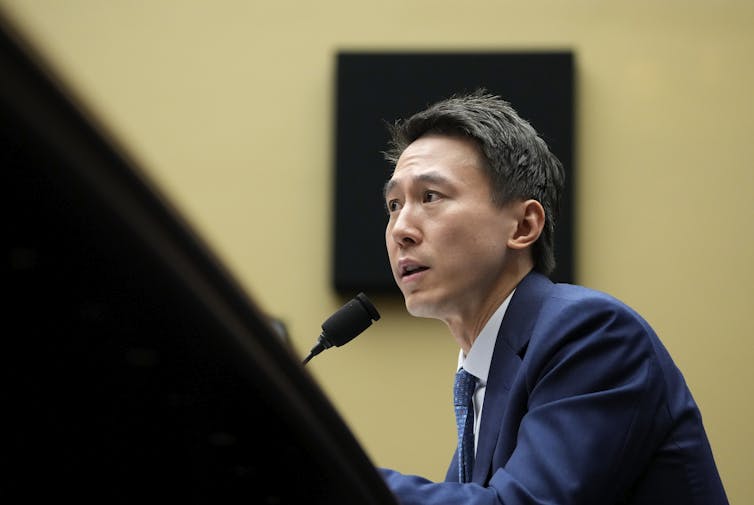
TikTok has likewise been framed as a propaganda tool for the Chinese government, leading to US congressional hearings on privacy concerns. In addition to broader international efforts by other lawmakers, there are clear concerns about the role governments should play in the development and use of artificial intelligence.
Despite these growing concerns, U.S. venture capitalists continue to invest heavily in the country’s AI sector, and there are few signs that investment in Chinese AI has, or will, slow. do not have.
Some argue that concerns about China are unwarranted, that repression is unlikely, and that other countries will only intervene in the development and distribution of technology if China does not.
But we cannot ignore how the Chinese government, or other governments, are deploying AI to achieve their goals.
AI gold rush
The realization that AI, especially large-scale language models like ChatGPT, has the potential to revolutionize business has sparked a speculative gold rush.
As companies seek to capitalize on these opportunities, they need to expand their portfolios into international markets. China stands ready to offer these companies a high return on investment.
The Chinese government has prioritized innovation to counter U.S. technological superiority. Recent estimates suggest that China has the fourth-highest number of AI “unicorns,” private startups with valuations above $1 billion.
However, unlike in the West, China has a clear line between state-owned and private organizations, and many companies host CCP committees within their organizations.
(AP Photo/Alex Brandon)
Given that social media could help China achieve its goals, TiKTok’s relationship with the Chinese government has changed over what content is presented on its platform and how user information is collected. , raises concerns about how it can be used to influence users’ beliefs and choices.
AI ethical business
Protectionism, nationalism and racism undoubtedly influence concerns about technology consumption and adoption. Research has repeatedly demonstrated that the country of origin of a product influences consumer perceptions. However, these factors should be carefully weighed against others.
Like many countries, China seeks global influence through soft power. After the communist revolution, the Chinese state has sought to guide technological development for the purpose of social surveillance and regulation. Such customs are deeply rooted in the Chinese philosophy of prioritizing harmony.
Social harmony can also come at a cost to others. Uyghurs, political dissidents, disobedient people and groups are all targets of the Chinese government. The repressive surveillance of Xinjiang Uyghurs has not only resulted in the detention of Uyghurs in camps, but has also resulted in many Han Chinese settlers leaving the province.
Western governments and AI
No value-neutral technology exists. Values influence the choices of AI designers, developers, and users.
We must be wary of the signals of virtue of being fixated on China’s problems and ignoring our own problems. This is because the difference is not the type of problem, but the degree of the problem.
In North America, governments’ mass surveillance of the population, the military’s unclear policy on autonomous weapons, and the collection of user data by private organizations must all be taken into account.
AI has both domestic and military applications, as recent revelations about parts of a Russian-made drone used to attack Ukraine revealed. Three-Quarters of Drone Parts Turned Out to be Made in the U.S. Investors cannot ignore the moral implications of the global supply chain when it comes to AI.
Coordinated efforts are key
Even though industry is the main driver of AI development, all stakeholders have a role to play. The Chinese government’s involvement in her AI development may be too great, but the Western government’s no-intervention approach poses problems of its own.
These issues include the prevalence and politicization of disinformation and the increase in anxiety and depression associated with social media use.
Regulation isn’t the only answer, but it’s a start. With the United States considering legislation for systems like ChatGPT and Canada finalizing its own broad AI framework, the Chinese government is arguably looking to enact its own legislation to help tighten controls.
Industry leaders and academics are probably in the best position to understand this technology. However, governments can provide insight to users and investors who may be unaware of larger issues within the tech ecosystem such as privacy and security.
To illustrate this, Sequoia Capital, one of the largest venture capital firms investing in China, has asked national security agencies for advice. The recent decision to split its US and Chinese operations has undoubtedly been influenced by this process.
Enhancing democratic values in the face of AI requires a coordinated international effort among industry, governments and non-governmental organizations.


