


artificial intelligence has emerged as a powerful technology that can drive significant business transformation across industries. However, traditional machine learning models struggle to keep up with the dynamic nature of our rapidly evolving world, effectively managing the influx of data generated by the Internet of Things (IoT) and self-driving cars. have been hindered from processing. The inability to adapt to new data streams has been a major limitation of ML models. Fortunately, things are changing with the advent of adaptive AI. Adaptive AI represents a breakthrough in artificial intelligence by introducing continuous learning capabilities. Adaptive AI model It can evolve and adapt in real time as new data becomes available. This dynamic nature of adaptive AI enables enterprises to effectively meet the challenges posed by an ever-changing data environment.
Adaptive AI is the next evolutionary advance in artificial intelligence that blends advanced autonomous learning techniques with machine learning capabilities. Unlike previous AI iterations, adaptive AI systems exhibit remarkable adaptability to changing conditions. This adaptability is achieved by retraining the model and continuously learning from newly acquired information. Adaptive AI proactively adjusts algorithms, decision-making processes, and actions to steadily improve performance over time. This dynamic nature allows the system to respond more effectively to changes and failures, achieving its objectives with greater efficiency and accuracy.
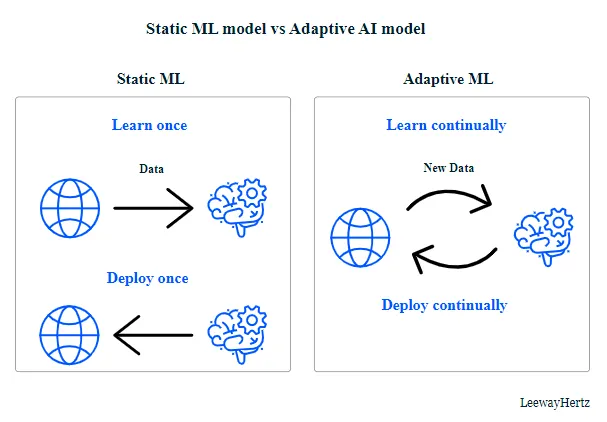
Adaptive AI works based on continuous learning (CL), a key aspect of achieving AI capabilities. Continuous learning refers to the ability of a model to learn autonomously and adapt to new data as it becomes available in real time. It mimics the human ability to continuously acquire, refine, and transfer knowledge and skills. While traditional machine learning focuses on creating models for production, continuous learning makes it possible to utilize data received in production to retrain models and incorporate new insights. can. Netflix’s “next” recommender system needs to be continuously retrained to recommend the next show based on user preferences. Continuous learning ensures high accuracy by adapting to changing movie selections, user preferences and market trends. This automates adaptability, reduces the need for manual retraining, saves time, and is an effective approach to improving model accuracy. Adaptive AI’s continuous learning allows models to evolve, improving accuracy and adaptability to dynamic data. By leveraging new information, adaptive AI models become more adept at achieving goals in changing conditions, ensuring relevance and value in dynamic business environments.
AutoML plays a key role in continuous learning for adaptive AI by automating the entire machine learning pipeline. Eliminates the need for manual intervention, reduces training time and resources, and improves model accuracy. AutoML implementations include user-friendly frameworks, hyperparameter optimization, and open-source algorithms such as computer vision transfer learning that leverage pre-trained models for efficient training and deployment. .
After training, the adaptive AI pipeline performs model validation to ensure that it works effectively and selects the best model for deployment. Monitoring is then incorporated to facilitate feedback loops and connect pipelines to data sources for continuous learning. By integrating AutoML and monitoring, companies can automate model selection, deployment, and improvement. This iterative approach ensures accuracy and relevance in dynamic environments and maximizes the potential of adaptive AI.

Adaptive AI drives business growth by combining agent-based modeling and reinforcement learning. This unique combination enables real-time adaptation to real-world changes, even in production environments. One example is the US Army’s adaptive AI system, which acts as an individual tutor, assessing strengths, optimizing educational approaches, effectively measuring progress, and adapting the learning process to meet diverse needs. transform the
The importance of adaptive AI for business growth can be summarized as follows:
Increased efficiency and automation: Adaptive AI automates routine tasks and processes, freeing up valuable employee time and improving overall operational efficiency.
Better decision making: Adaptive AI provides real-time insights and data-driven decisions, minimizing the potential for human error and enabling more accurate and informed business decisions.
Personalization and customization: Adaptive AI models are trained to understand individual customer preferences, enabling businesses to deliver personalized experiences and customized products and services.
Competitive Advantage: Companies that adopt adaptive AI can leverage its capabilities to increase efficiency, innovation, and adaptability to gain a competitive edge and stay ahead of their competitors.
Increased customer satisfaction: Adaptive AI enables businesses to serve customers faster and more effectively, leading to increased customer satisfaction and increased loyalty.
Cost reduction: Improved automation and decision-making with adaptive AI can lead to significant cost savings through reduced manual work and optimized resource allocation.
Improved risk management: Adaptive AI can analyze data and predict potential risks, allowing businesses to proactively identify and mitigate potential problems, minimize risks, and improve overall risk management. I can.
Adaptive AI, with its ability to continuously learn and adapt in real time, offers a wide variety of use cases across industries. Here are some notable examples:
Personalized Marketing: Adaptive AI can analyze customer data, preferences, and behavior to deliver highly personalized recommendations, offers, and experiences. This can be applied to e-commerce, entertainment streaming platforms, personalized marketing campaigns and targeted advertising.
Fraud detection and cybersecurity: Adaptive AI can continuously analyze patterns and anomalies in real-time data streams to detect fraudulent activity and improve cybersecurity posture. You can identify suspicious behavior, protect against cyberthreats, and prevent potential compromise of your financial, banking, and online transactions.
Healthcare and medical diagnostics: Adaptive AI can analyze large volumes of patient data, medical records, and diagnostic imaging to provide accurate and timely medical diagnoses. It helps detect disease earlier, optimize treatment plans and improve patient outcomes.
Supply chain optimization: Adaptive AI can analyze real-time data on inventory levels, demand fluctuations, transportation logistics, and market trends to optimize supply chain operations. Predict demand patterns, automate inventory management, and streamline logistics processes.
Smart manufacturing: Adaptive AI can optimize manufacturing processes by continuously analyzing production data, detecting anomalies, and predicting equipment failure. This enables predictive maintenance, reduces downtime and improves overall operational efficiency.
Self-driving cars and transportation: Adaptive AI plays a key role in self-driving cars, enabling them to adapt to changing road conditions, traffic patterns and potential hazards. Improve the safety, navigation and overall performance of autonomous vehicles and intelligent transportation systems.
Energy management and sustainability: Adaptive AI can optimize energy use, analyze consumption patterns, and recommend energy-saving strategies for buildings and smart grids. Reduce energy waste, improve efficiency and support sustainable practices.
Financial analysis and trading: Adaptive AI analyzes market trends, financial data and news to provide real-time insights for investment decisions and algorithmic trading. Enhance portfolio management, risk assessment and trading strategies.
In conclusion, adaptive AI represents a major advance in artificial intelligence, offering amazing capabilities that can learn, adapt, and optimize strategies in response to real-world conditions. Adaptive AI holds great promise in various industries because it can dynamically adjust algorithms, decision-making processes, and actions.
Adopting adaptive AI gives companies a distinct competitive edge in the market. You can provide faster, more effective service and improve customer satisfaction, loyalty and retention. Adaptive AI’s automation and optimization capabilities also drive cost savings by eliminating repetitive tasks and optimizing resource allocation. The transformative potential of adaptive AI also extends to decision-making processes, enabling companies to make more accurate and efficient decisions. By embracing adaptive AI and harnessing its immense potential, businesses can maximize their potential and effectively navigate their future potential.


