
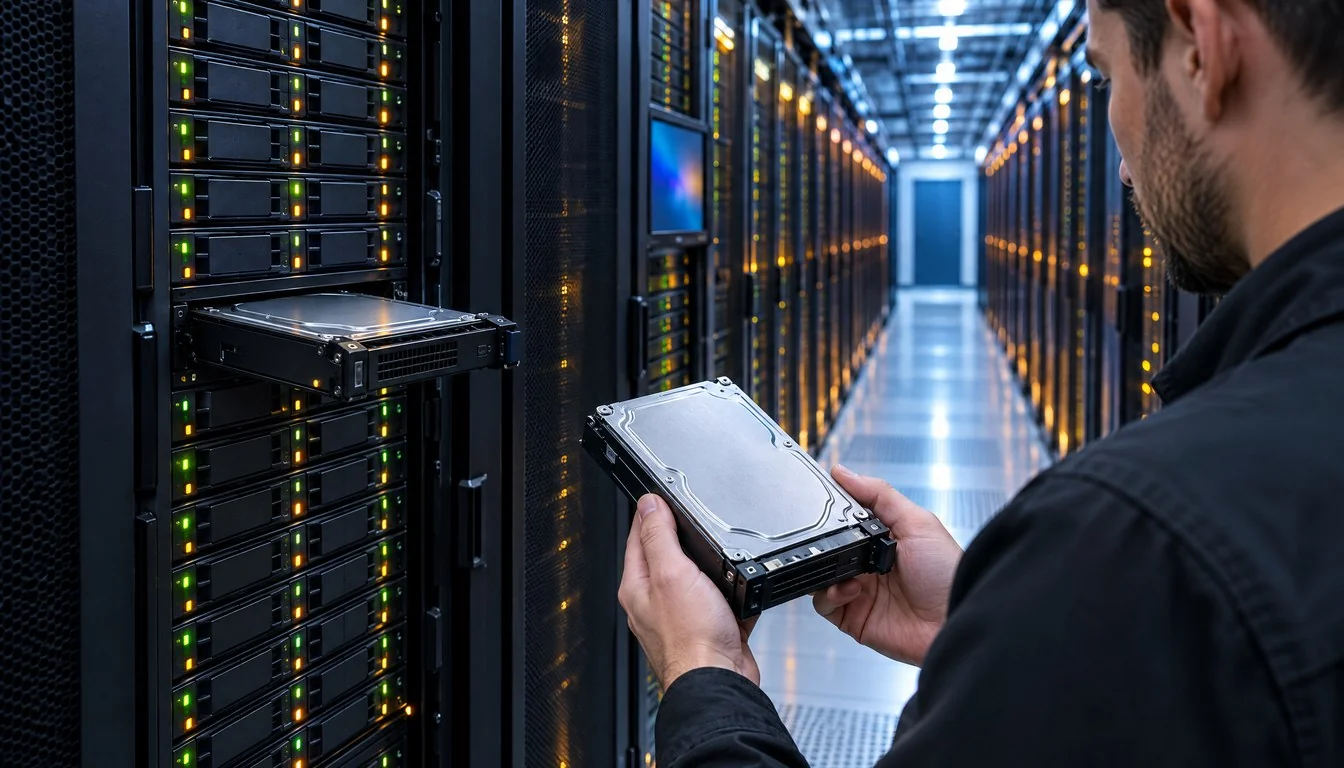
Western Digital’s fiscal third quarter 2026 gave the hard drive business its loudest AI endorsement in years. The company reported $3.34 billion in revenue, up 45% year over year, and pointed to AI workloads as the main reason, according to Yahoo Finance’s WDC Q3 deep dive. The results landed April 30, 2026, and the questions they raised about durability still shape how investors read the stock today, October 23.
This analysis walks through what Nasdaq: WDC actually reported, how the ePMR drive ramp worked, and why the AI storage demand story keeps circling back to spinning disks. It also sorts confirmed figures from claims that circulated in secondary coverage and did not hold up against the official release. If you followed our earlier piece on the NAND shortage that sent SSD prices up 303%, think of this as the other half of the same story: the cheap, dense tier that sits behind all that flash.
A quick note on timing. Western Digital has reported again since this quarter, and the company’s later fiscal fourth quarter and full-year 2026 release is the place to check for the most current numbers. Everything below sticks to the fiscal Q3 print and the call that followed it.
Don’t miss new tech stories on Google
Add Tech Insider once in the Google app and our stories appear in your news suggestions.
Add Now
What Western Digital Reported for Fiscal Q3 2026
The headline figures are clean and easy to verify. Revenue came in at $3.34 billion. GAAP gross margin hit 50.2%, and non-GAAP gross margin reached 50.5%. Non-GAAP diluted EPS was $2.72, while GAAP diluted EPS landed at $8.20.
Those margins matter more than the revenue growth. Hard drive makers spent a decade as low-margin, cyclical suppliers that investors treated like commodity shops. A gross margin above 50% looks more like a software-adjacent infrastructure vendor than a company that bolts platters into metal boxes. It tells you pricing power has returned and that the product mix is tilting toward the highest-capacity drives, where the economics are best.
The revenue growth rate also implies a sizeable base effect. A 45% jump to $3.34 billion means the same quarter a year earlier came in near $2.3 billion by simple arithmetic. In other words, the company added roughly $1 billion of quarterly revenue in twelve months. For a business that sells physical, capacity-constrained hardware, that is a steep climb.
WDC Q3 Earnings by the Numbers
The table below collects the confirmed fiscal Q3 2026 figures from Western Digital’s official results. Nothing here comes from secondary commentary.
| Metric | Fiscal Q3 2026 |
|---|---|
| Revenue | $3.34 billion (up 45% year over year) |
| GAAP gross margin | 50.2% |
| Non-GAAP gross margin | 50.5% |
| GAAP diluted EPS | $8.20 |
| Non-GAAP diluted EPS | $2.72 |
| Cash flow from operations | $1.12 billion |
| Free cash flow | $978 million |
| Total exabytes shipped | 222 EB (up 34% year over year) |
One detail jumps out. GAAP EPS of $8.20 sits far above non-GAAP EPS of $2.72, which is the reverse of the usual pattern where adjustments add back costs and lift the non-GAAP figure. The official summary we worked from does not explain the gap, so readers who care about earnings quality should open the reconciliation tables in the release itself instead of assuming a cause.
Why AI Storage Demand Keeps Landing on Hard Drives
The company’s argument is simple and, on its face, hard to dispute. In the results release, CEO David Goeckeler said: “The demand drivers are clear: Virtually every AI workload, from training, inference, agentic AI to physical AI, creates data that is stored persistently and cost-efficiently on HDDs.”
Read that sentence closely. It does not claim that AI models run on hard drives. GPUs pull training data from fast flash and memory, and inference lives in HBM and DRAM. The hard drive pitch is about everything that has to be kept afterward: raw training corpora, checkpoints, logs, generated outputs, and the growing pile of agent traces that nobody wants to delete. That data needs to sit somewhere for years, and cost per terabyte decides where.
The same logic explains why the memory makers are riding the cycle too. Our look at Micron’s DRAM and HBM4 push into 400-layer NAND shows the fast end of the stack scaling up. The hard drive tier scales alongside it because every additional GPU cluster generates data faster than flash budgets can absorb. For wider context on how model builders and their infrastructure bills connect, see our AI and machine learning coverage.
The Globe and Mail framed the same dynamic in its piece on the storage behemoth skyrocketing on AI demand, which treats the storage names as a second-order AI trade. That framing matters because it explains the stock’s behavior. When AI sentiment wobbles, drive makers often move with chip names, even though their revenue depends on data retention rather than compute cycles.
The ePMR Ramp: 4.1 Million Drives and 118 Exabytes
The most concrete operational datapoint in the quarter was the ePMR ramp. Western Digital shipped more than 4.1 million units of its latest-generation ePMR drives, representing 118 exabytes, with capacity points up to 32 terabytes. That 118 exabytes sits inside a total of 222 exabytes shipped, up 34% year over year.
On the earnings call, Western Digital management put it this way: “We delivered 222 exabytes to our customers, up 34% year-over-year. This includes over 4.1 million drives or 118 exabytes of our latest generation ePMR with capacity points up to 32-terabytes, demonstrating our ability to quickly ramp new technologies and products in support of strong customer demand growth.” The full Fortune-hosted call transcript carries the surrounding discussion.
What the Shipment Math Shows
Two simple calculations help put the ePMR number in perspective. They are our own arithmetic on the confirmed figures, not company statements.
# Derived from Western Digital's reported fiscal Q3 2026 figures
ePMR share of exabytes  = 118 / 222              = 53.2%
Avg ePMR capacity/drive = 118,000,000 TB / 4.1M  = ~28.8 TB
Implied prior-year rev  = 3.34B / 1.45           = ~$2.30B
FCF as share of revenue = 978M / 3.34B           = ~29.3%
Just over half of all exabytes shipped came from the newest drive generation, and the average ePMR drive carried close to 29 terabytes. That second number says buyers are not mixing in many small-capacity ePMR units. They are choosing the top of the range, which is exactly what lifts margin per drive.
| Shipment Metric | Value | Source Type |
|---|---|---|
| Total exabytes shipped | 222 EB | Company results |
| Year-over-year growth in exabytes | 34% | Company results |
| Latest-generation ePMR drives shipped | More than 4.1 million | Company results |
| ePMR exabytes | 118 EB | Company results |
| Top ePMR capacity point | 32 TB | Company results |
| ePMR share of total exabytes | About 53% | Derived by Tech Insider |
| Average ePMR capacity per drive | About 28.8 TB | Derived by Tech Insider |
Revenue Up 45%, Exabytes Up 34%
Revenue grew faster than exabytes. When dollars outpace volume, the usual explanation is price per unit, product mix, or both. Management said on the call that revenue was driven by strong demand across end markets and an improved pricing environment, which fits the pattern. A pricing-led beat is welcome, but it also raises the question every analyst asked next: how long does a tight market stay tight?
Dual Pivot Technology and the Throughput Problem
Capacity is only half the story with large drives. A 32-terabyte disk that still reads at the speed of a 10-terabyte disk takes far longer to rebuild, scrub, or serve under load. Western Digital described Dual Pivot Technology as a way to improve HDD throughput and bandwidth, which targets exactly that mismatch.
The company has not published, in the material we verified, the specific mechanical or firmware details that deliver the gain. So we will not guess at read speeds or IOPS numbers. What the announcement does establish is intent: the vendor sees bandwidth per drive, not just terabytes per drive, as a selling point for AI data lakes where objects are large and access patterns are mostly sequential.
That distinction matters for buyers. Cloud operators care about cost per terabyte, but they also care about how many drives they must stripe across to hit a target throughput. If Dual Pivot Technology lets fewer spindles meet the same bandwidth goal, the real saving shows up in rack space and power rather than the sticker price. Expect third-party testing to decide whether the claim holds in production.
From 32TB to 40TB: What the Next ePMR Step Means
The next capacity step is already on the calendar. Western Digital management said: “As we introduce our next gen EPMR, which is a 40 terabyte drive, that’ll be a 25% step up already from our current drives which are at the 32 terabyte capacity range.” The same call transcript, as quoted by roic.ai, has management saying: “We are ramping the next-generation ePMR in the second half of calendar year ’26.”
The arithmetic checks out: 40 divided by 32 is 1.25. For a data center operator, a 25% capacity jump in the same 3.5-inch slot means 25% more data per rack unit without a new building. That is the real product. Customers are not buying drives so much as buying density and the power budget that comes with it.
Because the ramp window falls in the second half of calendar 2026, the transition is happening right now. Anyone watching the next set of company results should look for commentary on qualification progress, yield, and how quickly 40-terabyte parts displace 32-terabyte parts in the shipment mix. A smooth handoff would extend the margin story. A stumble would expose how dependent the current numbers are on a single product generation.
Cash Flow and Margins: Why Investors Cheered
Cash flow from operations reached $1.12 billion and free cash flow hit $978 million. Against $3.34 billion of revenue, free cash flow ran at roughly 29%, which is an unusually high conversion rate for a hardware manufacturer. The gap between the two figures is about $142 million (our arithmetic), so most operating cash dropped straight through.
Compare that with the capital intensity elsewhere in the AI supply chain. Our reporting on Meta lifting AI capex to $145 billion shows how much cash the buyers of this hardware are spending. Western Digital sits on the receiving end of that budget, and it keeps a bigger share as free cash flow than most companies in the chain. That is the core of the bull case.
The investing.com write-up of the call, Western Digital’s Q3 2026 earnings beat forecasts and the stock surges, captures the market reaction. The headline tells the story: the print beat, and the shares jumped. A beat that large resets expectations, though, which makes the next quarter harder to clear.
How Wall Street Read the Print: Market Questions on the Outlook
The Yahoo Finance deep dive title says it plainly: AI storage demand and technology upgrades drive performance, and the market questions the outlook. Strong numbers rarely end the debate. They move it. Four questions dominated the discussion around this report.
- Pricing durability. If the improved pricing environment reflects tight supply, it can reverse when capacity catches up.
- Demand concentration. A handful of hyperscale buyers drive most high-capacity orders, so a change in their purchasing cadence moves results fast.
- Technology transition risk. The move from 32TB to 40TB ePMR, and the arrival of HAMR alongside it, must go smoothly to protect margin.
- AI sentiment. Storage stocks trade with the broader AI complex, so a sentiment shock hits them regardless of order books.
That last point is not theoretical. On the day the Nasdaq sank 2.58% as AI doubts hit chip stocks, hardware names across the stack fell together. A company can post a 50% gross margin and still get sold on a bad macro day.
Claims That Did Not Check Out
Some of the coverage around this story contained numbers that conflict with Western Digital’s official results. We held them out of the analysis above, and readers who see them elsewhere should treat them with caution.
- A headline claim of $4.38 billion in revenue and 55.5% growth, tied to a different quarter label, does not match the official fiscal Q3 2026 figures of $3.34 billion and 45%.
- A quote credited to executive Kris Sennesael about exabyte acceleration from next-generation ePMR and upcoming HAMR platforms appears in secondary coverage only, not in the official results.
- Reported figures such as 89% of revenue from cloud customers, 199 exabytes of nearline shipments, and “no plans” to raise unit HDD production are not confirmed by the official release.
None of this means the claims are false. It means they lack backing in the primary documents we could verify. When a number matters to a trade or a purchasing decision, go to the company’s release and call transcript first.
Western Digital vs Seagate vs Toshiba: The Competitive Picture
Three companies make nearly all of the world’s hard drives: Western Digital, Seagate, and Toshiba. That oligopoly is the structural reason pricing can improve when demand surges. Capacity is slow to add, because new drive technology takes long cycles and heavy capital to qualify.
| Factor | Western Digital | Rivals (Seagate, Toshiba) |
|---|---|---|
| Current high-capacity platform | ePMR, up to 32TB shipping | Not verified in our source set |
| Next capacity step | 40TB ePMR, ramp in second half of calendar 2026 | Not verified in our source set |
| Throughput approach | Dual Pivot Technology | Not verified in our source set |
| Fiscal Q3 gross margin (non-GAAP) | 50.5% | Not compared here |
| Heat-assisted recording (HAMR) | Reported to arrive alongside ePMR | Competitive race, details not verified here |
We left the rival columns deliberately thin. Our verified source set covers Western Digital, and stuffing the table with unconfirmed competitor specs would break our own rule against guessing. The structural point stands without them. All three vendors are chasing the same prize, which is more terabytes per platter, and the one that ships qualified high-capacity drives to hyperscalers first tends to lock in multi-quarter volume.
The flash side of the market is also reshuffling. Our report on SK Hynix halting a Solidigm IPO shows enterprise SSD ownership in flux, and any change in flash supply feeds back into how much data operators can afford to keep on hot tiers versus cold ones.
Historical Context: HDDs Were Supposed to Be Dying
For most of the 2010s, the consensus held that flash would swallow the hard drive market. Laptops went solid-state first, then performance servers followed. Hard drive makers retreated to the data center, where cost per terabyte still favored spinning media.
The cloud boom then handed the industry a second life, and AI is the third wave. Every new application that produces data and wants to keep it, from video to sensor logs to model checkpoints, adds to the cold and warm tiers. The result is a market that looks nothing like the one analysts wrote off a decade ago. Revenue near $3.34 billion in a single quarter, at a 50%-plus gross margin, would have sounded implausible in the mid-2010s.
History also offers a warning. Hard drive markets have a long record of boom and bust, since supply additions arrive in lumps and demand can pause when buyers digest inventory. The current cycle may be structurally stronger because of AI, but the pattern of overshoot has repeated enough times that skeptics have good reason to ask for proof of durability.
What the Quarter Means for Cloud Buyers and Hardware Teams
For infrastructure teams, the practical takeaways are straightforward. Capacity is tight at the top of the range, so lead times on 32TB-class drives deserve attention in any capex plan. The 40TB generation promises relief in density terms, but only once volume production arrives in the second half of calendar 2026.
Teams should also plan for tiering rather than choosing sides. Flash, which our readers have watched get pricier, handles hot data. Hard drives handle the bulk of retained AI data. The smart design splits workloads by access pattern and treats the two as complements. Storage cost discussions across the chip industry, including our look at how Micron’s $54.23 billion quarter set the tone for Korean chips, point the same direction: memory and storage budgets are climbing across the board.
Smaller buyers feel this differently. They do not get allocation priority, so they face the consumer-facing side of price pressure. Anyone building a NAS or a lab cluster this quarter should expect to pay more per terabyte than last year and should budget for it.
Five Predictions for the Next Two Quarters
These are our analytical judgments, not company guidance and not statements from any named executive.
- 40TB ePMR becomes the story. With the ramp scheduled for the second half of calendar 2026, commentary on qualification and early shipments should dominate the next calls.
- Exabyte growth stays below revenue growth. As long as pricing and mix stay favorable, dollars should keep outpacing units, as they did in fiscal Q3.
- Margin debate intensifies. Gross margin above 50% invites scrutiny, and the first sign of price softening will get heavy attention.
- HAMR gets more airtime, not more volume. Reports on the call framed it as arriving alongside ePMR, so expect talk of customer qualification before meaningful shipments.
- Storage stocks keep trading with AI sentiment. Order books may stay strong, but share prices will keep reacting to the broader AI trade.
The takeaway: Western Digital proved in fiscal Q3 that AI data retention is a real, paying market for hard drives. What it still has to prove is that the margin and the growth survive the handoff to the next product generation and the next turn of the pricing cycle.
Frequently Asked Questions
What did Western Digital report for fiscal Q3 2026?
Western Digital reported revenue of $3.34 billion, up 45% year over year, on April 30, 2026. GAAP gross margin was 50.2%, non-GAAP gross margin was 50.5%, GAAP diluted EPS was $8.20, and non-GAAP diluted EPS was $2.72.
How many exabytes did Western Digital ship?
The company shipped 222 exabytes, up 34% year over year. Of that, 118 exabytes came from more than 4.1 million latest-generation ePMR drives, with capacity points up to 32 terabytes.
Why does AI need hard drives?
AI workloads produce data that must be stored for long periods. Western Digital argues that training, inference, agentic AI, and physical AI all generate data that sits most cost-efficiently on HDDs. GPUs still rely on flash and memory for active work.
What is Dual Pivot Technology?
Western Digital describes Dual Pivot Technology as an approach that improves HDD throughput and bandwidth. The verified material does not give detailed specifications, so performance claims should wait for independent testing.
When will 40TB ePMR drives arrive?
Management said on the earnings call that it is ramping next-generation ePMR in the second half of calendar year 2026. The 40-terabyte drive is a 25% step up from the current 32-terabyte capacity range.
Were the $4.38 billion and 55.5% figures real?
Those numbers appeared in some secondary headlines but conflict with Western Digital’s official fiscal Q3 2026 results of $3.34 billion and 45% growth. We treat them as unconfirmed and did not use them.
Has Western Digital reported results since fiscal Q3?
Yes. The company published fiscal fourth quarter and full-year 2026 results in a later release. Check that release for the latest figures, since this article covers the fiscal Q3 report and call only.


