
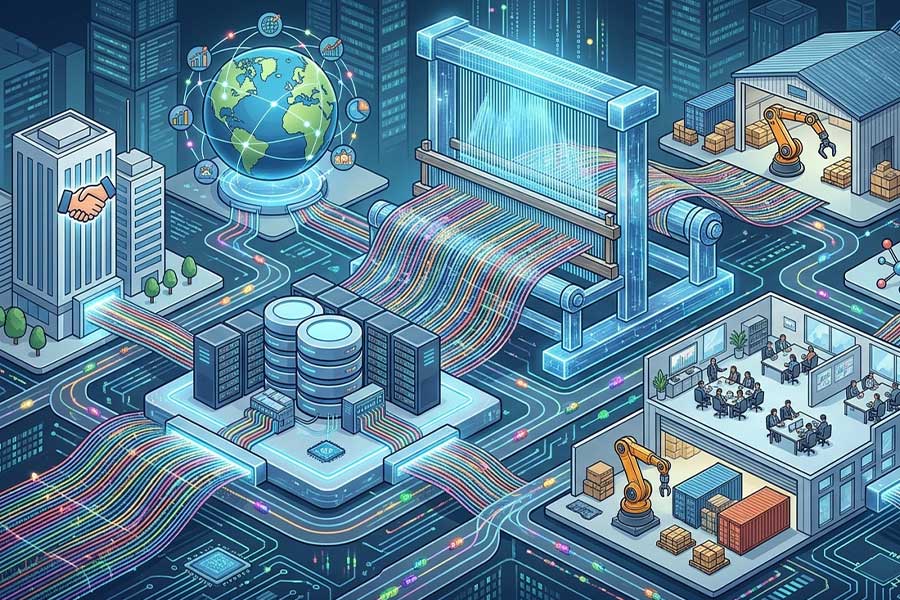
Today’s companies run on a growing web of applications, data platforms, cloud environments, workflows, and purpose-built business systems. The development of technology has opened new possibilities for automation and intelligence, and it has also created a lot of fragmentation. HR may be working with one set of applications, finance another, and sales, marketing, IT, operations, and customer service all have their own data environments and technology stacks. Therefore, valuable information is often trapped in organizational and technological silos.
These siloed systems create challenges that are so much more than just integrating data. Critical information is spread across several platforms, which may make it difficult for business leaders to get a complete picture of how the organization is performing. Sales teams may not have access to relevant customer-service insights, finance teams may not have real-time visibility of operational changes, and HR leaders might find it difficult to connect workforce capabilities with changing business requirements. When systems don’t talk well, decision-making slows down, processes become repetitive, and automation opportunities are limited.
Most traditional enterprise integration approaches were designed to support application-to-application integration and data movement from one system to another. But the AI-powered businesses of today require more than just connectivity. They need an intelligent layer that can understand data, relationships, context, business processes, and decisions across the organization. Introducing AI Fabric, a new approach to enterprise intelligence.
AI Fabric is an intelligent layer of connectivity that links together enterprise data, applications, AI models, workflows, and decision-making processes. Instead of forcing organizations to change their current technology ecosystem, an AI Fabric can connect existing environments, making their information more available to intelligent applications and to enterprise users. It offers a basis for developing a more unified digital environment, while enabling organizations to maintain investments in their existing infrastructure.
The arrival of AI Fabric also marks a larger shift in how companies are embracing AI. Initially, organizations adopted AI in the form of isolated use cases, departmental tools, and individual copilots. These initiatives can deliver value, but AI implementations that are not connected can create new silos rather than breaking down existing ones. AI capabilities need to be able to communicate across business functions and operate with shared organizational context to enable enterprise-wide intelligence.
AI is able to make this possible by translating information in real time and transforming dispersed data into contextual intelligence. A connected AI environment could pull in customer behavior, financial information, supply chain conditions, workforce data, and operational events to make more comprehensive decisions. Such insights can then be used by intelligent workflows to automate activities across multiple departments.
The outcome is an enterprise where information can move more easily between functions and decisions are informed by a richer organizational context. AI Fabric can accelerate decision-making, automate cross-functional processes, build more responsive business operations, and help improve collaboration.
The following sections discuss the technologies that support an AI Fabric, how it can be applied to some of the largest business functions, the benefits it can bring, the challenges organizations need to address, and how it will evolve in the future. As enterprises evolve into more and more intelligent operating models, AI Fabric could be the connective tissue linking data, applications, workflows, and intelligence across the modern organization.
Also Read: AiThority Interview with Gou Rao, co-founder and CEO at NeuBird AI
Understanding AI Fabric
AI Fabric is a smart enterprise architecture that enables the integration of data, applications, AI models, workflows, and decision-making across different business functions. AI Fabric doesn’t see artificial intelligence as a collection of isolated tools; it creates a connective layer that allows intelligence to flow through the organization.
The primary goal of traditional integration is to enable information to be exchanged between systems. AI Fabric adds intelligence to that connectivity by understanding context, identifying relationships, producing insights, and enabling or automating decisions.
The AI fabric can provide:
- Intelligent enterprise connectivity: Connecting business processes, data sources, AI models, and applications.
- Unified data and AI layer: Provides relevant enterprise data to intelligent applications.
- Cross-functional intelligence: Insights from finance, HR, sales, marketing, operations, IT, and customer service are combined.
- Connected decision-making: A more complete picture for business leaders to evaluate risks and opportunities.
- Intelligent Orchestration: Coordinating action across multiple systems, triggered by business events and decisions.
That’s not necessarily about replacing the current enterprise platforms. Alternatively, AI Fabric may develop an intelligence layer to wrap around them, allowing organizations to extract more value from their existing technology investments.
a) The Evolution of Enterprise Intelligence
Business technology has shaped the development of enterprise intelligence. Early organizations worked on traditional departmental systems, each with their own separate databases and applications for finance, HR, sales, and operations. The design of these systems focused primarily on the individual business function.
Enterprise application integration provided the means to connect these systems. Organizations used integration platforms, middleware, and APIs to enable information sharing between applications. This resulted in the reduction of some data silos, but the emphasis was often on connectivity rather than intelligence.
Cloud and data platforms have emerged, giving an enterprise more access to information. The use of data warehouses, data lakes, and cloud applications has enabled companies to consolidate larger volumes of information and to undertake more sophisticated analytics.
The next step was to implement AI that was tailored to the specific needs of each department. Marketing teams used AI to improve personalization. Sales teams used AI for predictive scoring. HR used AI to deploy talent analytics. IT organizations deployed AI-powered operations. These systems had developed useful capabilities but often worked in isolation from each other.
AI Fabric is a step toward enterprise-wide AI intelligence, in which different AI capabilities may benefit from shared context and work across business functions.
In brief, this development can be summed up as:
- Traditional department structures.
- Integration of business applications.
- Cloud and data platforms
- Department-specific AI adoption.
- Enterprise-wide AI intelligence.
b) Transitioning from Connected Systems to Connected Intelligence
Connecting systems is just the first step in the evolution of an intelligent enterprise. Organizations are increasingly dependent on technology that understands the importance of information, the relationships between various business events, and the correct course of action.
Data integration, extracting and aggregating information from different sources, is the basis. Application interoperability enables enterprise platforms to talk to each other using APIs and other integration methods.
Workflow connectivity takes this a step further, allowing actions in one system to launch processes in another. For example, changes in customer status may trigger actions in finance, marketing, customer service and sales.
Artificial intelligence-powered orchestration increases the intelligence of these workflows. Artificial intelligence systems can evaluate incoming information and then determine its importance, recommend an action, and potentially even start approved processes.
Context-aware enterprise intelligence means that decisions are not made on single data points, but on the broader organizational context.
Key capabilities include:
- Data integration across enterprise systems.
- Application interoperability.
- Cross-functional workflow connectivity.
- AI-powered orchestration.
- Context-aware intelligence.
- Intelligent decision support.
This shift changes enterprise technology from an interconnected set of applications to a more integrated intelligence environment.
c) Core Characteristics of AI Fabric
AI Fabric has several characteristics that make it an enterprise intelligence layer. The architecture should be able to interconnect different applications, data sources, AI models, and infrastructure environments, so interoperability is key.
Real-time intelligence enables organizations to deal with business events as they occur, rather than only periodically through reports. Context awareness allows artificial intelligence systems to interpret information in line with business relationships, processes, and objectives.
Scalability is just as important. Enterprise AI environments must scale with increasing data volumes, users, applications, models, and business processes without becoming prohibitively complex.
Other basic characteristics include:
- Interoperability – The ability to connect different technologies and applications.
- Real-time intelligence – It is the processing and interpretation of information in response to business events as they happen.
- Context awareness – Understanding how business objectives, processes, and data relate to each other.
- Scalability – Supporting the scaling of enterprise workloads and AI applications.
- Smart automation – Turning insights into synchronized actions.
- Cross-functional connectivity – Sharing knowledge across organizational boundaries.
These capabilities, combined, enable a more flexible enterprise operating model through AI Fabric.
d) The role of AI Fabric
The reason why AI Fabric is so important is that organizations are more and more aware that information is in multiple systems and business functions. These different environments can be hard to understand without an intelligence layer and how various events influence each other.
AI Fabric can be used to connect data and applications that were siloed within the enterprise to help remove enterprise data silos and create greater organizational visibility. Instead of relying on reports from individual departments, leaders can get a wider business context.
It’s not only about the visibility. Connected intelligence can connect business decisions across functions. For example, market demand changes can affect sales forecasts, inventory planning, staffing needs, financial forecasts, and customer engagement approaches.
AI Fabric can therefore support:
- Elimination of enterprise data silos.
- Improved organizational visibility.
- More coordinated business decisions.
- Faster cross-functional collaboration.
- Accelerated enterprise agility.
- Intelligent automation.
- A unified intelligence environment.
Finally, AI Fabric is the foundation for organizations that want to evolve from fragmented digital operations to businesses that are connected, intelligent, and continuously responsive.
Core Technologies power the AI Fabric
AI Fabric brings together enterprise data, applications, AI models, and workflows by integrating multiple technologies into a single intelligence fabric. These technologies enable immediate information processing, business context understanding, and intelligent action orchestration across functions in organizations.
Each layer in the construction of connected enterprise intelligence—from APIs to event streaming to automation to cloud infrastructure—plays an important role in building AI and knowledge graphs. Together, they lay the foundation for scalable, agile, and AI-enabled business operations.
a) Artificial Intelligence and Machine Learning
The intelligence engine that drives AI Fabric is built on artificial intelligence and machine learning. They allow enterprise systems to analyze massive amounts of data, recognize patterns, predict outcomes, and recommend actions.
Predictive intelligence enables organizations to forecast customer demand, financial risks, workforce needs, supply chain disruptions, and other business events. Pattern recognition can uncover relationships that are not immediately obvious in traditional reporting.
These insights can then be translated into actionable guidance for business users in the form of decision recommendations. AI models can be improved through continuous learning as new data and outcomes become available.
Machine Learning implementation for the Enterprise AI Fabric can be used for:
- Predictive intelligence.
- Pattern recognition.
- Decision recommendations.
- Continuous learning.
- Enterprise optimization.
- Risk and opportunity identification.
b) Business Data Platforms
The information basis of AI Fabric is provided by enterprise data platforms. Modern organizations generate information from CRM systems, ERP platforms, HCM applications, websites, IoT devices, customer interactions, monetary systems, and operational applications.
These sources can be brought together in unified data environments with proper governance and controls over access. Real-time data access allows intelligent applications to run on current business data, and data lakes and lakehouses to host and analyze large volumes of structured and unstructured data.
Data governance at the enterprise level sets the standards for data quality, ownership, security, and use of data, while data integration makes sure that information can be moved between systems.
Core capabilities are as follows:
- Unified data environments.
- Data lakes and lakehouses.
- Real-time data access.
- Enterprise data integration.
- Data quality management.
- Enterprise data governance.
AI Fabric needs a strong data foundation for consistent, trustworthy intelligence.
c) Intelligent Integration & APIs
APIs are essential to establish connectivity between enterprise applications. API-first architecture enables organizations to expose business capabilities and data in a standardized way that facilitates the interaction of applications with artificial intelligence (AI) systems.
Application interoperability allows information to be transferred from one platform to another without requiring replacement of the entire system. You can link CRM, ERP, HCM, marketing, finance, customer service, and operational platforms through enterprise system connectivity.
These systems can work together through cross-platform workflows. Smart API orchestration adds another layer to this, allowing artificial intelligence systems to figure out what services or applications to call based on specific business conditions.
The main capabilities are as follows:
- API-centric Architecture
- Application interoperability.
- Enterprise systems connectivity.
- Workflows compatible with multiple platforms.
- Smart API orchestration.
- Integration services (reusable).
Consequently, APIs are important conduits through which AI Fabric orchestrates enterprise capabilities.
d) Knowledge Graphs
The knowledge graphs can be used by the AI Fabric to understand the relationships between the enterprise entities. Knowledge graphs are about connections between people, customers, products, suppliers, processes, applications, transactions, and business events, not information as individual records.
Artificial intelligence systems can understand the relationships between different pieces of information with the help of enterprise knowledge representation. Relationship mapping can reveal connections that might otherwise stay hidden between organizational silos.
Intelligent applications may take advantage of these relationships in providing recommendations or answering questions through contextual reasoning. Cross-functional knowledge discovery can help people find relevant information from different departments.
Knowledge graphs can provide:
- Enterprise knowledge representation.
- Relationship mapping.
- Contextual reasoning.
- Cross-functional knowledge discovery.
- Smart Suggestions.
- Enterprise search and discovery
These are particularly helpful when organizations want artificial intelligence to analyze complicated business relationships instead of just extracting individual data points.
e) Generative AI and Enterprise Copilots
Generative AI provides a natural language interface for employees to leverage enterprise intelligence. Enterprise AI assistants can help employees complete tasks, summarize information, generate documents, and answer questions.
Conversational intelligence allows users to communicate with enterprise systems in natural language rather than through a series of applications. For example, an employee could request a summary of customer performance, workforce trends, financial exposure, or operational risks, and the answer would be based on authorized enterprise data.
AI-generated business insights can help turn complex data sets into simple recommendations, while cross-functional copilots can extract information from multiple business systems.
Examples of applications are:
- Enterprise AI assistants.
- Conversational intelligence.
- Natural-language access to business data.
- Cross-functional copilots.
- AI-generated business insights.
- Intelligent knowledge retrieval.
AI Fabric and generative AI together can also increase the accessibility of enterprise intelligence to employees at all levels and functions.
f) Event Streaming and Real-Time Intelligence
A lot of business decisions depend on stuff that happen all the time. Event streaming allows organizations to capture and process these events in real time, providing a continuously updated view of enterprise activity.
Real-time event processing can capture transactions, customer interactions, supply chain events, application activities, security signals, and operational changes. Continuous data ingestion ensures that artificial intelligence systems are provided with updated information rather than solely relying on historical datasets.
Business event detection can discover significant changes, and instant intelligence generation can convert those events into alerts, predictions, recommendations, or automated actions.
Key capabilities include:
- Real-time event processing.
- Continuous data ingestion.
- Business event monitoring.
- Instant intelligence generation.
- Context-aware decision-making.
- Real-time anomaly detection.
This enables AI Fabric to help enterprises that need to react quickly to changing situations.
g) Workflow automation and AI orchestration
AI Fabric is much more valuable when intelligence can be applied to action. Workflow automation links insights and decisions to business processes so organizations can automate approved actions across departments.
Intelligent execution of workflows: AI recommendations can be used to identify the next right process step. Cross-functional automation can also be used to coordinate activities between sales, finance, HR, operations, IT, and customer service.
AI agent orchestration takes this a step further by enabling multiple AI agents or intelligent services to collaborate and execute complex business processes. Automated decision workflows can assign tasks, request approvals, update systems, and send notifications based on pre-defined governance rules.
Main Capabilities:
- Smart workflow implementation.
- Cross-functional automation.
- AI Agent Orchestration
- Automated decision-making processes.
- Optimization of business processes.
- Smart task assignment.
By integrating automation and intelligence, organizations can move from a basic understanding of business events to a more efficient response mode.
h) Hybrid & Cloud Infrastructure
AI Fabric needs infrastructure that can handle large-scale data processing, AI workloads, applications, and integrations. Cloud-native AI infrastructure has the scalability needed to adapt to evolving enterprise workloads.
Distributed computing allows AI workloads and data processing to run across multiple resources. Multi-cloud environments allow organizations to take advantage of different cloud platforms depending on their performance, security, regulatory, or business needs.
Hybrid enterprise architectures are also important because a lot of organizations still run a mix of on-premises systems, private clouds, and public cloud services. So AI Fabric has to build a bridge between intelligence in these environments without creating more fragmentation.
The core infrastructure capabilities are as follows:
- AI infrastructure that is cloud native.
- Distributed computing.
- Multicloud environments
- Hybrid enterprise architecture.
- Scalable infrastructure for intelligence.
- Flexible AI implementation.
By intelligently integrating with scalable infrastructure, AI Fabric can provide the technical foundation needed to connect enterprise data, applications, workflows, and AI capabilities at scale.
Business Applications for AI Fabric
AI Fabric could be more than just technology integration and instead become an intelligence layer supporting nearly all major enterprise functions. The ability to connect data, applications, workflows, and AI capabilities enables organizations to generate a common context across departments, while still allowing each function to retain its specialized systems and processes. This empowers finance, sales, HR, operations, IT, cybersecurity, and leadership teams to make better coordinated, data-driven decisions.
a) Finance and Enterprise Planning
Connected intelligence can help improve enterprise decision-making in one of the most important areas of finance. AI Fabric can enrich financial data with operational, sales, workforce, and market data to provide a more holistic view of business performance.
Connected financial intelligence can help finance teams understand how changes in one business function affect financial results in other areas. For example, financial forecasting in real-time can encompass up-to-date revenue, expenses, inventory levels, customer activity, and personnel costs. These insights can be used to identify areas where resources can be reallocated to optimize budgets.
Cross-functional financial decision-making allows finance leaders to assess investments and risks by drawing on information from across the organization, while cash-flow intelligence can provide earlier visibility into shifts in liquidity.
The main applications are as follows:
- Interconnected financial intelligence.
- Real-time financial forecasting.
- Budget optimization.
- Cash-flow intelligence
- Cross-functional financial decision-making
b) Sales and marketing
Salespeople and marketing people are both consumers of and producers of huge amounts of customer information. AI Fabric enables you to unify data from CRM, marketing, customer service, website behavior, transaction history, and external signals to build unified customer intelligence.
Buyer intent analysis can pick up signals that suggest a possible buying activity. Instead, sales teams may utilize lead and opportunity intelligence to prioritize prospects in the current context, making them less dependent on static CRM data.
Marketing and sales alignment can be improved when both teams use shared customer intelligence. Marketing campaigns, sales pipeline, customer behavior, and market conditions may also be used for revenue forecasting.
AI Fabric can support:
- Unified customer intelligence.
- Buyer intent analysis.
- Lead and opportunity intelligence.
- Marketing and sales alignment.
- Revenue forecasting.
This integrated approach can help fill in the information gaps that hinder revenue teams from responding more effectively to changing buyer behavior.
c) Human Resources and Workforce Management
HR organizations can use AI Fabric to link employee data with operational demands and business strategy. Workforce intelligence brings together an employee’s organization, compensation, capacity, learning, performance, roles, and skills.
Skills analysis can assist in the identification of emerging gaps and identification of available capabilities within the workforce. Connecting these findings to business forecasts via workforce planning, organizations can anticipate their hiring, reskilling, or restructuring needs.
Within the framework of employee experience personalization, you can provide context-aware services, learning recommendations, and career opportunities to your employees. Talent decision support can assist managers in identifying qualified candidates for positions, projects, or development programs.
Applications are:
- Unified workforce intelligence.
- Skills analysis.
- Workforce planning.
- Employee experience personalization.
- Talent decision support.
This enables AI Fabric to produce workforce intelligence as a strategic input into the overall enterprise planning process.
d) Customer Experience
More and more, the customer experience is dependent on the flow of information across multiple enterprise systems. The AI Fabric can pull CRM data, customer service interactions, purchase history, marketing engagement, product usage, and other customer signals to create connected customer profiles.
Omnichannel intelligence provides organizations with insight into how customers engage across channels, rather than within each interaction. Personalized engagement can then be designed to suit the context, preference, history, and current behavior of the customer.
AI-powered customer support can use enterprise knowledge and customer information to generate more relevant responses. Real-time customer decisioning can identify the best next-best action for an interaction, whether that’s suggesting a product, escalating a service issue, or providing targeted help.
Major applications are as follows:
- Connected customer profiles.
- Omnichannel intelligence.
- Personalized engagement.
- AI-powered customer support.
- Real-time customer decisioning.
This can create a more seamless and contextual customer experience.
e) Supply Chain and Operations
Supply chains generate information across procurement, manufacturing, logistics, inventory, suppliers, warehouses, and customer demand. AI Fabric can connect these data sources to provide end-to-end operational visibility.
Demand forecasting is the process of predicting future needs by combining historical sales and current market signals. Inventory intelligence can help companies understand stock levels, movement, and potential shortages. Supplier risk analysis may also include financial signals, operational disruptions, geopolitical events, and supplier performance. Then smart logistics orchestration can orchestrate transportation, inventory, and fulfillment decisions in response to changing conditions.
Organizations can implement AI Fabric to:
- Total transparency of operation.
- Demand forecasting
- Inventory smart.
- Supplier risk analysis.
- Smart logistics orchestration.
By connecting intelligence, operations teams can shift from managing reactively to more predictive and adaptive operations.
f) IT and Enterprise Technology
IT teams manage complex technology environments that continually produce operational data. AI Fabric can be integrated into infrastructure monitoring, application performance, service management, security information, and business processes.
IT operations intelligence can identify relationships between technical events and business impact. Application monitoring can detect performance issues, and automated incident management can prioritize and route incidents based on severity and organizational context.
With information about workload, infrastructure optimization can improve the use of resources. AI-powered IT service management can help employees with simple tech requests and allow IT teams to resolve complex issues more efficiently.
Some examples of applications are:
- IT operations intelligence.
- Application monitoring.
- Automated incident management.
- Infrastructure optimization.
- AI-powered IT service management.
This brings the broader business objectives closer in line with enterprise technology operations.
g) Risk management and cybersecurity
Cybersecurity is another domain where fragmented intelligence can present serious dangers. AI Fabric incorporates identity systems, endpoint information, network activity, cloud environments, application logs, threat intelligence, and business context.
Unified security intelligence provides security teams with a holistic view of threats across multiple environments. Risk analysis can help to measure the potential business impact of security events, and threat detection systems can identify unusual activity.
Automated incident response involves taking predefined actions once threats are detected. Cybersecurity information can also be combined with operational and business continuity data in enterprise resilience planning to prepare for potential disruptions.
Primary applications include:
- Integrated Security Intelligence
- Detection of potential threats
- Risk assessment.
- Automated incident response.
- Planning for enterprise resilience.
By taking security intelligence and business context into account, organizations can prioritize threats based on their potential impact to the enterprise rather than treating all alerts as equal.
h) Executive Decision Intelligence
AI Fabric can unify data from across business functions to provide a single view of enterprise performance at the executive level. Unified executive dashboards can include financial, operational, customer, workforce, sales, and risk information.
Cross-functional business intelligence enables leaders to see how different business events are related to each other. Predictive decision support can help identify emerging opportunities and risks, and scenario analysis can help executives evaluate potential outcomes before pursuing significant decisions. You can use enterprise strategy optimization to link those findings to organizational priorities and resource allocation.
Executive Applications are:
Unified Executive Dashboards
- Cross-functional business intelligence.
- Scenario planning.
- Decision-making support (predictive).
- Enterprise strategy optimization
It transforms executive reporting from a collection of departmental metrics to a more comprehensive intelligence environment.
Business Benefits of AI Fabric
AI Fabric can deliver value by transforming fragmented enterprise data into connected intelligence. It can be used to orchestrate data, applications, AI capabilities, and workflows across business functions instead of simply adding another layer of technology. The resulting intelligence environment can improve decisions, streamline operations, improve agility, and produce more consistent experiences.
a) Unified Enterprise Intelligence
The most basic advantage of AI Fabric is the creation of connected business intelligence. By integrating information from disparate systems, organizations can eliminate information silos and get a more complete view of enterprise performance.
Connected business data means departments are working with the same information, not disparate sets of data. Shared organizational context helps to understand how decisions made in one function can impact the decisions made in another by artificial intelligence (AI) systems and employees.
This might provide:
- Connected business data.
- Elimination of information silos.
- Shared organizational context.
- Improved enterprise visibility.
b) Faster decision-making
Disconnected information can add considerable time to the decision-making process of the business. Employees might have to manually merge reports, ask other departments for information, or search across applications.
AI Fabric can reduce information latency with real-time intelligence and AI-based recommendations. It makes it easier to find relevant data and to evaluate the state of the business by providing decision-makers with a broader context.
That can lead to executives responding more quickly to operational disruptions, customer shifts, risks, and emerging opportunities.
Advantages:
- Real-time intelligence.
- AI-powered recommendations.
- Reduced information latency.
- Faster executive decisions.
- More responsive decision-making.
c) Enhancement of Operational Efficiency
AI Fabric can increase efficiency by linking workflows that have traditionally operated in isolation. Cross-functional automation can reduce the need for manual handoffs and coordinate activities across departments.
Reduced duplication of processes may also remove duplicate data entry and duplicate activities. Intelligent workflows can route tasks, trigger actions, and coordinate processes based on business rules and AI-generated insights.
Once organizations have better visibility into how people, technology, capital, and operational capacity are being used, they can then optimize resources.
d) Increased Business Agility
Businesses are increasingly required to respond quickly to changing markets, customer behavior, economic conditions, and technological developments. AI Fabric connects real-time intelligence within your organization with your business processes to fuel agility.
Decision-making is flexible, as leaders can respond to changing conditions with current information, not just historical reports, and adaptive enterprise processes can be adjusted accordingly.
This makes possible:
- Faster response to market changes.
- Adaptive enterprise processes.
- Real-time organizational intelligence.
- Flexible decision-making.
- Continuous business optimization.
e) Improved Experiences for Employees and Customers
Connected intelligence can also improve employee and customer experiences. Context-aware personalization allows organizations to provide more relevant interactions based on their past relationships and current needs.
Connected customer journeys can help ensure that customers’ information can be maintained across departments and channels. Personalized employee services can also provide workers with information, recommendations, and assistance that is relevant. Faster service delivery will improve customer satisfaction by reducing repetitive requests and unnecessary handoffs.
f) Stronger Innovation
This can accelerate innovation by increasing the reusability of AI capabilities across the organization. “Instead of building siloed AI applications for specific departments, enterprises can build common intelligence capabilities that can be deployed across different scenarios.
Re-use of data, models, APIs, and workflows across an enterprise helps to facilitate the adoption of AI. Faster experimentation allows teams to test new applications without rebuilding their entire technology environment.
Teams can also combine capabilities from different business areas, and leverage shared intelligence to foster cross-functional innovation.
g) Better Enterprise Resilience
AI Fabric can enhance resiliency by enabling the connection of predictive risk intelligence across the enterprise. Rather than viewing financial, operational, cybersecurity, supply chain, and workforce risks separately, enterprises can instead look at the whole picture, developing a more holistic understanding of how risks interact with each other.
Scenario-based planning can help leaders assess possible disruptions, while linked business continuity processes can facilitate coordination of responses across departments.
In the end, AI Fabric can help enterprises move from a fragmented intelligence model to a connected operating model that brings together data, AI, workflows, and decisions. This lays the groundwork for more aligned enterprise performance, greater resilience, agility, and faster decision-making in an increasingly complex digital world.
Challenges and Risks
AI Fabric can help create a smarter, more connected enterprise, but implementing it inside a complex organization presents significant technical, operational, security, and governance challenges. In a clean energy world, startups are infrequent. Most have multiple cloud platforms, fragmented databases, decades of legacy applications with diverse data management strategies, and departmental processes. So building a single intelligence layer requires strong governance and organizational alignment with some careful architecture.
a) Enterprise Integration Complexity
Integration of AI Fabric with existing enterprise technology is a major hurdle. Many large enterprises depend on legacy applications but also on modern cloud platforms, SaaS tools, databases, and niche departmental applications. These environments may implement different architectures, data formats, APIs, and authentication mechanisms.
The presence of multiple data environments may complicate the establishment of uniform information flows. Another problem is API compatibility—older apps may not comply with the current integration standards. Cross-platform integration can be particularly complex when organizations have to integrate CRM, ERP, HR, finance, supply chain, cybersecurity, and operational platforms.
On top of that complexity, data and applications can be used in multiple public cloud environments, private clouds, and on-premises infrastructure, which adds to the complexity of hybrid architectures.
Organizations should focus on:
- Modernizing integration layers gradually.
- Establishing standardized APIs and data interfaces.
- Creating reusable integration services.
- Supporting hybrid and multi-cloud environments.
- Maintaining clear enterprise architecture standards.
Phased integration helps organizations to build AI Fabric capabilities without disruption to critical business operations.
b) Data Quality and Governance
AI Fabric’s effectiveness is determined by the information it has access to. Inconsistent records, duplicate data sets, out-of-date information, and disparate enterprise data can all lead to less reliable AI-generated insights.
Also, the same business entities may have different definitions by different departments. For example, finance, sales, and customer service may each have their own definition of an active customer or revenue-generating account. Artificial intelligence systems can produce inconsistent recommendations based on inconsistent data.
Therefore, it is necessary to establish who owns the data. Master data management helps organizations create authoritative records for customers, employees, products, suppliers, and other important entities.
Effective governance should address:
- Data ownership and accountability.
- Master data management.
- Data quality standards.
- Information consistency.
- Data access policies.
- Data governance frameworks.
As information is always changing and artificial intelligence systems become increasingly dependent on real-time enterprise data, enterprises must view data governance as an ongoing process.
c) AI Governance & Explainability
As AI Fabric gets involved in decisions being made in the enterprise, organizations must ensure AI recommendations are transparent, accountable, and trustworthy. Inadequate, unbalanced, or historically biased data used to train models may lead to algorithmic bias.
Explainable artificial intelligence can help users to understand why a model makes a certain recommendation. This is particularly important when AI influences decisions on credit, pricing, risk, security, resource allocation, customers, or employees.
Moreover, there needs to be clarity as to who is responsible for decisions made by AI. Organizations need to determine when AI is able to make or act on decisions autonomously, and when it needs human sign-off.
Governance mechanisms are:
- Algorithmic bias testing.
- Explainable AI.
- AI decision accountability.
- Human oversight.
- Model validation.
- Responsible AI governance.
Strong governance can enable organizations to leverage AI automation without accepting the outputs of AI as inherently correct.
d) Cybersecurity and Privacy
Cybersecurity implications of enterprise systems integration using AI fabric. A unified intelligence layer may be an attractive target for attackers as it has the potential to access large amounts of sensitive business information.
You need to secure the data residing in your AI and data platforms and the data in transit between systems so that you can secure enterprise data. Identity and access management are especially important because users, applications, AI agents, and services may require different levels of access.
Besides, AI security should also address other types of attacks, e.g., hacking of AI models, prompt injection, data leakage, malicious inputs, hijacking of AI agents, etc. But with a Zero Trust architecture, we can make sure we’re constantly assessing every user, every application, and every connection, rather than automatically trusting.
The following security strategies should be included:
- Strong identity and access management.
- Zero Trust architecture.
- Encryption and secure data handling.
- AI-specific security controls.
- Continuous monitoring.
- Regulatory compliance.
Privacy requirements also need to be built into the architecture of the AI Fabric from the start, not an afterthought once deployed.
e) Organizational Silos and Adoption
Technology alone can’t bust down organizational silos. Departments may have different definitions of success, different processes, different technology preferences, and different priorities. So, although the underlying technology can connect systems, departmental resistance can stymie the adoption of AI throughout the enterprise.
Cross-functional collaboration is critical as AI Fabric impacts information flow between departments. Sales, finance, HR, IT, operations, marketing, and customer service must define common data standards and processes. The alignment of leadership is equally important. Executives require a clear vision of enterprise intelligence and how AI Fabric can help to achieve business goals.
Organizations should allocate funds to:
- Cross-functional collaboration.
- Leadership alignment.
- AI literacy.
- Employee training.
- Change management.
- Clear AI adoption policies.
Employees are more likely to adopt connected artificial intelligence systems when they view them as tools that enhance their work, not as a substitute for existing processes.
f) Managing AI Complexity
As enterprises deploy numerous AI models and agents, the AI Fabric itself can become complex. Organizations may use different foundation models, specialized machine learning algorithms, departmental copilots, and autonomous agents for various purposes.
AI agent coordination is becoming increasingly critical as multiple agents interact with the same business processes or data. Interoperability of models can also be difficult when systems have different architectures, interfaces, or data requirements.
AI lifecycle management is required to understand risk, phase out legacy systems, versioning, model updating, and model performance monitoring.
Companies should establish:
- Centralized AI governance.
- Model inventories.
- AI lifecycle management.
- Agent coordination frameworks.
- Model monitoring and evaluation.
- Enterprise AI standards.
With no such controls, organizations could end up with an AI environment as fragmented as the systems it was designed to connect.
g) Platform and Vendor Lock-in
Vendor lock-in is also a potential pitfall of AI Fabrics implementations. Organizations can become overly reliant on particular cloud platforms, AI models, integration providers, or proprietary ecosystems.
Technology lock-in can make it difficult or expensive to change vendors later. As enterprise needs evolve, proprietary AI ecosystems may impede interoperability and reduce flexibility. So organizations should look for the vendor’s long-term viability, security, scalability, portability, API availability, and open standards. The effective governance of Vendors should comprise:
- Technology lock-in assessment.
- Interoperability requirements.
- Open Standards
- Vendor risk management.
- Data portability.
- Long-term architecture planning.
The flexible architecture enables organizations to leverage rapidly evolving artificial intelligence (AI) technologies without being overly reliant on a single provider.
Future Outlook
AI Fabric will probably evolve from an intelligence and integration layer to a central part of the intelligent enterprise. As AI models become more capable and enterprise systems more connected, organizations will move to environments where intelligence is constantly generated, shared, and acted upon across business functions.
a) Autonomous Enterprise Intelligence
Future AI Fabric environments will increasingly support self-optimizing business operations. Instead of just telling employees what’s happening, artificial intelligence (AI) systems will evaluate conditions in a business, find opportunities or risks, and suggest or take approved actions.
Autonomous decision support can help leaders analyze complex business situations, and AI-based enterprise orchestration can enable the coordination of workflows across departments.
Possible future capabilities may include:
- Self-optimizing business operations.
- Autonomous decision support.
- AI-driven enterprise orchestration.
- Intelligent business ecosystems.
- Continuous business optimization.
The goal is to build businesses that can sense changing conditions and react fast, while also guaranteeing that they are well governed by humans.
b) AI Agents Across Business Functions
AI agents will become more important components of AI Fabric. Instead of a single, general-purpose AI assistant, organizations might deploy specialized agents in finance, sales, HR, operations, IT, and cybersecurity.
Financial agents can track financial performance and spot anomalies. Sales agents can rank opportunities and research accounts. HR agents could help with employee services and workforce planning. Operations agents could manage supply chains and propose changes.
IT and cybersecurity staff can identify technical problems, analyze threats, and follow pre-established response protocols. These agents could cooperate via multi-agent business workflows that would allow the coordination of complex processes across organizational boundaries.
Examples include:
- Finance agents.
- Sales agents.
- HR agents.
- Operations agents.
- IT and cybersecurity agents.
- Multi-agent enterprise workflows.
c) Real-Time Enterprise Intelligence
The future enterprise will be built on real-time intelligence, not periodic reporting. Continuous business monitoring will enable standard artificial intelligence systems to monitor customer behavior, financial conditions, operational activity, workforce changes, supply chain events, and security signals as they occur.
Use live enterprise data to continually gain insight into business performance. These signals can be tied to workflows and actions through real-time decision-making. Predictive organizational intelligence will allow companies to see emerging risks and opportunities before they emerge from standard reporting.
Organizations will be able to move from:
Historical reporting -> Intelligence in real time -> Predictive action -> Continuous optimization
d) Hyper-Connected Business Ecosystems
AI Fabric will continue to expand beyond the boundaries of a single enterprise. Organizations could link with suppliers, distributors, technology providers, customers, and other ecosystem participants via intelligent partner networks.
With the right security and governance controls in place, sharing data across enterprises can provide a fuller picture of customer relationships and supply chains. Connected supply chains can share intelligence to enhance demand forecasting, logistics, inventory management, and risk planning.
In the future, ecosystem-level intelligence may allow for the dynamic coordination of some processes across multiple organizations while still being in control of their own systems and data.
This could lead to:
- Intelligent partner networks.
- Cross-enterprise data sharing.
- Connected supply chains.
- Ecosystem-level intelligence.
- Collaborative AI workflows.
e) Self-Organizing Companies
AI Fabric will also help organizations that are committed to continuous learning from their own operations. Artificial intelligence can be leveraged by enterprises to study the results and identify opportunities for improvement, rather than treating business processes as fixed.
Organizational learning can be continuous by capturing lessons from operational events, employee activity, business decisions, and customer interactions. As new data comes in, the AI model can be fine-tuned to make better predictions and recommendations.
Knowledge accumulation will allow organizations to maintain institutional intelligence as employees, systems, and processes change. Automated process optimization can locate inefficient workflows and propose improvements. Self-learning companies will work through a continuous feedback loop more and more:
- Observe business activity.
- Generate intelligence.
- Make or support decisions.
- Measure outcomes.
- Learn from results.
- Improve future decisions.
f) Enterprise Architecture for AI-Native
The next generation of enterprise architecture will need to focus more on AI than on just adding it to existing applications. AI-first application design will embed intelligence into the core business processes from the very beginning.
Intelligent APIs will allow AI agents and applications to access enterprise capabilities securely. Autonomous artificial intelligence systems will need agent-ready infrastructure to provide identity, data access, orchestration, monitoring, and governance.
Composable enterprise platforms will also allow organizations to build applications and intelligence capabilities as needed, rather than being constrained by rigid technology stacks.
AI-native environments will focus on:
- AI-first application design.
- Intelligent APIs.
- Agent-ready infrastructure.
- Composable enterprise platforms.
- AI-native workflows.
- Built-in governance and security.
g) The AI Fabric – The Enterprise Intelligence Layer
Finally, AI Fabric can be the foundational intelligence layer that can interconnect all major enterprise functions. However, in the technology category, an architecture that would allow the interaction of data, applications, AI models, agents, workflows, and decisions, rather than a standalone category, could be provided.
Implementation of unified enterprise intelligence would provide a shared context across departments within organizations. Intelligent decision architecture may be able to tie insights directly to enterprise processes, while cross-functional AI orchestration may be able to coordinate activities across business functions.
As more decisions are made autonomously or with AI assistance, the importance of enterprise-wide AI governance will increase. Organizations will need clear policies around models, agents, data, access, security, accountability, and oversight by humans.
Continuous digital transformation can be a continuous capability, not a series of big technology projects. The AI Fabric will be the connective tissue for enterprises to learn, adapt, automate, and optimize continuously.
The smartest organizations of the future won’t necessarily be the ones that have the most AI tools. Those are the ones that can transform intelligence into coordinated action and connect that across the enterprise. AI Fabric can serve as the connective tissue that can help businesses become more resilient, responsive, collaborative, and ready for an increasingly AI-driven economy.
Final Thoughts
AI Fabric, the next-generation enterprise intelligence, provides a way for organizations to evolve from a siloed AI initiative, disconnected applications, and fragmented data to a unified intelligence environment. Traditional enterprises are usually built on departmental systems that address specific business problems but have little visibility outside their own boundaries. AI Fabric provides an intelligent connective layer that connects these environments so that data, applications, workflows,s and decisions can all communicate across the enterprise without businesses having to change out all their existing systems.
We are building AI Fabric, enabled by the technology advances that are increasingly making this connectivity possible. Enterprise data platforms form the foundation for information access in a range of business scenarios and can turn enterprise data into predictive insight and recommendations using machine learning and artificial intelligence. APIs enable interoperability of applications. Knowledge graphs build context between business entities. Generative AI enables employees to interact with enterprise intelligence in natural language. Event streaming delivers real-time information, workflow automation connects knowledge to action, and cloud infrastructure offers the scale to enable enterprise-wide intelligence.
It affects almost every business operation. Finance teams can use connected financial intelligence to improve forecasting. Sales and marketing teams can use consolidated customer and revenue insights. HR can use workforce intelligence to optimize talent planning, and operations teams can build a more holistic view of business processes and supply chains. Customer experience teams can deliver more contextualized and personalized interactions, while IT and cybersecurity teams can share technical and security intelligence. AI Fabric ties these functions together, allowing organizations to make decisions based on the context of the entire enterprise, not just information within a department.
There are also significant benefits for companies. Real-time intelligence can speed up decision-making by providing leaders with a fuller picture of how business events relate to each other in the organization. Function automation can prevent duplication of processes and maximize the use of resources. Connected intelligence can help enterprises respond faster to operational disruptions, new risks, customer expectations, and market changes. Meanwhile, shared intelligence can enhance client and employee experiences, speed up innovation, and improve organizational resilience.
However, the adoption of AI Fabrics is not only a function of the interconnectivity of technology. Organizations must develop responsible AI frameworks, contemporary integration architectures, cybersecurity controls, privacy protections, and robust data quality and governance practices. When AI is used to make important decisions, it is essential to have human supervision and explainability. Interoperability helps prevent over-dependence on a single technology vendor. Also crucial is organizational readiness, since enterprise intelligence requires collaboration among business leaders, IT teams, data specialists, security professionals, and employees.
You can see AI Fabric is not just another enterprise integration layer. It creates a highly intelligent connective tissue that allows data, applications, AI models, workflows,s and decisions to interact. With this foundation in place, organizations can evolve from siloed AI experiments to an integrated intelligence ecosystem that learns, adapts and optimizes performance in real time.
AI is increasingly impacting businesses, and AI Fabric enables organizations to connect data, applications, and intelligent decision-making across all business functions to build a future-ready, resilient, and connected enterprise.
Also Read: AI and The Future of Work: Artificial Intelligence Is Expanding Organizational Intelligence Beyond Human Limits
[To share your insights with us, please write to psen@itechseries.com]


