
two universities Hawaii in Manoa The research project was selected by the first U.S. Department of Energy (Department of Energy) Genesis Mission Portfolio, Placement ahA flagship research campus among a carefully selected group of universities and research institutions nationwide that utilizes artificial intelligence (A.I.) Accelerate scientific progress.
In the announcement on July 22nd, Department of Energy said the project was selected for development and demonstration A.I.– Tools and workflows designed to accelerate breakthroughs in energy, science, and national security. Each project will be eligible for a Phase I award of between $500,000 and $750,000 over nine months, providing researchers with the opportunity to develop innovative projects. A.I.– Positioned to compete for up to $15 million in future Phase II awards while advancing leading research.
“Two choices instead of one ah Manoa Projects in this highly competitive field Department of Energy Mission reflects its strength ah “It is the creativity of our research community and faculty in pursuing solutions to some of the most complex challenges facing society.” ah Chad B. Walton, interim vice president of research and innovation; “in ahwe are committed to fostering an environment where bold ideas, interdisciplinary collaboration, and new technologies can work together to create meaningful impact on society and beyond. HawaiiBut across the country and around the world. ”
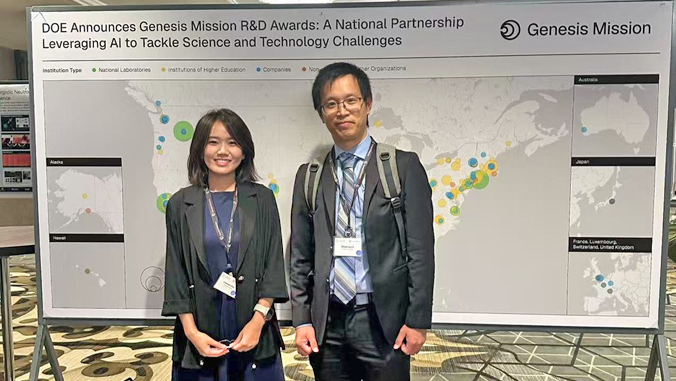
two people ah Manoa Selected projects will be led by researchers from the Department of Electrical and Computer Engineering and the Department of Physics and Astronomy.
A.I. Critical infrastructure security
One of the projects, led by Assistant Professor Liuwan Zhu in the Department of Electrical and Computer Engineering, focuses on improving security and reliability. A.I. Systems used in critical infrastructure. a project called stratos (Security and Trust Runtime Architecture for Time-Critical Operational Sciences). A.I. Security platform designed to detect and respond to targeted cyber threats A.I. A system used for real-time operations such as power grid management and forecasting.
The research team will test the technology using a dual-site platform that includes: ah Manoa Argonne National Laboratory Campus Microgrid and Real-Time Computing System. The project includes collaborators from Old Dominion University and Argonne National Laboratory.
A.I. Advance the search for extremely rare decay processes
The second project is led by Professor Zepeng Li from the Department of Physics and Astronomy. A.I. Fundamental models supporting the search for neutrino-free double beta decay, one of the most important unanswered questions in nuclear and particle physics. Neutrino-free double beta decay is an extremely rare nuclear process that, if observed, could help scientists better understand the nature of neutrinos, mysterious “ghost particles” that are abundant in the universe and constantly pass through us without interacting. In particular, this rare decay process could tell us whether a neutrino is its own antiparticle.
Researchers around the world are investigating this phenomenon using different types of detectors, but each experiment typically relies on its own specialized software and analysis techniques. Lee’s projects aim to create something shared. A.I. The framework can learn from data across multiple detector technologies, helping researchers identify patterns, analyze results, and improve coordination between experiments studying this rare event. In this project, the unified A.I. Accelerate exploration of this rare process with a framework that streamlines data analysis across the different detector technologies used in neutrinoless double beta decay experiments.
Genesis missions come together Department of Energy Laboratory and university combine cutting-edge technology A.I.high performance computing and scientific expertise. ah Manoa It was one of 168 universities selected for the first round of the Genesis Mission Project, which included a total of 278 research activities involving more than 340 institutions nationwide. Through these projects, ah Researchers will contribute new applications. A.I. While strengthening the fields of fundamental physics, energy systems, and national security, HawaiiThe role of in cutting-edge scientific research.