
As artificial intelligence becomes an increasingly powerful tool for discovering new molecules and materials, researchers are working to understand how and when machine learning models should remain grounded in the physical laws that govern the natural world.
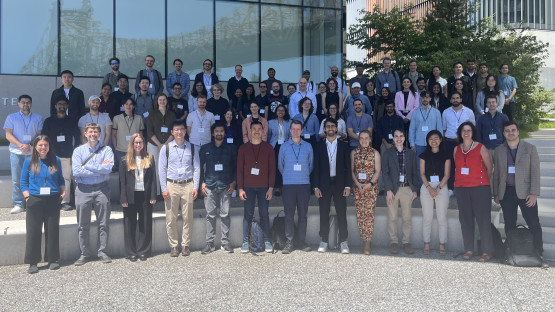
This challenge was the focus of the CECAM Workshop on Physics-Aware Machine Learning for Molecules and Materials, held June 1-3 at Cornell Polytechnic Institute in New York City and hosted by Shwen Yue, assistant professor in the Cornell Duffield School of Engineering’s Robert F. Smith School of Chemical and Biomolecular Engineering. The event brought together approximately 80 researchers from universities, national laboratories, and industry, including 28 invited speakers from the United States, Canada, United Kingdom, Germany, Switzerland, India, and Australia, to explore how AI can improve predictions of molecular behavior, accelerate materials design, and advance scientific discovery while maintaining accuracy, interpretability, and reliability.
The three-day program featured presentations, poster sessions, and discussions aimed at identifying common challenges and exploring areas for cooperation. Together, these discussions highlighted the field’s biggest open questions and identified future research priorities in machine learning for molecular and materials science.
Discussions focused on approaches to incorporating physical laws such as symmetry and conservation principles into machine learning models, as well as ways to improve model interpretability and quantify uncertainty in AI-driven predictions. Participants also considered ongoing challenges in the field, such as how to incorporate complex physical phenomena such as charge transfer, while discussing when physics knowledge is essential and when increasingly powerful data-driven models are sufficient. A recurring theme was that future progress should be measured not only by predictive accuracy on benchmark datasets, but also by the ability of models to generalize to real-world scientific problems and match experimental observations.
“This workshop brought together some of the world’s leading researchers to challenge conventional thinking and ask fundamental questions at the forefront of AI in molecular and materials science,” Yue said. “Ultimately, we need machine learning models that give us the right answers for the right reasons.”
The event was sponsored by a number of organizations, including the European Center for Computational Atoms and Molecular Sciences (CECAM), Cornell Duffield Polytechnic Institute, Cornell Research & Innovation, Cornell AI Initiative, Princeton University’s AI for Accelerated Innovation Initiative, New York University, AI Research at the University of Virginia, Schrödinger Inc., DE Shaw Research, Radical AI, and Mirror Physics.


