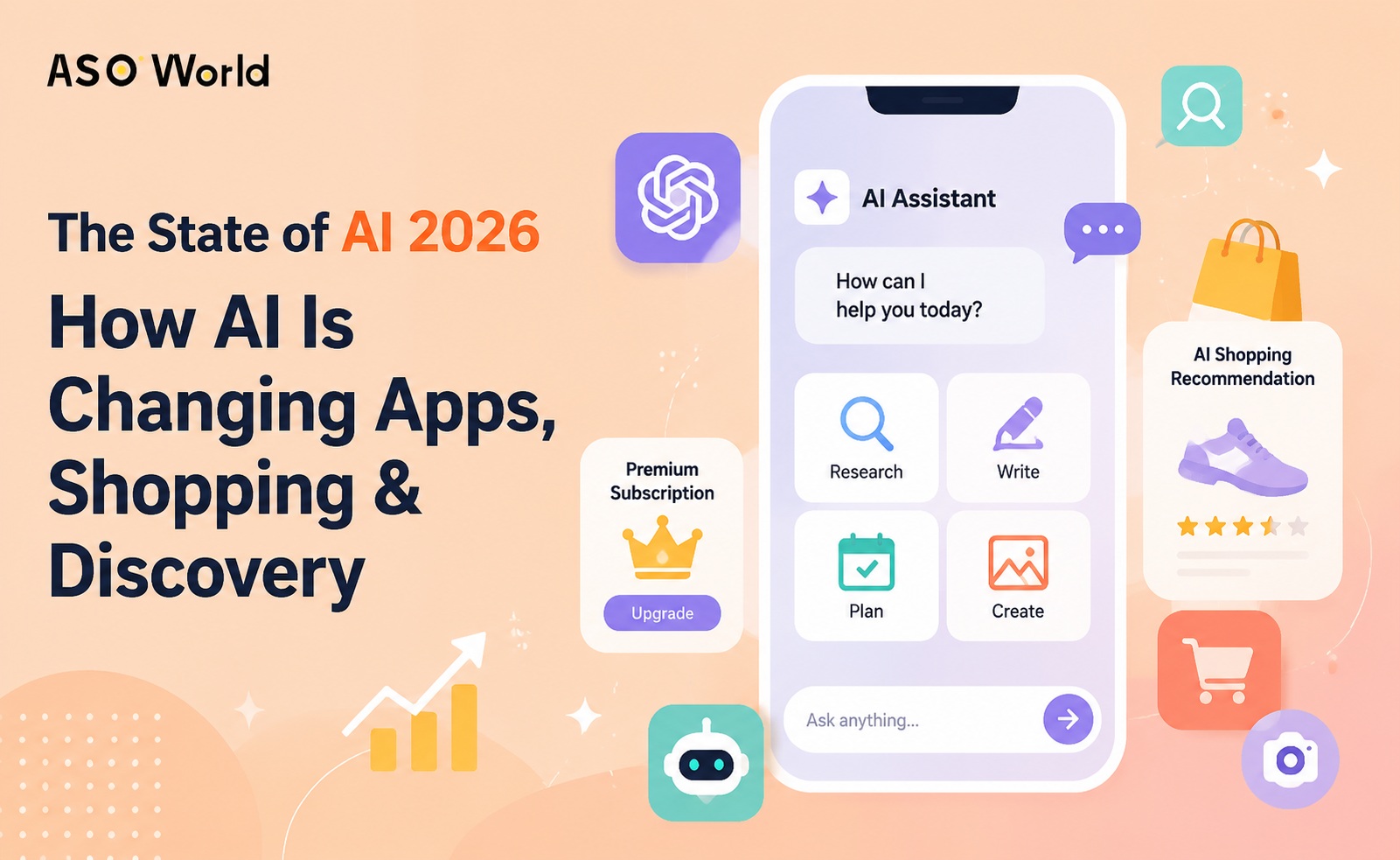
AI assistants, premium subscriptions, retail referrals, and “AI” keyword discovery are reshaping the way people search, shop, work, and choose mobile apps.
Generative AI is moving beyond the early adoption stage and becoming everyday consumer behavior in mobile apps and across the web. According to the latest information from Sensor Tower The state of AI 2026 According to the report, the global time spent on generative AI apps is expected to reach 36 billion hours in the first half of 2026, more than double the 17.2 billion hours recorded in the same period in 2025.
This growth is indicative of broader changes. AI is no longer just a technology layer within a product. It’s becoming a destination, a discovery engine, a shopping assistant, a productivity interface, and a monetization category in its own right.
AI assistants are gaining traction, but the race is on again.
ChatGPT remains the leading AI assistant in terms of scale. Sensor Tower reported that ChatGPT will become the fastest mobile app to reach 1 billion monthly active users in May 2026, reaching this milestone in about three years. The report also noted that ChatGPT, DeepSeek, and Google Gemini together accounted for nearly 90% of the total time spent across AI assistant apps in Q1 2026.
However, the AI assistant market is not locked down. ChatGPT’s “true audience” share, which measures unique users across mobile apps and the web, reportedly fell below 50% for the first time in March 2026. While rivals like Google Gemini and Claude are gaining traction, Claude’s US audience share has more than tripled on the back of strong web usage.
This creates a more complex market than we saw during the first wave of consumer AI. Categories are concentrated but not static. Users are starting to choose different AI tools for different tasks, including search, writing, coding, image generation, inference, research, productivity, shopping, and professional workflows.
AI app revenue is shifting to utility-driven subscriptions
Consumer spending on AI apps is also accelerating. Sensor Tower expects global in-app purchase revenue from AI apps to exceed $4 billion in the first half of 2026, an increase of 36% from the second half of 2025.
The key trend isn’t just that users are paying for AI. That’s why they’re paying. The best AI apps are increasingly positioned as practical tools rather than entertainment experiments. Users subscribe to AI products because they can save time, improve output quality, support work tasks, automate research, generate creative assets, and enhance learning.
For example, Claude’s average mobile revenue per user in the US reportedly increased from less than $0.50 in September 2025 to $2.76 in May 2026. This type of ARPU movement suggests that premium AI products can transform once users clearly understand the value of advanced features.
AI is becoming the discovery channel for shopping
One of the report’s most important findings is the rise of AI-powered commerce discovery. Generated AI referrals to shopping websites increased across all major retail categories from Q4 2024 to Q1 2026.
This is important as AI assistants begin to influence the path between intent and purchase. Instead of opening a search engine, marketplace, or social platform first, consumers can ask an AI assistant to compare products, summarize reviews, recommend alternatives, or explain which options fit their specific needs.
Sensor Tower also highlighted Rufus, Amazon’s AI assistant, noting that shoppers using Rufus convert at nearly twice the rate of non-users. This is just one example, but it points to a larger pattern. This means that AI interfaces can shorten the distance between research and trading.
For developers and product teams, this could change the way apps, tools, and digital services are discovered. Traditional search optimization remains important, but as AI systems mediate discovery, AI-readable product information, clear positioning, structured content, and strong user signals are likely to become even more influential.
“AI” has become a search signal in the app store
The report also shows that AI is directly transforming mobile app discovery. According to Sensor Tower, keyword searches for “AI” have led to a surge in U.S. app downloads over the past two years. Over 200,000 apps now mention AI in their descriptions, and they are on track to reach 10 billion downloads worldwide by the first half of 2026.
This doesn’t mean all apps should simply add “AI” to their metadata. As markets become more crowded, general positioning can become less effective. Users are becoming more familiar with AI features and are becoming more selective about what they find useful. Keywords may get attention, but retention depends on whether the product solves a real problem.
A better strategy is to describe AI in terms of user outcomes. That means faster editing, smarter planning, automated summarization, personalized recommendations, improved search, better learning, more accurate decision support, and more.
AI-themed advertising is entering a more competitive stage
AI is also becoming a major advertising theme. Sensor Tower reports that U.S. digital ad spending on AI-themed creative reached $1.3 billion from January to May 2026, a 48% year-over-year increase.
This increase in spending reflects both opportunity and saturation. In the early stages of the AI boom, “AI-powered” messaging could stand out on its own. In 2026, the term will become commonplace across productivity, education, photo editing, finance, shopping, health, entertainment, and enterprise software categories.
That means the next stage of AI marketing is likely to be more tangible. Instead of “This app uses AI,” the winning message might be “This app can help you complete this task more efficiently thanks to AI.” Performance creatives, onboarding, pricing pages, and app store screenshots should immediately demonstrate use cases.
Web AI usage is increasing along with mobile
The expansion of AI is not limited to mobile apps. Sensor Tower reports that generated AI websites generated more than 67 billion visits and approximately 23 billion hours in the first quarter of 2026, an increase of 28% and 41% year over year, respectively.
This web growth is important because many advanced AI workflows remain browser-first. Professional users often prefer web interfaces for long prompts, file handling, coding, research, and multi-step workflows. Mobile, on the other hand, supports everyday access, quick answers, voice interaction, camera-based input, and lightweight productivity.
The result is a multi-platform AI market. Successful products may need to go beyond an app-only or web-only strategy and be designed for continuous use across devices.
What should developers focus on next?
The AI app market in 2026 will be defined by three simultaneous factors: mass consumer adoption, intense platform competition, and rising expectations for product quality.
- Discovery is changing: Users are discovering apps through AI-related searches, AI assistants, app stores, social platforms, and retail-style recommendation flows.
- Utilities are driving revenue: When AI solves repeatable, high-value problems, consumers are more willing to pay.
- AI assistants are becoming the gateway. These are increasingly influencing the way people search, shop, compare and choose tools.
- General AI branding is weakening. Clear use cases and measurable outcomes are becoming more important than broad AI claims.
- Cross-platform behavior is important: Many users move between web and mobile depending on the complexity of their tasks.
The next stage of AI app growth is about more than just evaluating model performance. It will reward distribution, trust, ease of use, personalization, and clear product-market fit. For developers and marketers, the central question is changing from “Can we add AI?” “Can AI create habits that users are willing to maintain and pay for?”
FAQ
Why is time spent on generative AI apps increasing so rapidly?
Generative AI apps are increasingly helping us with everyday tasks like writing, research, coding, imaging, learning, planning, shopping, and more. When users find repeatable value, engagement increases.
Are AI apps still dominated by ChatGPT?
Although ChatGPT remains the largest AI assistant by scale, competitors such as Google Gemini, DeepSeek, and Claude are also gaining increasing use in certain markets and workflows.
What does this trend mean for AI app marketing?
AI app marketing should focus on clear use cases, app store visibility, conversion optimization, retention, and differentiated positioning. Simply adding “AI” to an app’s metadata is no longer enough in a crowded market.