Since arriving at UNSW in 2005, Professor Fabio Luciani has worked on machine learning in the field of systems immunology.
Since he first joined UNSW, Faculty of Medicine Professor Fabio Luciani has been applying computational biology and machine learning to understand how the immune system works in health and disease. Throughout his career, his research has combined computational biology, statistics, and machine learning, fields that now form an important part of modern artificial intelligence (AI).
We will focus on autoimmune diseases, one of the biggest challenges in biomedical research, where the immune system mistakenly attacks the body’s own tissues as a result of both environmental and genetic factors. Professor Luciani’s research focuses on unraveling the complex factors surrounding the causes of these diseases.
“The number of autoimmune diseases is increasing and rare diseases are being discovered,” Professor Luciani said. “Common diseases such as type 1 diabetes, multiple sclerosis and celiac disease are on the rise. Approximately one in four adults has an autoimmune disease, none of which is curable. This is a huge problem in terms of the health status of our society.”
Over the past decade, technologies such as imaging and genomics have allowed researchers to dissect the mechanisms that cause this disease.
“We have worked hard to apply machine learning and AI-driven data analysis to analyze these signatures, which are the molecular mechanisms that can explain the causes of autoimmune diseases.”
Comparison of machine learning and AI-generated models
Professor Luciani is one of the founding members of the UNSW Cellular Genomics Futures Institute. The institute is contributing to advances in single-cell genomics, allowing researchers to study DNA, RNA, and proteins at the single-cell level.
“This gives us a huge amount of data on autoimmune diseases. We are using genomics, single-cell techniques, and machine learning on autoimmune disease datasets all together,” Professor Luciani said.
Early on, we had to develop machine learning techniques to identify what was needed.
“For example, we were interested in proteins called T-cell receptors, which are proteins that are a very important part of the immune system used to recognize foreign antigens. In the context of autoimmune diseases, we needed a way to identify these T-cell receptors one at a time on each cell, so we needed to develop a technology to do that,” Professor Luciani said.
These approaches combine statistical modeling and machine learning and form part of a broader range of AI techniques that have continued to evolve over the past two decades.
“Large datasets were fed into these models, and the models provided predictions. The modeling was learning in an informed way rather than generatively.
“Machine learning still uses techniques that allow us to interpret machine behavior. However, with large language and generative models, the results can be much more difficult to interpret. They can make predictions, but they don’t tell us how.”
This is the fundamental difference in Professor Luciani’s laboratory. He and his team are still hard at work interpreting what the model does. They want to predict what’s wrong with autoimmune diseases, but they also want to understand how.
Innovators in understanding protein shapes
The Nobel Prize in Physics and Chemistry, to be awarded in 2024, is a major breakthrough for the field of medical research. These two awards recognized mathematical models used in AI and how they have been successfully used to predict the structure of proteins, the building blocks of life.
For Professor Luciani and his team, knowing the shape of proteins in the body has changed the way autoimmune diseases are studied.
“It has helped us in so many ways, from understanding the effect of that mutation on a protein if you are born with it, to designing new drugs to help treat it,” Professor Luciani said.
Initially, the team applied machine learning techniques to genomics data. Their current approach combines these approaches with generative AI models that can predict protein structure and interactions.
“We have been studying T-cell receptors from a genomic perspective for many years, and now from a protein perspective as well.
“We’re looking at their 3D shape, which is really important because they recognize antigens, foreign bodies, viruses, self proteins, and that’s where autoimmunity comes in.”
“No one knows what causes autoimmune diseases. We are combining AI tools to answer complex questions about what happens when you have an autoimmune disease and how immune cells go out of control,” Professor Luciani said.
Looking to the future to deliver research that has real impact
In January 2026, Professor Luciani expanded his laboratory from UNSW to the Westmead Institute for Medical Research (WIMR) and was appointed as Director of Functional and Immunogenomics Research Strategy.
“Together with my team, I will help drive major research programs at the intersection of immunology, genomics, bioinformatics and artificial intelligence, with a focus on improving outcomes for immunocompromised patients and transplant recipients,” said Professor Luciani.
This opportunity will complement his research into acquired mutations, which are “exploding” internationally.
“Rather than being inherited at birth, some immune cells acquire genetic mutations during a person’s lifetime. These are known as somatic mutations, and we believe they can fundamentally alter how immune cells behave, making them ‘rogue’ and contributing to autoimmune diseases.”
This idea of looking for somatic mutations as the cause of autoimmune diseases is currently being studied by researchers around the world. Professor Luciani and his team are world leaders in this field, but the technology to generate the data required by machine learning tools is prohibitively expensive.
“This research was made possible by the multidisciplinary team we put together. We needed clinicians who were willing to recruit patients, technical assistants in the lab, experts in immunology, genomics people who understood how to direct DNA and RNA at the single-cell level, and experts in machine learning. It’s a very skilled team that we had to build,” Professor Luciani said.
What Professor Luciani particularly likes about AI is that this technology can be very helpful from an equity, diversity, and inclusion perspective.
“We are all hungry for data. This is the perfect way to eliminate all kinds of discrimination. I am very confident that AI will be a great solution to make things more fair,” Professor Luciani said.
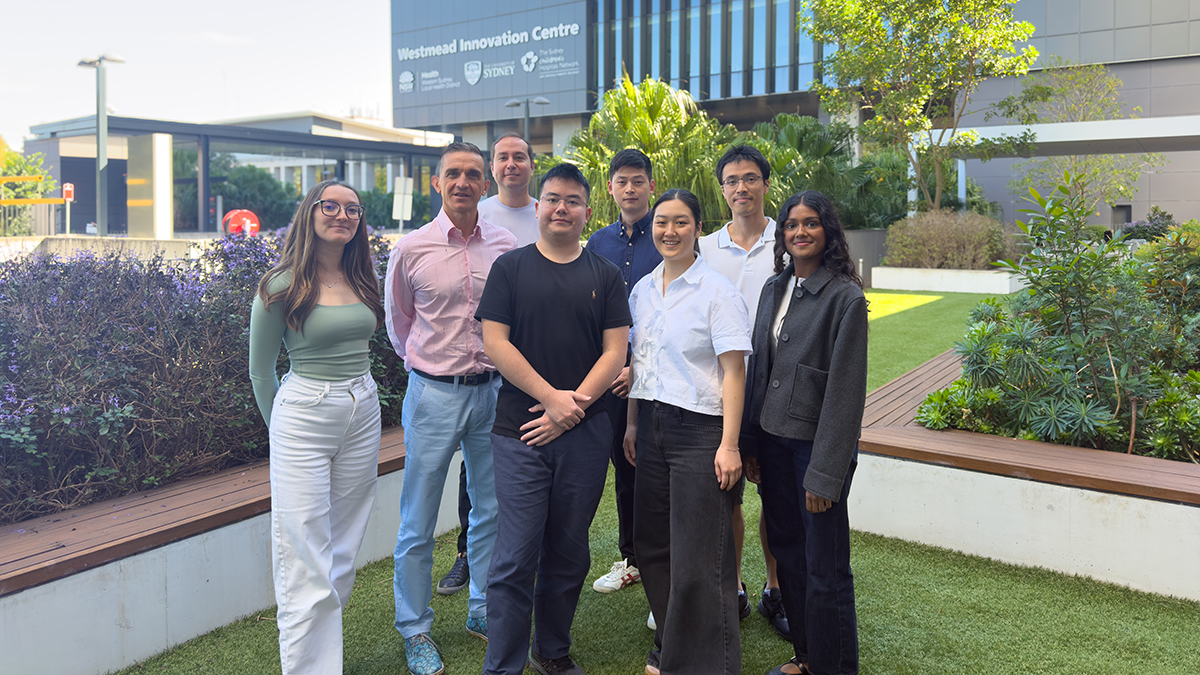
Main image: Martina Bonomi (doctoral student), Professor Fabio Luciani, Armand Safavi (postdoctoral fellow), Michael Lee (doctoral student), Jun Xin (research assistant), Anna Liu (honors student), Jackie Shi (research assistant), Cher Olivo (honors student).