
Humanity has many powerful tools in its cognitive arsenal. Language, abstract thinking, theory of mind, and many other factors define us as animals. One of our most powerful tools is pattern recognition. Pattern recognition is built into the foundational ground level of our cognitive structure.
Pattern recognition works at a basic fight-or-flight level, allowing us to respond quickly to threats to our survival. It also works much more slowly and in a more focused way, like when scientists look for patterns in large collections of data.
Our pattern recognition software is error prone. Pareidolia is the phenomenon of seeing patterns that don’t actually exist. For example, you can see what looks like a face in a simple rock, like the man in the moon. People have found meaning in seeing religious figures depicted on bread or hearing the lyrics of a song backwards.
Pattern recognition is probably the basis of all artificial intelligence. AI can process vast amounts of data and find important patterns much faster than humans. But sadly, new research shows that AI’s pattern recognition is just as prone to failure as ours. The study shows how easily AI can be fooled when tasked with detecting life, which will be needed in future missions searching for life on other worlds.
The study, titled “Can AI detect life? Lessons from artificial life,” will be presented at the 2026 Artificial Life Conference in Waterloo, Canada, in August. The authors are Ankit Gupta and Christoph Adami of Michigan State University.
“Modern machine learning methods have been proposed to detect life in extraterrestrial samples by exploiting their ability to distinguish between biological and non-living samples based on training models using mixtures of natural and synthetic organic molecules,” wrote Gupta and Adami. In this study, the researchers showed that these systems can tell with 100% certainty that the sample being studied is living, even when it is not. “This is because modern machine learning techniques tend to be easily fooled by out-of-distribution samples.”
What is *distributed sample*?
Machine learning systems are trained on datasets with implicit distributions. Consider an AI image recognition system designed to distinguish between dogs and cats. All breeds of dogs and cats are part of the implicit distribution. But what happens when a horse shows up? This horse is *not eligible for distribution*. Will the AI system confidently declare that the horse is a dog?
This is a simple example, but what if AI was responsible for distinguishing between living and nonliving things at the molecular level?
“Because extraterrestrial samples are very likely to fall outside the distribution provided by terrestrial biotic and abiotic samples, the use of AI methods for life detection is likely to result in significant false positives,” the authors write.
In future missions, AI will be tasked with detecting life. There is no known universal chemical biosignature, so efforts are underway to understand what types of molecules are alive based on their fundamental properties.
“One of them is that life needs to encode information,” study co-author Christophe Adami said in a press release.
DNA is a chain-like molecule that encodes and transmits information. The researchers used that fact to test how well AI could distinguish between molecules that could process information and those that couldn’t. Those who can do it are alive, but those who can’t are not alive.
This work used software called the Avida Digital Evolution Platform (Avida). This is an artificial life software platform used by scientists to study evolutionary biology. Using Avida, researchers create digital organisms. Digital organisms are self-replicating computer programs that mutate, compete for resources, and artificially evolve. This is powerful because researchers can use it to study natural selection and adaptation in silico.
Inside this petri dish of microprocessors, the digital organism replicates itself over and over again, each time introducing small errors and mutations. Computer code changes little by little, just like the genetic code of living things.
Researchers started by generating tens of thousands of digital creatures. Some of them contain instructions to reproduce themselves, others do not. These constituted a distribution sample, and the researchers trained a neural network to recognize all of them as living or non-living. The neural network correctly distinguished both types with 99.7% accuracy.
Once that sample was established, the researchers then introduced an undistributed sample, or untrained molecule.
“Here, we use Artificial Life to test whether an AI classifier can be tricked into misclassifying potential biomarker molecules that are polymers made from a specific alphabet,” the researchers wrote.
They first introduced digital organisms into neural networks that were easily recognizable as unable to copy themselves. Then, they gradually replaced parts of the code that prevent organisms from replicating themselves. The AI was confused and after just 150 code modifications, it confidently declared that it had detected life, even though digital organisms could not replicate it. “We found that after 150 executions of the model query, the spoofing confidence was 100% for all executions,” the authors wrote.
“We were able to fool the AI 100% of the time no matter what order we started the commands in,” said Gupta, a doctoral student in computer science and engineering at MSU.
There are many command sequences that can fool the system. “Therefore, the chances of encountering such a sequence are quite high,” Adami added.
Imagine a spacecraft on an astrobiology mission to Mars or somewhere else. Its AI is trained on data from life on Earth. It is highly likely that you will come across something that is not in the distributed sample. That way, even if we haven’t discovered life, we can still claim to have discovered life. Only later, after the data is audited by the human mind, can we know for sure.
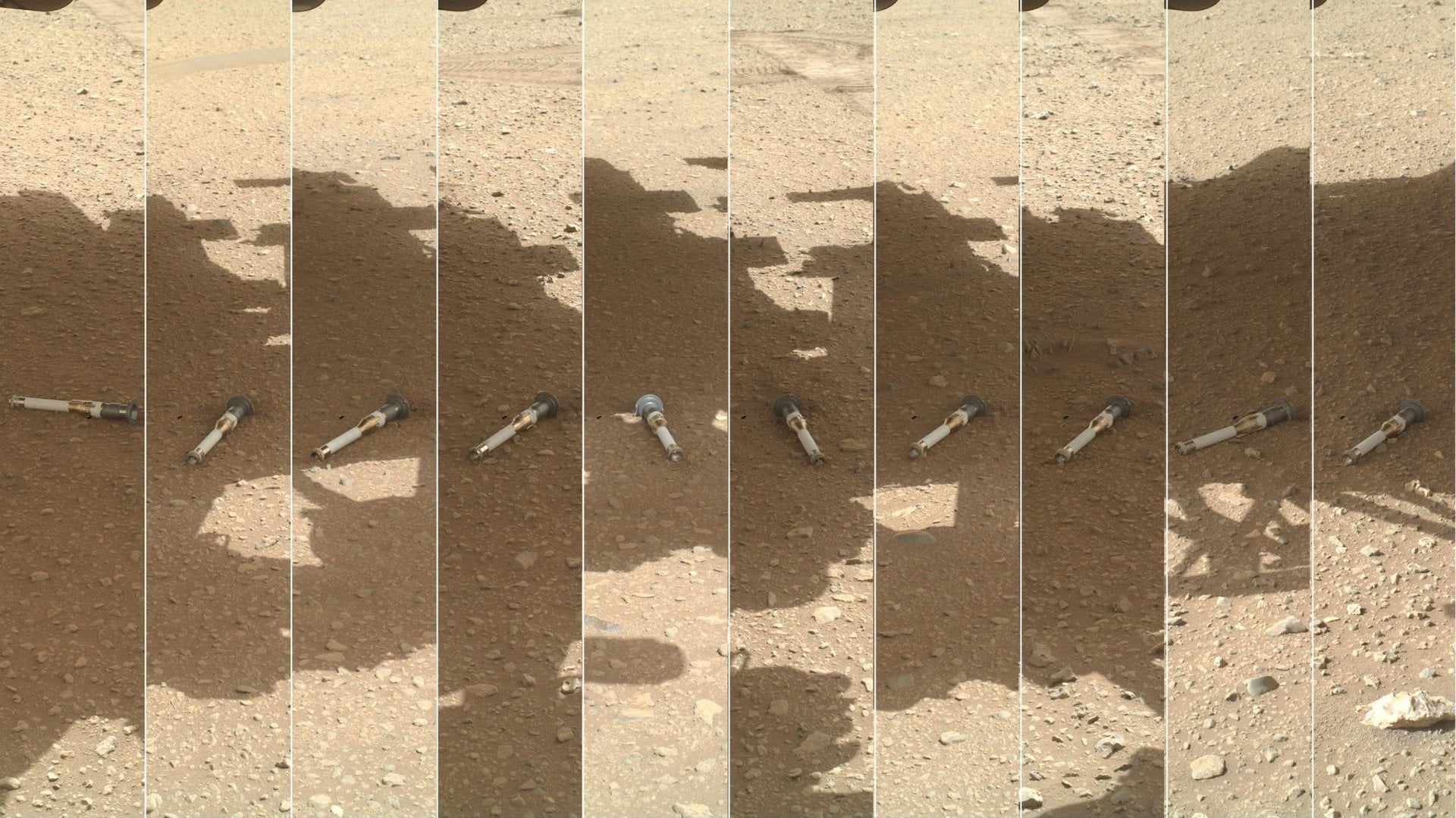 *This image shows part of a sample tube collected by the Perseverance rover during its stay on Mars. They will eventually return to Earth, at least hopefully. But what if future rovers collect samples and use AI to determine whether evidence of life exists? This approach could be plagued by false positives and would likely require human fact-checkers. Image credit: NASA/JPL-Caltech/MSSS*
“AI has an Achilles heel,” says lead author Adami. “You can recognize a pattern and completely misclassify it.” His words carry weight. Adami is a professor of microbiology, molecular genetics, physics, and astronomy at MSU, as well as one of the original designers of the Avida software.
The next step for researchers is to train the AI on real-world data and see how easily it can be fooled.
Most of us have used LLMs and witnessed LLMs being confident about things that just aren’t true. If you’re looking for a restaurant in a new city or asking a restaurant about vulcanized rubber or a million other pretty trivial things, that might not matter much. But the stakes are even higher when you play a leading role in a multibillion-dollar scientific mission to another world.
“We conclude that if the number of false positives (false high-confidence fixed points) outweighs the true positives (because they are outside the distribution on which the AI was trained) in samples from extraterrestrial measurements, then there is a risk of accepting high-confidence classifications at face value,” the authors explain.
This study highlights what is becoming very clear. That means AI needs fact checkers. I’m not saying that AI isn’t valuable, just that it has limitations.
“We need an independent way to check their work,” Adami said. “Humans need to be involved.”
This is extremely difficult to implement in a space mission. The Perseverance rover is collecting and caching samples for eventual, hopeful return to Earth. What if another, more advanced, future rover did the same thing, using AI to recognize traces of extraterrestrial life in its samples? That would cause excitement, but we won’t really know until the samples reach a lab on Earth.
False positives are even more inconvenient. This could be catastrophic. “This is a very serious vulnerability,” Adami said.
“If the proven vulnerability of AI methods to high-confidence failures outside the scope of distribution is transferred to AI-informed life exploration, the use of such methods in space missions is likely to undermine public confidence in astrobiology missions,” the authors conclude.


