
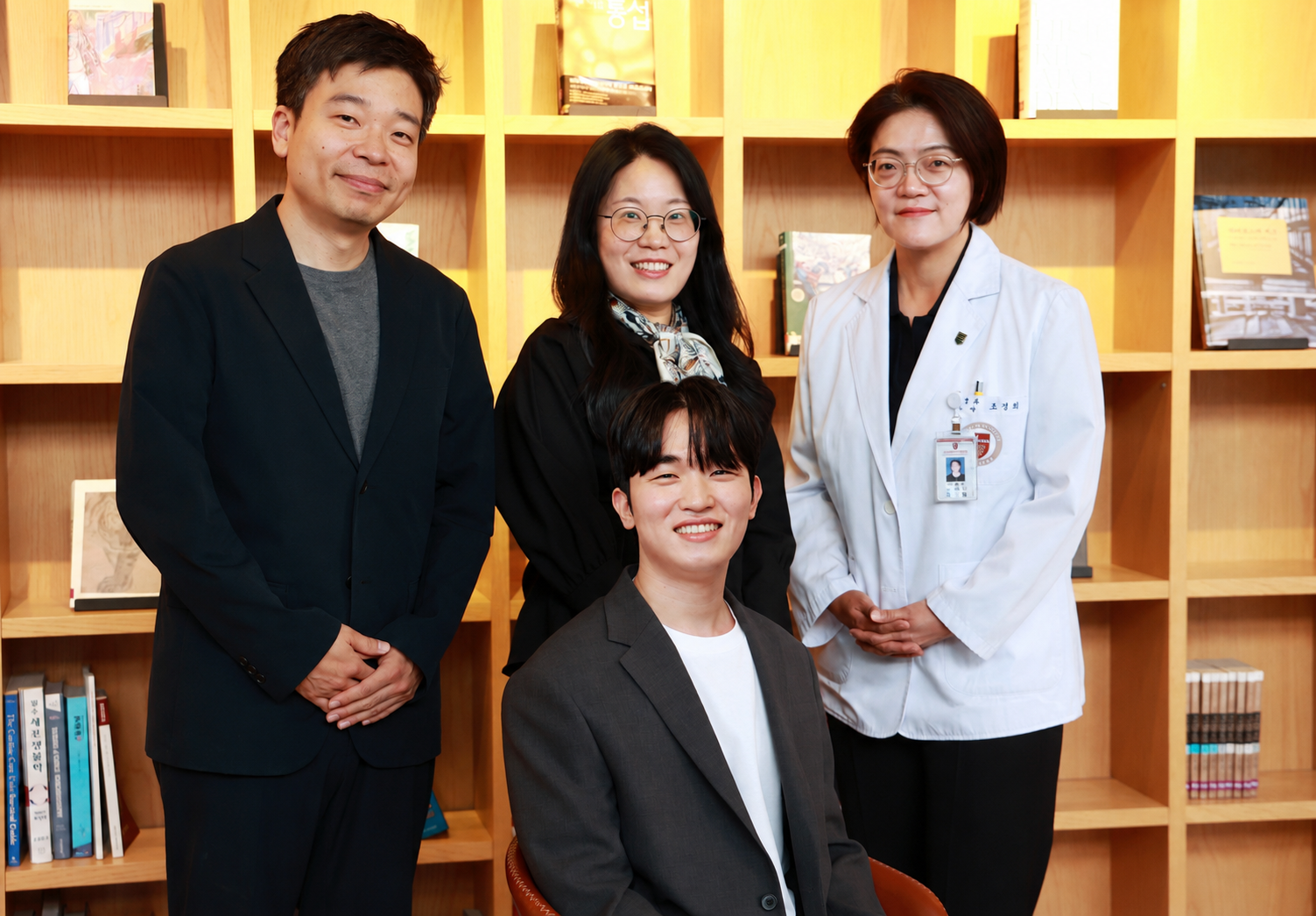

< 研究チームのメンバー 左から成均館大学のチョ・ウン・チョン教授、KAISTのリサ・リム教授、高麗大学安岩病院のチョ・キョンヒ教授、下段がKAIST応用科学研究所のジョンヨプ・ペク博士。 >
Cerebrovascular disease can cause serious sequelae if treatment is delayed, but it is difficult to detect it before symptoms appear. KAIST researchers have developed an AI technology that analyzes real-life daily activity and environmental data of older adults and identifies digital behavioral markers of cerebrovascular disease risk based on subtle changes in the home.
KAIST (Chairman Bae Choong-sik) announced on July 12 that a research team led by Professor Lisa Lim of the Department of Civil and Environmental Engineering has developed an AI framework in collaboration with Professor Cho Eun-chung of the Department of Electronics and Electrical Engineering at Sungkyunkwan University (President Yoo Ji-beom) and Professor Cho Kyung-hee of the Department of Neurology at Korea University Anam Hospital (Kim Dong-won, Director). uses longitudinal lifelog data collected in older adults’ homes to identify prodromal stages of cerebrovascular disease and assess impending diagnostic risk.
This study is based on lifelog data from 1,224 older adults collected by LivOn Care Co., Ltd. in a real residential setting. The research team analyzed a total of 13,362 two-week lifelog samples and demonstrated the potential for early detection of warning signs through subtle changes in daily life, rather than relying solely on traditional approaches of treating disease once it has already occurred.
The research team developed an AI technology that analyzes daily activity, sleep, circadian rhythm, indoor environment information, age, and chronic disease data to identify the risk stage of cerebrovascular disease. This indicates that changes in daily life patterns, which are difficult to detect through hospital tests alone, may provide important clues for early detection of warning signs of cerebrovascular disease.
Furthermore, by analyzing changes in lifestyle patterns over time, they were able to assess whether a patient is nearing a diagnosis of cerebrovascular disease. When classifying life log data within 4 weeks before diagnosis as the “imminent diagnosis risk period” and data within 12 weeks before diagnosis as the “non-imminent period,” AI was able to distinguish between the two periods with a high accuracy of 96.53%. The results suggest that small changes in daily life may help identify whether a person is at increased risk of cerebrovascular disease, even before they visit the hospital.

< 図1.研究イメージ: この研究では、高齢者の自宅で非接触センサーを通じて収集された活動、睡眠、生活リズム、室内環境データをAIを使用して分析し、健康なグループと診断されたグループの間の「診断前リスクグループ」を特定し、診断の時期が近づくにつれて「差し迫ったリスク」を評価します。 >
Another major feature of this research is that explainable AI is applied not only to determine the presence or absence of risks, but also to identify the lifestyle patterns and environmental factors behind the decisions.
The analysis showed that older people in the prodromal stage of cerebrovascular disease tended to exhibit frequent sustained activity between 10pm and 2am, a time when the body normally prepares for sleep. In other words, irregular life rhythms, such as delayed sleep onset and decreased differentiation between day and night activities, were closely associated with precursor signals of cerebrovascular disease.
The researchers also found that as the time of diagnosis approached, the frequency of continuous nighttime activity from 6pm to 10pm decreased significantly, and the time of inactivity increased. Low indoor humidity, indicative of a dry indoor environment, also emerged as an important factor in identifying imminent diagnostic risks.
The research team hopes that this technology can be used as a digital healthcare tool that can objectively monitor the health status of older adults who have difficulty articulating their condition, while also providing useful early warning indicators for medical professionals and caregivers.
However, the research team explained that this study does not predict the exact onset of cerebrovascular disease or replace clinical diagnosis. Rather, it is an assistive technology aimed at supporting prevention and early medical consultation, which requires prospective validation in a larger group of patients before actual clinical application.
Professor Lisa Lim said, “The key point of this study is not that AI should replace hospital diagnosis, but that it can first detect risk signals from small lifestyle changes at home and connect patients to medical care at the right time.” She added, “We hope that this technology will contribute to the transition from a medical system that treats diseases after they occur to one that supports prevention and early intervention.”
The study, with KAIST’s Dr. Jeongyeop Baek as lead author, was published on June 2 in npj Digital Medicine, a leading international journal in digital healthcare published by Nature Portfolio, with an impact factor of 15.1, ranking it in the top 0.3% of JCR journals.
*Paper title: AI home monitoring of behavioral markers of cerebrovascular disease
DOI: https://doi.org/10.1038/s41746-026-02836-7
This study was also supported by a National Research Foundation (NRF) grant (RS-2025-16068234) funded by the Korean government (Ministry of Science, Information and Communication).
/Open to the public. This material from the original organization/author may be of a contemporary nature and has been edited for clarity, style, and length. Mirage.News does not take any institutional position or position, and all views, positions, and conclusions expressed herein are those of the authors alone. Read the full text here.


