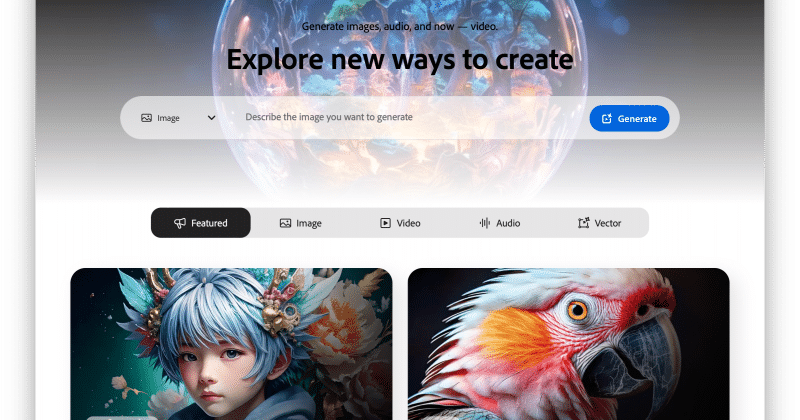
Google just gave video editors the ability to talk to their timeline. Announced on June 30, the company’s new Gemini Omni Flash model is now built within Adobe Firefly, allowing creators to edit videos using plain English text prompts instead of making manual frame-by-frame adjustments.
The important thing to remember here is that this isn’t just a shiny tech demo. It’s a $0.10-per-second pricing model that has the potential to reshape the way content is created in every industry involved in digital media, including crypto marketing, NFT art, and the increasingly visual world of the decentralized creator economy.
What Gemini Omni Flash actually does
This model handles multimodal input. This means you can process text, images, and videos at the same time. In English, you input a rough clip and say, “Replace your character’s costume with a red jacket and make the lighting warmer,” and the AI takes care of the rest.
Tasks like swapping characters, transferring styles, and relighting scenes are all in the menu. This system maintains audio and visual consistency throughout. This has historically been a sticking point for generative video tools.
Adobe isn’t just introducing one model. Alongside Gemini Omni Flash, the company has integrated an image generation model called Nano Banana 2 Lite into the Firefly platform. The strategy is clear. Stack multiple AI models from various partners on top of Adobe’s own tools to create a Swiss Army knife for creative professionals.
Matt Chotin, Adobe’s senior director of products, said the integration will help creators “move from idea to finished content faster through pro-grade tools.”
Trust is more important than you think
To address trust concerns with AI-generated videos, the integration enables C2PA content credentials and SynthID watermarks by default. C2PA is essentially a digital provenance system that stamps content with metadata that indicates where it came from and how it was modified. SynthID is Google’s invisible watermarking technology that embeds machine-readable signals into AI-generated media.
This is something the world of cryptocurrencies should pay attention to. The provenance of content is fundamentally a verification problem, the same kind of problem that blockchain technology was designed to solve. Projects building on-chain authentication layers, decentralized identity verification, and NFT-based content licensing are competing in the same conceptual space as C2PA. When Google and Adobe build provenance tools directly into their creative stacks, it raises the bar for Web3 projects that claim to do the same thing.
A partnership that grows with history
This integration did not happen overnight. Google and Adobe previously collaborated to bring the Gemini 2.5 Flash Image model to Adobe Firefly and Express on August 26, 2025. Its previous rollout included a temporary unlimited generation offer for paid users, which was essentially a loss leader to hook creators into AI-assisted workflows.
With a pricing of $0.10 per second, Gemini Omni Flash is accessible enough for independent creators while delivering significant revenue at enterprise scale. One minute of AI-generated video output costs $6.
What this means for the cryptocurrency and digital asset market
Google and Adobe AI’s partnership isn’t about cryptocurrencies on the surface. However, the second-order effects directly spill over into several sectors adjacent to cryptocurrencies.
First, the creator economy. Platforms like Livepeer, which offers distributed video transcoding, and Render Network, which offers distributed GPU rendering, are betting that AI-driven content creation will dramatically increase the demand for computing resources.
Second, NFTs and digital art. Generative AI models that can produce high-quality video at low cost will fundamentally change the economics of digital art creation. Artists using these tools can iterate faster, create more variations, and experiment with styles that would have required an entire production team just a few years ago.
Third, there’s the tokenized content licensing angle. Blockchain-based licensing protocols like Story Protocol are looking to build the infrastructure for exactly this scenario. The more AI-generated content floods the market, the more urgent the issue of intellectual property attribution becomes.
Competitive pricing is also important for crypto projects that rely on AI models for their products. Google’s $0.10 per second benchmark effectively sets a ceiling on what decentralized AI networks can charge for comparable video generation tasks.