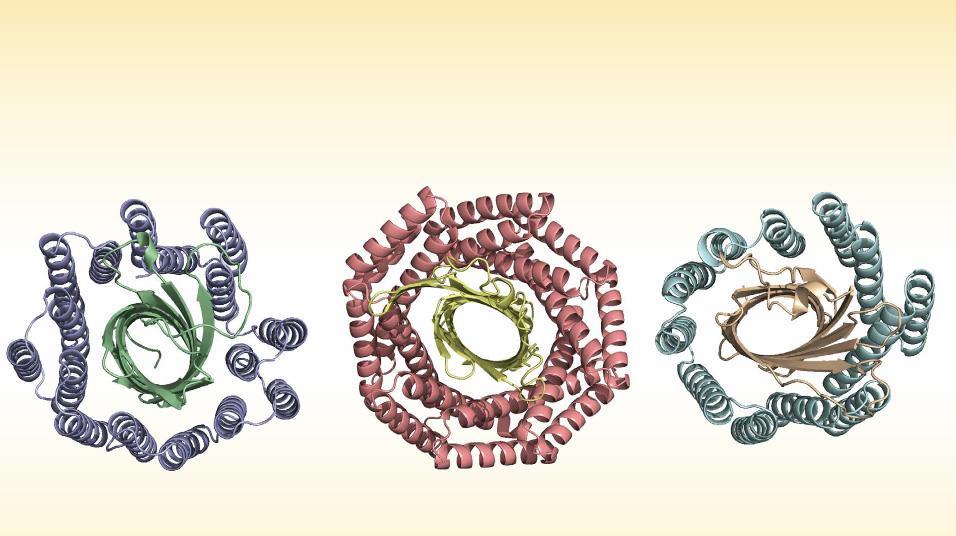
US researchers have shown that protein sheaths designed using deep learning algorithms can be used to solubilize cell membrane proteins without significantly affecting their structure or function. This technique makes it much easier to study membrane proteins and could lead to the development of new drugs and vaccines.
Nearly one-third of the human proteome is comprised of proteins that reside within or span cell membranes, such as receptors and ion channels, and are the targets of more than half of clinically approved drugs. However, they are inherently insoluble in water, making research difficult. “Membrane proteins are embedded in this oily environment, which is the lipid bilayer, so the way to get them out is to use detergents,” explains Ljubica Mihaljevic, a computational biologist at the University of Washington’s Protein Design Institute in Seattle. “It’s like washing greasy dishes. The membrane breaks down and the surfactant micelles wrap around the protein, protecting it from the solvent while allowing it to dissolve in the solution.”
This process is labor intensive and unreliable, meaning that further separation steps are required to isolate the protein before use. In 2015, another US-based research group developed a new approach by surrounding membrane proteins with the naturally occurring apolipoprotein AI.1 This protein is amphipathic. It has a lipophilic interior that interacts with hydrophobic residues on the surface of membrane proteins and a hydrophilic exterior that makes the entire complex soluble in aqueous solution. However, the interaction between apolipoprotein AI and proteins is nonspecific.
rapper’s joy
Mihaljevic and colleagues in the group of David Baker, co-recipient of the 2024 Nobel Prize in Chemistry for computational protein design, used the deep learning algorithm RF diffusion to custom design protein sheaths called Wraps (water-soluble RF-diffusion amphiphilic proteins) tailored to encapsulate the cell-binding regions of specific target proteins while leaving the functional ends free.2 The amino acid sequences of these wraps are genetically encoded and co-expressed with membrane proteins. Escherichia coli Bacteria. The research team used this approach to capture and analyze a variety of membrane proteins.
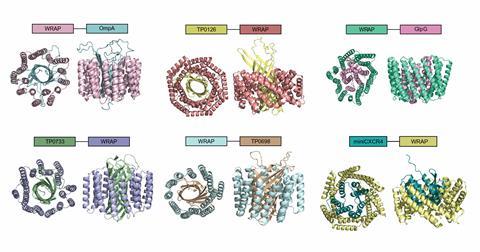
The researchers focused on mycobacterial porin proteins whose structures had previously been solved using traditional methods. “What we can do now is look at structures that have not changed based on previous structures,” Mihaljevic says. “Unfortunately, the other proteins that we were able to wrap were too small to actually solve the structure.” As techniques such as cryo-electron microscopy improve, the researchers hope they will be able to directly see the structure of smaller wrapped proteins.
The researchers then studied other proteins, including the animal’s outer membrane proteins. Treponema pallidum Bacteria that causes syphilis. The researchers used the AlphaFold protein folding algorithm to predict the shape of folded proteins and design wrap sheaths that fit those structures. They discovered that the resulting sheath can bind to proteins and stabilize them in solution. The bound proteins were reactive with serum extracted from rabbits infected with syphilis. Mihaljevic said the current research was “just a proof of concept,” but revealed that collaborating labs are studying the technology’s potential for monoclonal antibodies and vaccines.
“The challenge of solubilizing cell membrane proteins is a huge challenge, and this makes a very important contribution,” said Zhang Liu, a synthetic biologist at the University of California, Irvine. He believes one of the first applications could include biochemical assays of samples isolated from patients. “Even in more general drug development and biological applications, we always face the challenge of not having access to a reliable source of the membrane proteins we use, and I have some confidence that this method, and others in this field, will make a big change in that direction.” He said the technology is promising enough for researchers to start applying it, concluding, “We’ll see use cases where this technology works really well and where other developments are needed.”