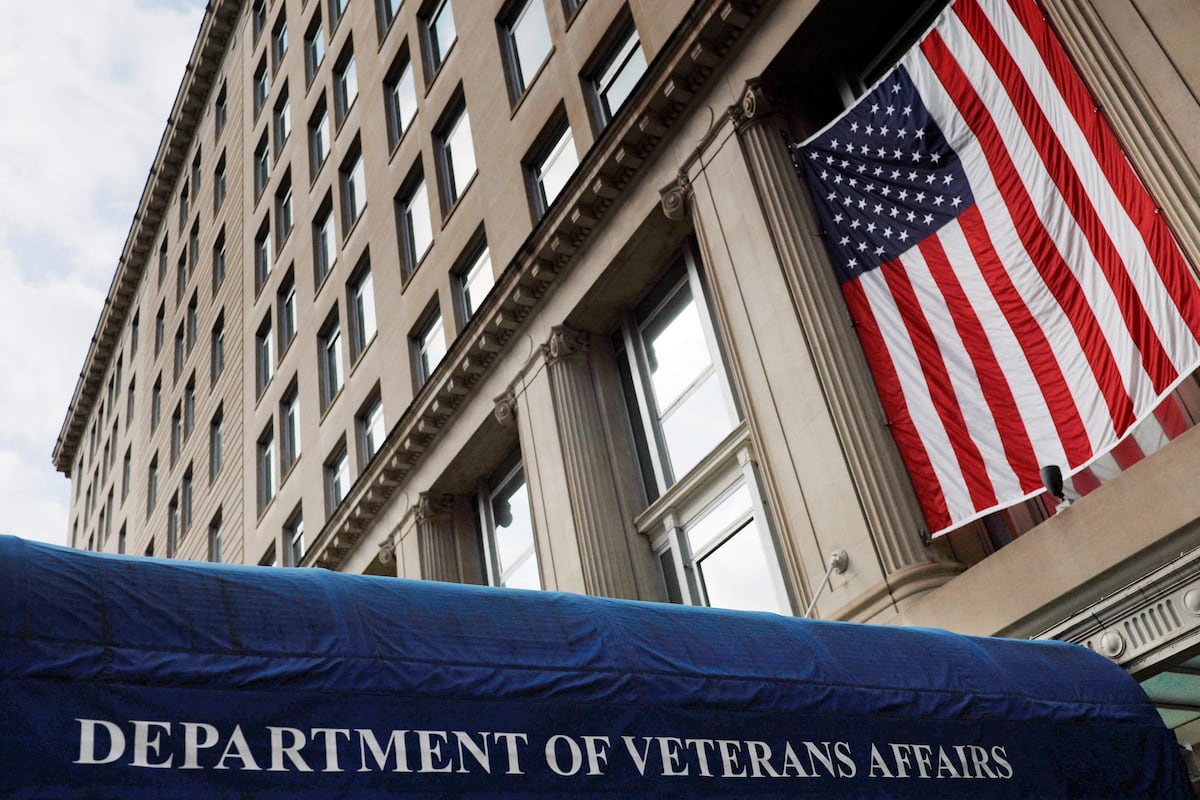
The Department of Veterans Affairs currently has 367 documented artificial intelligence use cases supporting everything from medical appointments and disability claims to customer service and record management. But veterans seeking medical care or VA benefits may encounter artificial intelligence without realizing it.
VA’s recently released 2025 AI Inventory identifies 215 of these use cases as high-impact systems. While Veterans Affairs officials say safety measures and human oversight remain in place, veterans’ advocates argue that veterans are more likely to trust AI systems if they understand when they are being used and what role they are performing.
For Navy veteran Marcus Williams, the issue came to the fore during a recent vet visit. “Yesterday, a nurse asked if it was okay to use AI to help with notes during doctor’s visits,” Williams said. “I was offended that she didn’t look too happy when I told her no.”
Williams said he declined because he was uncomfortable with the use of AI during his visit and did not understand how it was being used in practice. Veterans, advocates, and former VA clinicians interviewed by Military Times described varying levels of veteran awareness about when AI will be used and what role it will play in veterans’ interactions with their departments.
Veterans may not know when AI is involved
Veterans Affairs officials say many veterans may not be interacting with artificial intelligence in the way they think they are. “The term ‘AI’ cannot be used interchangeably with VA’s automated decision support system,” VA spokesperson Quinn Slaven told Military Times. “Automation is limited to doing exactly what it is programmed to do, whereas AI can evaluate patterns in data.”
Slaven said, “At the beginning of the visit, the provider will ask if the Veteran would like to use Ambient AI Scribe and explain how it works. The Veteran can consent, opt out, or ask the provider to turn off Ambient AI Scribe at any time. If the Veteran chooses not to opt out, the provider will record the visit using Ambient AI Scribe.”
Veterans interviewed by Military Times described a variety of experiences with AI use and notifications. Williams said he was asked if he would agree to AI-assisted note-taking during a recent appointment. Tim King, an Army veteran, said he was never asked. “We’ve been getting a ton of emails about it recently,” King said. “I’ve never been asked if it’s okay to use it during a meeting, and I have no intention of allowing it to be used.”
Some veterans said they didn’t know the difference between automation and AI, while others said they saw the technology differently.
Advocates say transparency needs to extend beyond inventory
John Retzer, director of the National Legislative Directorate for Disabled Veterans of the United States, said the Veterans Administration’s public inventory is an important step toward transparency because it provides a unified account of how AI is being investigated and implemented across benefits, health care, and operations.
But Retzer said the inventory is largely operational at a high level, providing limited insight into how systems are monitored after deployment, how performance is evaluated over time, and what accountability mechanisms are triggered when problems occur.
“Veterans would benefit from more detailed, consistent, and publicly accessible information about how these systems work in practice, not just their intended use,” he said.
Retzer explained that veterans should expect clear notice when artificial intelligence is used to make decisions that affect their care and benefits, along with continuous monitoring, strong privacy protections, and meaningful human oversight. But Retzer cautions that human oversight alone cannot answer widespread concerns about whether AI will inform veterans’ medical appointments, records, and benefits experiences when they contribute to that experience.
He said that even if a clinician or claims processor makes the final decision, veterans may receive little information about the documentation supporting that decision or how AI impacted the workflow.
Clinical use raises new questions
Notifications can be especially important in medical settings. In January, the VA Office of Inspector General issued preliminary recommendations identifying potential patient safety risks associated with the Veterans Health Administration’s use of generative AI chat tools for clinical care and documentation.
The watchdog found that VHA lacked a formal mechanism to identify, track, and resolve risks associated with generated AI, and expressed concern that the lack of standardized processes could limit the department’s ability to protect patient safety.
The recommendation states that output generated by approved AI chat tools may be used to support medical decision-making and copied into the veteran’s electronic health record. OIG also noted that generative AI systems can produce inaccurate output that includes omissions, which can impact diagnostic and treatment decisions.
OIG’s review is still ongoing, and the recommendations do not identify specific instances of harm to patients. However, the lack of a standardized process to manage AI-related risks could limit VHA’s ability to identify patterns, improve safety, and address issues related to generative AI tools used in clinical settings, the researchers said.
Clinical documentation can impact future treatment, disability claims, and continuity of care over many years. Missing details or inaccurate entries may require repeat appointments, additional paperwork, or lengthy efforts to correct your records.
Veterans and clinicians recognize both risks and benefits.
Not all veterans view artificial intelligence with skepticism. Helen Cooper, a Marine Corps veteran and former nurse at the Tennessee Veterans Affairs Medical Center, said she welcomes AI-based documentation if it results in more accurate records.
“If I had to choose between AI to help us thoroughly document our visits and the current state of overworked nurses and doctors who blatantly ignore what we say or fill our charts with utter nonsense, I would choose AI,” Cooper said.
“Time and time again, VA physicians completely ignore documenting veterans’ concerns,” she added. “If a robot can’t do the job, we’re happy to let it do it.”
Dr. Charles Faulk, an Air Force veteran and former VA physician, said documentation requirements have expanded dramatically over the course of his career, often forcing clinicians to spend hours completing records after office hours. “The bill burden at the Veterans Administration has probably tripled in the last quarter century,” Faulk said. “Maybe AI will make clinicians’ lives easier.”
But even veterans who support the use of artificial intelligence said they want to understand how it will impact their care. “They need to know what it actually does before it’s okay to use it,” Tim King explained.
DAV’s Retzer said veterans should expect clear notice when AI is used to make decisions that affect their care and benefits, and should be able to understand how those systems will impact their interactions with the veteran.
“AI must not undermine due process, reduce access to earned benefits, or replace necessary human judgment in decisions that affect veterans’ lives,” Retzer said.