
The advertising infrastructure of AI giants like OpenAI is less than a year old. Still, my expectations are high.
According to EMarketer, AI search will become the fastest growing marketing channel, with numbers topping $100 billion.
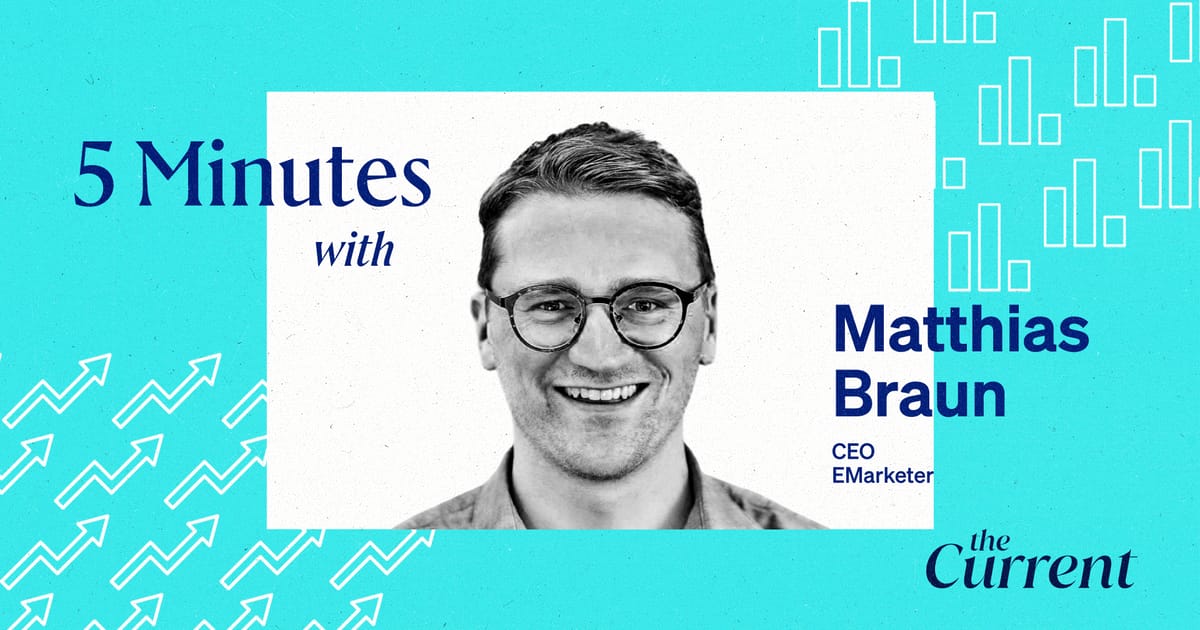
As CEO of EMarketer, Matthias Braun runs one of the most influential research businesses that tracks all these developments. He has a front row seat to how budgets actually work compared to what marketers claim to focus on.
Brown spoke about this and more to Lee Singletary at the Cannes Lions International Festival of Creativity.
This interview has been lightly edited for clarity.
Everyone is talking about AI search right now. Is consumer behavior actually changing in a meaningful way, or is it still relatively early to live up to the hype?
Yes and no. This is a typical researcher’s answer.
Yes, things are definitely changing. We know that half of the US adult population regularly uses an LLM. For the first time since the pandemic, we see time spent with media increasing again, with people spending an average of 16 minutes a day on LLMs and AI. This is a major shift in consumer behavior.
However, there are many things that remain the same. I still often see people searching using traditional methods.
trade desk intelligence published research This shows that 95% of consumers still search the open web even after conducting an LLM search. Do you think that could indicate a trust issue?
There are some very interesting data points that we looked at. First, when you talk to or ask questions of people who use AI regularly, 2 out of 3 people say they prefer LLM answers for detailed information-seeking questions. However, only one in three people said they trusted the answers more than traditional search. So this disparity definitely exists.
What are the predictions for ad spending in AI search?
Our EMarketer forecasts US AI ad search spending to be $68 billion by 2030. This has a very broad definition that includes not only the prompted results themselves, but also the ads that appear next to the AI search results. But we think it’s a huge growth area in that field.
How will AI search reshape traditional marketing and funnels?
There’s a lot of talk about how the funnel will be shortened and the LLM will make it all pointless. I would like to be very careful about that. There are some trends that have been around for a long time.
The things I want to focus on the most are the creator economy and social. I don’t think it can be helped. It will be affected in completely different ways by AI.
For example, in social, the number of campaigns and the number of creative units people are using for a given campaign has increased tenfold. This is an impact of AI, but not necessarily funnel shortening that we’re talking about. Of course, there are areas where I see that happening and where it will have a big impact over time.
At the moment, we don’t see much shopping behavior in LLM. If anything, the AI users we asked in our representative survey actually said they preferred a traditional search experience or shopping in an app.
According to EMarketer, consumers are becoming more price-sensitive, value-oriented, and in some cases even shopping less frequently. At the same time, digital ad spending is also increasing. How can we improve this balance? What is your advice to marketers?
There are three things to note. The first is that overall consumer confidence is at its lowest since we began measuring it.
That’s very scary and I think it applies to your question as well. Additionally, the U.S. digital advertising market is experiencing tremendous growth, with 13% to 14% growth this year.
However, we also see that consumer spending is actually still increasing. This is of course also a reflection of the inflation that we are seeing. So there’s a big gap between consumer confidence and what consumers are actually doing in terms of spending, and marketers should continue to look at that.
Certainly, while brands are realizing that it makes sense to focus on price reduction strategies in some product areas, in others people are still splurging and there are certainly categories where they want to have an experience like they have had in the past.


