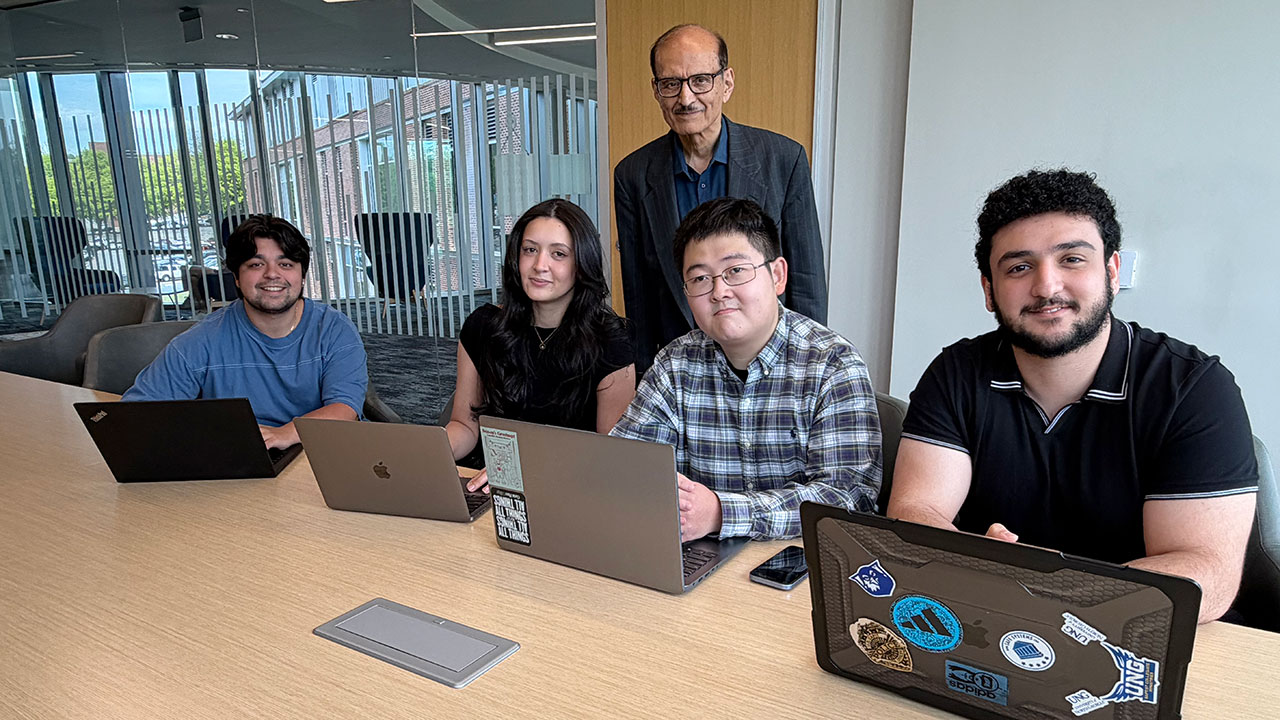
“Research was never in my plans before. My plans were to become a software engineer with a focus on security,” said Burns, a first-generation college student. “Now I love the world of research and contributing to research. I not only want to learn new things, but I want to generate my own ideas and get them out into the world. Having someone to guide you and show you the steps is very helpful.”
Jiayong “Richard” Zheng of Sugar Hill, Georgia, is pursuing a master’s degree in computer science and will receive his bachelor’s degree in computer science in December 2024.
His research is using machine learning models to detect anomalies that could lead to fraud in insurance.
“Working with Dr. Ghaffarian gives me a great opportunity to practice machine learning,” said Zheng, who is also a first-generation college student.
Xavier Alvarenga of Flowery Branch, Georgia, who graduated in May 2026 with a bachelor’s degree in computer science and a minor in cybersecurity, conducted a forensic investigation of Facebook Messenger and its data to detect vulnerabilities. Working with Mr. Ghaffarian helped me understand how to investigate important issues and prepare for my master’s program in cybersecurity.
“This is a great opportunity to open these doors,” Alvarenga said. “Working with Dr. Ghaffarian helped me develop a sense of professional communication. I really enjoyed it.”
Kian Esmaili, who graduated from Woodstock, Ga., in May with a degree in cybersecurity, looked into machine learning models to help test and ensure system updates are secure before rolling them out across the company. He was inspired by the July 2024 CrowdStrike cyber attack. He said his work with Ghaffarian prepared him for graduate school at Georgia Tech, where he will study cybersecurity.
During the Fall 2025 semester, Esmaili and Ghaffarian presented a paper titled “AI-Driven Update Validation in Endpoint Security” at the IEEE Southeastern Conference in Huntsville, Alabama. This paper will be published in the conference proceedings. In the spring of 2026, Esmaeili and Ghafarian conducted research and wrote a paper titled “Misleading performance in Sysmon-based machine learning: The impact of data representation and temporal structure.” This paper has been submitted for possible publication to the prestigious EAI-approved Transactions on Security and Safety Journal.
“I learned a lot from him in terms of research and forensics,” Esmaili said. “Working with Dr. Ghaffarian played a huge role in my admission to Georgia Tech.”
Natalie Torres, who graduated in May 2026 with a bachelor’s degree in computer science, worked with Ghaffarian on a research project aimed at “developing and evaluating a hybrid invoice validation system that integrates deterministic financial management rules and supervised machine learning models to improve detection of high-risk invoices.” A paper on the results of this research is currently in preparation.
“I am passionate about mentoring and involving students in research projects in the field of computer science and cybersecurity. I encourage collaboration with students and provide them with the necessary training, apprenticeships, experiments, and implementation of research projects,” Ghaffarian said. “We believe that through research projects, students learn how to address real-world problems, implement viable solutions, and establish professional networks to build their future careers.”