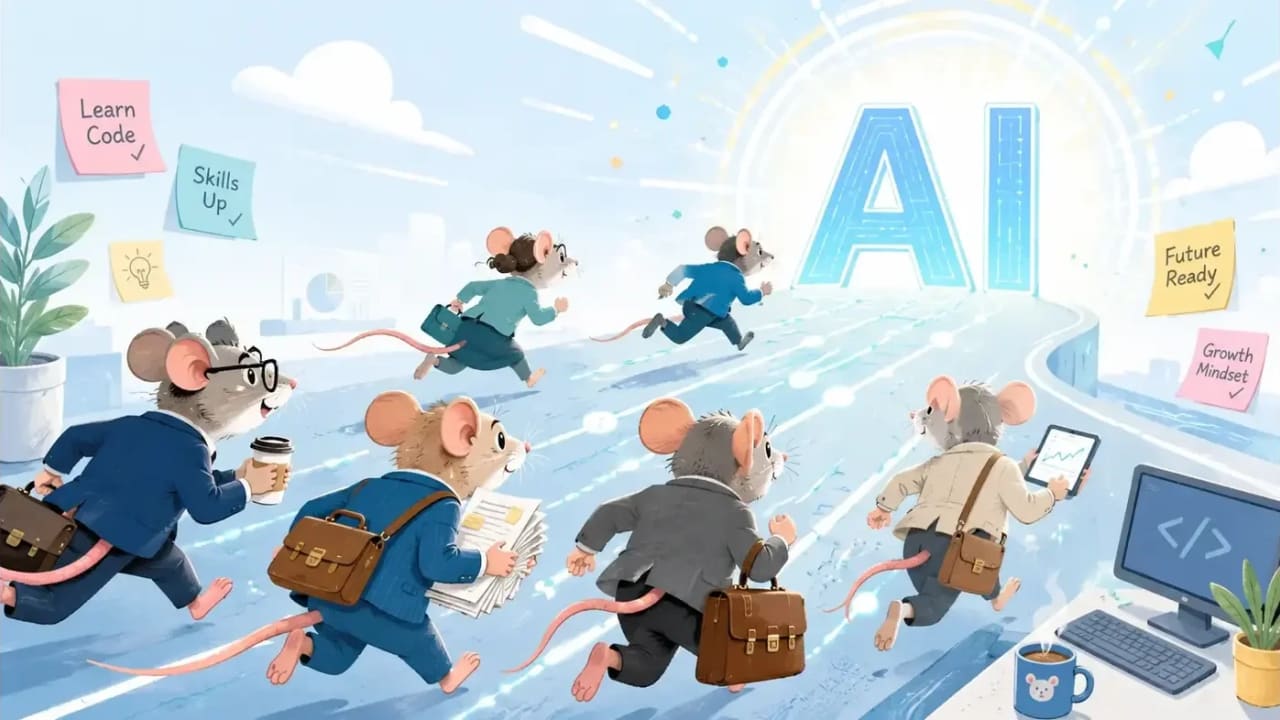
AI was promised to save time. In reality, for a significant number of employees, things are a little different. They still work during the day, but now also study at night and on weekends.
After a full day at work, when your computer should have already shut down, the ChatGPT tutorial opens. Next is a video about Claude. Then there are Cursors, AI agents, automations, prompts, updates, new versions, and another attempt to figure out what exactly the new tool everyone at LinkedIn “must know” does.
In this way, almost without us even noticing, artificial intelligence has created a new race. It’s not just competition with technology, it’s competition with other employees, competition with employer expectations and competition with the labor market, sending a clear message that those who don’t stay informed will be left behind.
New “learning tax”
Until recently, professional learning was an occasional affair: courses, seminars, corporate training, and perhaps an additional degree for those truly invested. However, the advent of the AI era has changed the pace. Learning a new tool once is not enough. I have to keep running.
According to a study conducted by EY (results of which were featured in an article published in Business Insider), 85% of American office workers have learned to work alongside AI agents during off-duty hours. Additionally, 83% of office workers said they taught themselves most of their AI knowledge, and 59% cited a lack of adequate training from their organization as a barrier to developing skills in the field. In other words, employers want workers who know how to use AI, but they don’t always have the time, budget, or framework to properly learn AI.
This is exactly where the new ‘learning tax’ was born. That is, the personal time that employees invest in staying relevant. It won’t show up on your payslip, it won’t necessarily be considered training, and it won’t necessarily be defined as part of the role. But in reality, more and more workers feel they have no other choice.

AI really saves time. The question is for whom?
Importantly, AI can indeed save time. lots of time. BCG’s AI at Work 2026 report found that 42% of employees who regularly use AI save at least eight hours a week, or nearly an entire day. This is a dramatic number and explains why organizations are rushing to implement these tools into nearly every department.
But the big question is, what happens to the time saved? Will the employees get their money back? Is it being used for deeper thinking, professional development, creativity, and strategic work, or will it simply translate into a new expectation of doing more, faster with fewer people?
In quite a few cases, the answer seems to be closer to the second option. Where it once took half a day to prepare a presentation, the first version is now expected to be ready within an hour. It is clear that what once took hours to write a document can now be “let the AI do it.” And if this tool knows how to summarize, draft, check, translate and analyze, why not perform yet another task?
Thus, the paradox of the AI era is born. Technology shortens processes, but it also raises the bar of expectations. Works don’t necessarily disappear. It simply shrinks over time and is then replenished with more work.
And now we also need to monitor the machine
And there’s another side to this competition that’s less glamorous and less talked about. That means AI doesn’t work alone. At least not really. You need someone to write the prompts, know what to ask, check the results, correct mistakes, make sure there are no hallucinations, hone your wording, and be accountable for the results. In other words, employees aren’t just using AI; They are also overseeing it.
Glean’s Work AI Index 2026 report refers to this phenomenon as “bot-sitting,” which is monitoring bots. According to the report, employees spend many hours each week monitoring, modifying, and improving AI output. Rather than performing the entire task themselves, they manage the machines that run it and fix it if they miss a mark.
And it is precisely here that part of the illusion is shattered. AI can write text, but someone needs to know if it’s correct. You can analyze the data, but someone needs to understand whether the conclusions are logical or not. You can suggest code, but someone needs to check that it doesn’t break the system. You can draft an email, but someone needs to make sure it’s not embarrassing, error-free, or legally dangerous.
In other words, new skills are not just about knowing how to “work with AI.” It’s about knowing how to manage it, question it, modify it, and identify when to take shortcuts and when it leads to pitfalls.
Most important skill: keep moving
After all, the story of AI in the job market is not just about whether it will replace workers. This is an important question, but it’s no longer the only one. The more immediate question is how this will affect the remaining workers.
The answer is that it changes the pace of their professional life. This requires students to learn faster, adapt faster, see more, prove more, and above all, not fall asleep while being supervised. In a world where new tools are released every week and updates arrive every month that promise to change the rules of the game, new employees are judged not just on what they know today, but on how quickly they can learn the next thing.
On the other hand, this is also an opportunity. Employees who learn how to properly work with AI can improve performance, save time, unlock new possibilities, and become more relevant. On the other hand, this is also a clear danger of burnout. Because it’s hard to call it peace of mind if every time you save means another task, and every new tool means more homework.
Therefore, the question that employers will have to answer in the coming years is not only “Do our employees know how to use AI?” but also “Who will give them the time to learn?” Who is guiding them? Who pays for training, and how can we ensure that technology meant to make work easier doesn’t become more pressure?
Because right now, for too many workers, the AI revolution looks more like Rat Race 2.0 than a shortcut. You work during the day, study at night, and come back to the office in the morning to find that the tools you finally understood have already been upgraded.