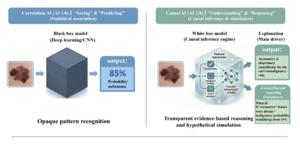
image:
Paradigm shift from correlational AI (1.0) to causal AI (2.0) in dermatology thought processes
view more
Credit: Higher Education Press
Skin diseases affect nearly a third of the world’s population, yet there is a severe shortage of dermatologists, with waiting times often exceeding three months. A new scientific review claims that smarter AI could help close this gap.
The paper introduces “AI Dermatology 2.0,” which is a fundamental shift from pattern matching AI that only answers “what” to causal inference AI that answers “why.” The causal algorithm improved the diagnosis of rare skin diseases by up to 32.9% in the test. The “skin digital twin” also enabled virtual drug trials and 72-hour eczema recurrence prediction with over 90% accuracy.
AI 2.0 can also act as an intelligent collaborator, increasing diagnostic accuracy in primary care from 73% to 82% and potentially reducing the average diagnosis delay of 10 years for hidradenitis suppurativa. The point is not to replace dermatologists, but to free them up to become “system commanders” focused on complex cases and patient care. “AI 2.0 will redefine the way dermatology is practiced,” said corresponding author Professor Yang Yang. “By moving toward proactive risk-blocking, we can achieve lifelong skin homeostasis for all patients.”
The study, titled “Dermatology AI 2.0: A Paradigm Shift Towards Causal Inference, Precision Forecasting, and Autonomous Intelligence,” skin May 11, 2026.
Research method
experimental research
Research theme
not applicable
Article title
Dermatology AI 2.0: Paradigm shift towards causal inference, precision predictions, and autonomous intelligence
Article publication date
May 11, 2026
Disclaimer: AAAS and EurekAlert! We are not responsible for the accuracy of news releases posted on EurekAlert! Use of Information by Contributing Institutions or via the EurekAlert System.