SAN DIEGO, Calif.–(Newsfile Corp. – June 21, 2026) – Aether AI, the leading artificial intelligence company building Causal World Models, today announced the closing of a $20 million seed funding round.
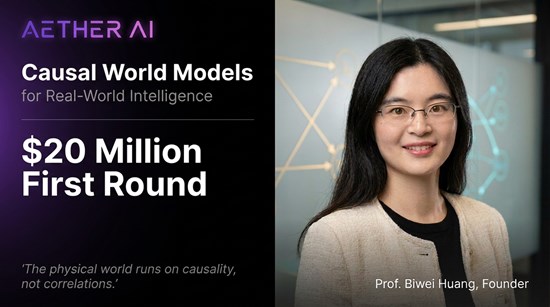
Professor Biwei Huang, Founder of Aether AI
To view an expanded version of this graphic, please visit:
https://images.newsfilecorp.com/files/9113/302286_c030310384f618f6_001full.jpg
This round was led by MPCiwith participation from Inno Angel Fund, SWC Global, Unity Venturesand other institutions. The funding will be used to accelerate research and development of Aether AI’s causal world model technology, expand its engineering infrastructure and science team, and support early commercial deployments in physical AI and robotics applications.
founder Professor Huang BiweiAether AI, a world-recognized researcher in causal discovery and machine learning and assistant professor at the University of California, San Diego, is building a new class of AI systems based on causation rather than correlation.
Aether AI’s mission is to establish causal inference as a foundational capability for next-generation AI. The company believes that while large-scale language model (LLM) and vision language action (VLA) systems have made impressive progress through scaling, their reliance on statistical correlation fundamentally limits their ability to generalize, infer, and operate reliably in real-world environments.
“Over the past decade, AI has become very good at recognizing patterns,” he said. Professor Biwei Huang, Founder of Aether AI.
“But the physical world operates on cause and effect, not correlation. For machines to make reliable decisions in complex real-world environments, they need to understand the mechanisms that produce outcomes, not just observe statistical associations.
At Aether AI, we are building causal world models because we believe the next leap in AI will not come from scaling existing architectures, but from paradigm shifts in how machines learn, reason, and interact with the world. ”
Build AI that understands mechanisms, not just patterns
At the core of Aether AI technology is a simple but powerful question:
How can AI move from recognizing patterns to understanding mechanisms?
Today’s leading AI systems learn primarily through statistical associations extracted from large datasets. Although such approaches are highly effective in controlled environments, they often suffer from problems with generalization, sample efficiency, and robustness in dynamic real-world settings.
Aether AI pursues a fundamentally different path through causal world models that allow machines to identify causal variables, learn causal structures, and reason about how systems evolve under intervention.
This approach allows AI systems to simulate outcomes, perform counterfactual reasoning, and build a deeper understanding of how the world works before acting.
Initial validation studies demonstrated Aether AI’s causal approach. 20-30% increase in data efficiency About the selected operation task. In some cases, as few as 50 high-quality causal annotations enabled previously consistently failing tasks to reach reliable success rates.
The company believes that its causal world model can significantly reduce training costs while improving generalization across environments and tasks.
Why physics AI?
Aether AI’s initial commercial focus will be on physical AI and robotics.
Every action a robot performs is an intervention in the physical world. Errors caused by statistical shortcuts have immediate consequences for failure, making robotics one of the most demanding and revealing testing grounds for causal inference.
The company’s long-term vision is to build an integrated causal inference layer, or “causal brain,” that can power a variety of robots and intelligent systems.
World-class team at Causal AI
Aether AI brings together top researchers, engineers, and builders from top universities and AI labs around the world.
Professor Biwei Huang has spent more than a decade discovering causal relationships and advancing the field of machine learning. Her research spans Carnegie Mellon University, the Max Planck Institute for Intelligent Systems, and the University of California, San Diego. She has authored over 100 publications in key areas such as NeurIPS, ICML, ICLR, and CVPR, and is the creator of widely adopted open source causal AI tools such as Causal-Learn and Causal-Copilot.
Aether AI is further supported by an impressive network of advisors, including pioneers and leaders in causal AI and machine learning, including Judea Pearl, Bernhard Schölkopf, Clark Glymour, Peter Spirtes, and Kun Zhang.
About Aether AI
Founded by Professor Biwei Huang, Aether AI is a frontier AI company building causal world models. This is a new class of AI systems that understand underlying mechanisms, reason under interventions, and operate reliably in complex real-world environments. Unlike traditional AI approaches that rely on correlation, Aether AI is fundamentally built on a causal foundation, allowing systems to model and reason about the mechanisms that cause real-world outcomes. We believe that the next breakthrough in AI will not come from scaling models, but from paradigm-level innovations in how machines learn and reason.
contact:
To view the source version of this press release, please visit https://www.newsfilecorp.com/release/302286.