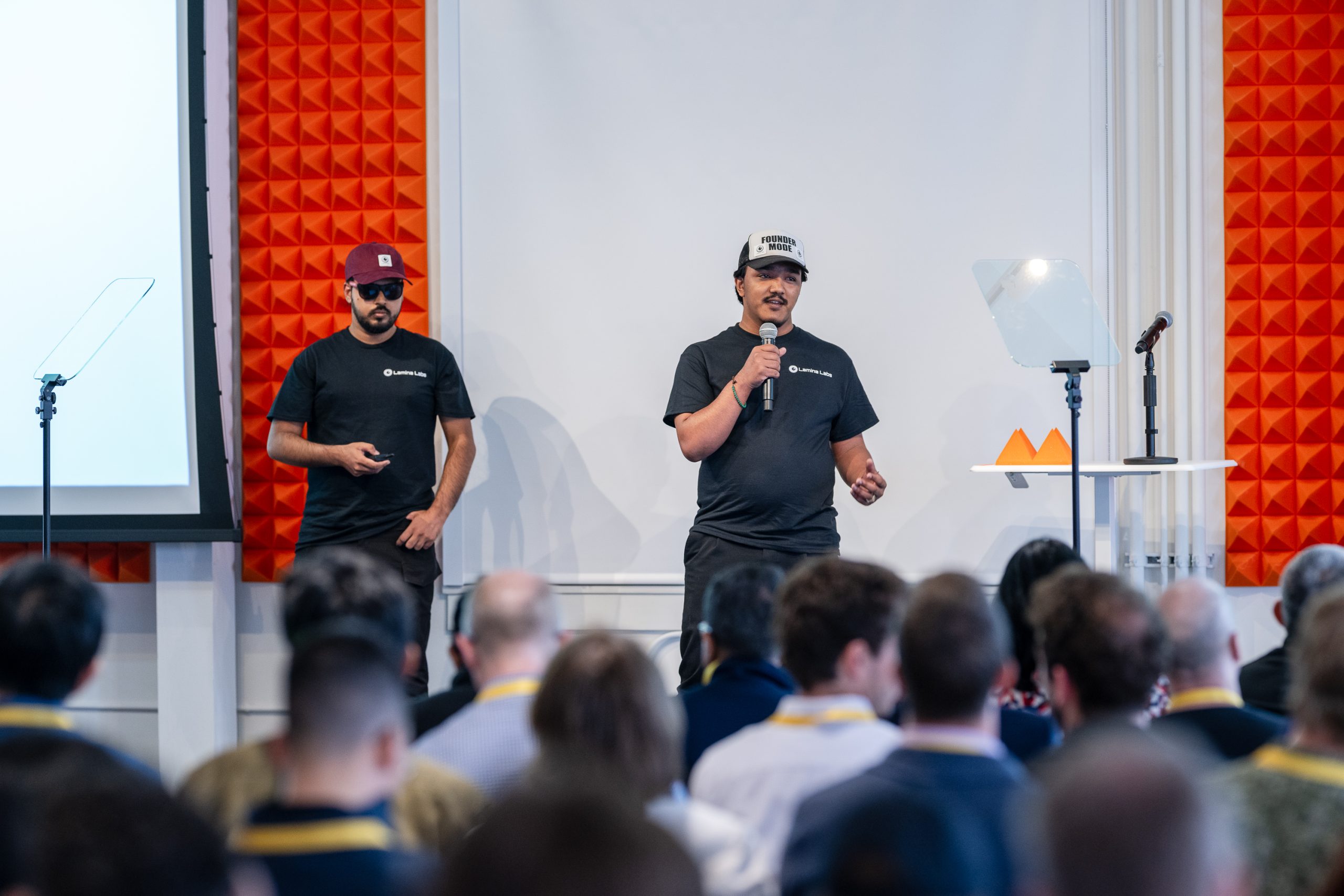
Two young Nepalis have founded an AI company that is taking off with funding from a top accelerator program in the US.
Sudip Rokaya and Kartikesh Mishra knew each other in Nepal, but met as students at the Massachusetts Institute of Technology (MIT) in Boston. They currently work on generated video as co-founders of Lamina Labs in San Francisco.
Their first product, Simi, which generates whiteboard-style instructional videos based on text prompts, received backing from top startup accelerator YCombinator (YC) and quickly secured another $3 million in funding.
“I studied a lot of physics in high school, and I was a visual learner, so I really liked the instructional videos,” says Rokaya, who is currently on leave from the Massachusetts Institute of Technology’s undergraduate program in mathematics and computer science. Rokaya was inspired by YouTuber 3Blue1Brown, who is known for using animation and visuals to explain math topics.
3Blue1Brown created Manim, a custom set of tools in the programming language Python used to create animations. This set of tools, called a library, can be used or modified by anyone.
Last summer, Rokaya tried automating this library to also create videos, but ran into a problem. Manim was designed for experienced Python users and before the era of the Large Language Model (LLM).
“Trying to force just this small library to run is difficult; it would cost millions of dollars to fine-tune it for accuracy,” says Kartikesh Mishra, co-founder and chief technology officer at Laminal. He studied electrical engineering and computer science at MIT and earned a master’s degree in engineering before moving to San Francisco.
Additionally, there were other startups already funded and working on the problem, so they abandoned the idea. But three months into the school year, Rokaya was taking a biology class that was “not my favorite.”
“We looked for AI tools that could learn through videos, and none of the ones we found were particularly good or seemed to be getting much better,” Rokaya recalls. The problem seemed to be technical, not financial.
At the time, Rokaya was considering using generative AI and agents to do “vibecoding.” This includes using LLM to rapidly generate and modify code and software.
“AI coding agents are the single greatest force multiplier available to founders today. This is no exaggeration. The impact is unreal,” Rokaya wrote to a LinkedIn audience of more than 5,000 people two months ago.
Sensing an opportunity, Rokaya skipped class in late October to work on his research, concluding that he could speed up the process by 50 times while producing a better final product. He showed it to Mishra, who worked at two startup companies in San Francisco. He was so impressed that he participated.
“One of the reasons I came to the United States was to gather knowledge in a way that I couldn’t get in Nepal,” Mishra said. “MIT was about learning, but in San Francisco I thought, why not work on what the world needs?”
win the competition
Their product, Simi, is named after Rokaya’s home village of Simikot, located in a remote corner of northwest Nepal. “We needed a cool name, and our investors liked it,” he says.
Simi can be tested online by anyone for free, and the test can generate one-minute instructional videos about economics concepts. This video is structured with examples, an intro, and even tips on how to apply the rules to real life. It would take a talented human animator many hours to create a similar video.
Users can enter simple or complex prompts to generate videos. In the final product, users can also choose between three aspect ratios, male or female voices, 80 different languages including Nepali, and lengths of 1, 2, 3, or 5 minutes.
In a cutthroat world of AI and technology where solutions are instantly copied, companies need a “moat” that elevates their products above the competition. Simi’s impressive moat is that it can produce faster, cheaper, and better videos at the same time.
From a quality perspective, Rokaya and Mishra followed an intensive iterative process of making small adjustments to the product, working out what didn’t work, and evaluating the final product.
Simi is a “deep tech” product, one that runs as close to the machine as possible, as opposed to “LLM wrappers”, which are products that use other models internally. As attention spans and patience decline, speed of production is a huge advantage.
Despite being a relatively small model, it achieves all of this and has low running costs. Rokaya said: “Since we are both from Nepal, we wanted to make sure Nepalis could afford this tool and deploy it through a cheap server that would reduce costs.”
He believes this can help teachers in isolated areas of Nepal like his hometown.
Although Lamina Labs initially believed that its product would be most useful in the education sector, the companies encountered problems in the early stages of sales. “The education business is slow, so we targeted small and medium-sized businesses instead,” said Rokaya, who believed this was a unique tool suitable for all sectors.
YC’s first post about stains went viral, and so did all subsequent updates. Twelve days after launch, the company had 4,000 users, 187 of whom were paying customers.
“Small businesses and home-based businesses in Kentucky, Florida,” Mishra said. “Pet day care centers use our tools to create videos for their clients about dog vaccinations.” One Saudi Arabian joined Simi’s Max plan and used up his allotment in three days.
Lamina Labs made news because it was the first all-Nepali startup to receive $500,000 in funding from YC, which connects its startup with an extensive network of mentors and other talent communities.
“It’s all about the community. You can text anyone in the system, including the CEO of Airbnb, and they’re very active,” Mishra says. “The acceptance rate is less than 1%. But once you get involved, the resources are nearly limitless. Mentors know what works and what doesn’t.”
Both point out that community, not money, is what matters most. Once every two weeks, they hold one private meeting with a YC partner (in their case the CEO of a public company) and one group office hour “pod” with 12 other companies, where they set revenue and customer growth goals for their company.
“Setting these goals publicly holds us accountable and creates a sense of urgency,” Rokaya says. “This makes people 100 times more productive and efficient than usual.”
Most recently, YC held a Demo Day from June 8th to 16th, where founders presented their product in front of 1,000 potential investors. The companies plan to speak to more than 100 investors before raising capital, but the first investors Lamina Labs spoke to were willing to invest the full $3 million they were seeking.
“They told us not to fundraise with anyone else and just get to work, so we’re pretty relaxed about this event,” Rokaya says.
Now that they have secured funding, Rokaya and Mishra plan to hire more engineers. Until now, it was just the two of us.
Rokaya has some prudent advice for Nepalis in this field. “People say they want to do a startup, it sounds cool, but most of the time they’re just not ready,” he says. “There are so many people in computer science. There are probably 1,000 like-minded people trying to succeed.”
Rokaya says people need to be “locked in” and focused 24/7. They used to wake up at 10 a.m., walk four steps to their desks, and work nonstop until 2 a.m. Mishra admits it’s not the healthiest lifestyle, but says the field is so competitive that he has to stay ahead of everyone else.
Our common Nepali background was a big help. “Many startups fail because over time the founders don’t get along with each other. We are both from Nepal, so it helps us to talk and understand each other and work together,” Rokaya says.