
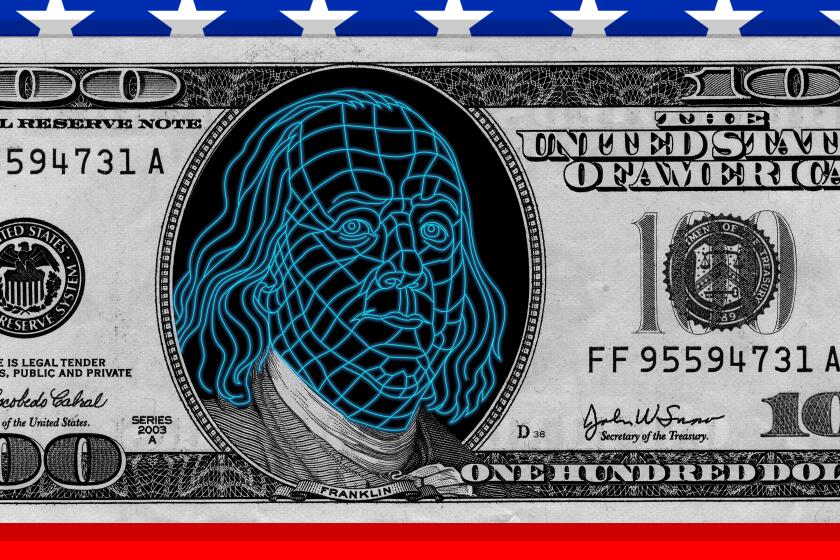
New super PACs are pumping out millions of dollars worth of ads to sway voters in congressional races across the country.
“President Trump said it best: ‘Celeste Malloy will never let you down,'” reads one ad promoting the Utah Republican in the upcoming primary.
“Val Hoyle will not back down as he stands up to Big Pharma and fights for local jobs,” says an ad supporting the Oregon Democrat ahead of his primary victory last month.
Super PACs have unremarkable names like Jobs and Democracy PAC and American Mission, and their text is so common that it looks like it was created by artificial intelligence.
That’s not that far off the mark. The AI industry funded advertising.
One network of super PACs is linked to Anthropic, the maker of the popular AI tool Claude, and the other is linked to Open AI, the maker of ChatGPT.
They are the biggest political spenders so far in the 2026 midterm elections, spending more than $37 million so far to influence races across the country, making them the largest group of outside spenders in congressional races so far. That number could rise sharply as campaigning heats up in the run-up to the November election and Silicon Valley’s biggest firms gear up to raise billions of dollars for companies and their executives.
The AI political spending boom is happening as emerging technology companies become increasingly “comfortable about using their power to achieve political goals,” said Adam Kovacevic, former head of public policy at Google and founder of the progressive-minded tech trade group Chamber of Progress.
Big AI companies have a history.
Anthropic was founded by former OpenAI employees who were concerned that the company was not focusing too much on its original mission of safely harnessing the power of AI.
The two companies are now major promoters of the burgeoning AI industry, and their disagreements over how the technology should be regulated are playing out in a broader political ad spending war targeting metropolitan and local legislative elections alike.
OpenAI believes that AI should only be regulated at the federal level.
Anthropic calls for stricter regulation and supports efforts in states like New York and California, which have passed more aggressive AI laws.
The groups spending in these races are super PACs, which, thanks to a 2010 Citizens United Supreme Court ruling, can raise and spend unlimited amounts of money in federal races.
In some elections, AI-backed political groups are spending more money than the candidates they support.
“As a grassroots guy, there was no way I could compete with that kind of money,” said Al Olszewski, whose opponent won by 30 points in the Montana Republican congressional primary with $877,000 in ad revenue from a super PAC backed by the OpenAI co-founder. “It was crushed.”
The AI giants have emphasized their independence from political groups.
One group is backed by $25 million from OpenAI co-founder Greg Brockman and his wife, Anna, in addition to $100 million tied to one of Silicon Valley’s largest venture capital firms, which holds a large stake in OpenAI. OpenAI’s head of global policy was reportedly involved in the group’s initiative.
The other side received $20 million from Anthropic and millions more from donors whose identities have not been made public.
This anonymous political funding, commonly known as black money, is growing in prevalence.

(Photo illustration from Los Angeles Times, source photo provided by Tech Oversight Project)
“This is now very commonplace,” said Brendan Glavine, director of insights at OpenSecret, which tracks campaign spending. “In 2024, we tracked over $1 billion in dark money.”
This total was $350 million more than the previous presidential election.
Cryptocurrency playbook
The political activities of these AI companies and executives reflect a dramatic shift from the way emerging technology companies have historically engaged with politics.
Google, for example, didn’t hire its first in-house lobbyist in Washington state until after it went public in 2005.
“I think for a long time, the lobbying strategy in the tech industry has been, ‘Leave us alone,’” Kovacevic said.
He sees the spending by these AI-related super PACs as following recent strategies developed by the crypto industry. The industry is funding the only network of political parties that spent more on parliamentary elections than on OpenAI this year.
“I think what the crypto industry realized was that there is no substitute for increased political power,” Kovacevic said.
The political stakes for these technology companies are significant.
“AI policy is not settled yet,” said Asad Ramzanari, who served as deputy director for strategy in the White House Office of Science and Technology Policy during the Biden administration and director of artificial intelligence and technology policy at the Vanderbilt Policy Accelerator.
Earlier this month, the Trump administration banned the most powerful AI model developed by Anthropic from being used by foreigners and even its own employees, forcing the company to restrict access for all users.
Manhattan match
The two super PAC networks have largely avoided producing ads that mention AI, choosing to avoid competing against each other in the same races.
There is one major exception.
Each campaign spent millions of dollars in the crucial Manhattan Democratic Congressional primary to replace retiring Rep. Jerry Nadler of New York.
The field includes Kennedy scion and social media star Jake Schlossberg and former Republican-turned-Trump critic George Conway, but the target of all the AI spending is Alex Boas, a former Palantir data scientist and current New York state congressman.

A New York state legislative candidate has sponsored a state bill that would require major AI companies to be transparent about their safety protocols and promptly report safety incidents. (Yuki Iwamura/AP)
That’s because Boas sponsored a state bill (known as the RAISE Act) that would require major AI companies to be transparent about their safety protocols and promptly report safety incidents. The bill was signed into law in December 2025.
The ads, sponsored by groups associated with OpenAI, which spent more than $7.5 million on the race, portray Boas as untrustworthy.
They cite his support from other tech billionaires, including former crypto tycoon and convicted financial fraudster Sam Bankman Fried. His super PAC spent $100,000 supporting him in his first bid for New York Congress in 2022.
“Who really shapes the AI safety of our children?” one ad asks.
The ad, sponsored by the Anthropic-backed network, which also spent more than $7.5 million supporting Boas, argues that his proposed legislation is the reason he should be elected.
“As a computer engineer, Alex Boas recognized how dangerous unregulated AI could be and authored the New York RAISE Act to put real safeguards against AI and hold big tech companies accountable,” the ad says.
The barrage of AI advertising in New York also includes what could be considered a Kumbaya moment in the ad wars. Another super PAC created to support Boaz is backed most heavily by both Anthropic and OpenAI employees, which are focused on AI safety.
The group, Dream NYC, spent more than $1.7 million supporting Boaz.
Boas and fellow New York state congressman Micah Lasher are leading the race in the latest polls ahead of the June 23 primary election.

An overview of businesses in St. George, Utah, on Wednesday. (Ian Moll/For the Times)
local republican
For voters in many parts of the country, the debate over AI policy revolves locally around the large data centers needed to power the technology.
In Utah, a data center plan in Box Elder County backed by “Shark Tank” television personality Kevin O’Leary has been controversial due to questions about its impact on the drought-prone state’s resources and its environmental impact on the nearby Great Salt Lake.
In the state’s most competitive Republican congressional primary, in the newly elected and expansive 3rd Congressional District, both candidates expressed concerns about how the project has been developed and called for more transparency about the plan and future data centers in the state.

Utah Congressional candidates Phil Lyman and Celeste Malloy during the June 1 debate. A super PAC backed by Anthropic spent more than $920,000 supporting Mr. Malloy. (Rick Egan/Pool/Salt Lake Tribune via Associated Press)
Despite similar positions on the project, an Anthropic-backed super PAC spent more than $950,000 supporting Malloy, who is running in a new district after the old district boundaries were changed.
“It’s a lot of money to put into a campaign,” said Phil Lyman, a former conservative Republican state representative who ran to the right of Utah’s Republican Gov. Spencer Cox, who lost the 2024 primary.
Reiman insists he is not an AI skeptic.
“I’m not against data centers. I’m for transparency,” he said. “I think the future of AI is bright.”
The group said it supports Malloy because it sees him as “someone who has worked on the issue” of AI regulation and “has provided leadership” to Republicans in Congress.
Malloy’s campaign did not respond to requests for comment.

Utah Congressional candidate Phil Lyman speaks at a cottage meeting held Wednesday at the Sunriver Community Center Ballroom in St. George, Utah. (Ian Moll/For the Times)
But Lyman suspects the group’s support for Malloy ahead of the June 23 primary has more to do with old-school politics than emerging technology.
One of the group’s two co-founders is Malloy’s predecessor in Congress, Chris Stewart.
“Everything they’re doing feels very coordinated,” Lyman said. “It makes me wonder if he still really controls the seat.”
Get the LA Times California Politics newsletter. Get in-depth insights on law, politics and policy in Sacramento, Washington and beyond delivered to your inbox twice a week.
This story originally appeared in the Los Angeles Times.


