
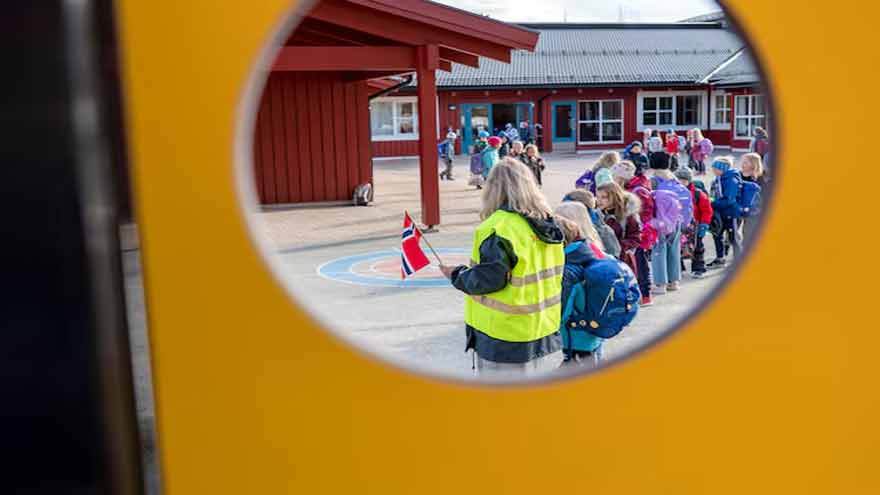
summaryIn April, the Norwegian government announced plans to ban children from using social media until they turn 16.
OSLO (Reuters) – Norway will largely ban the use of generative AI tools by primary school students, while also restricting their use in older children’s education to prevent negative effects on learning, Norway’s prime minister said on Friday.
Faced with a significant drop in educational test scores, the government has banned the use of smartphones in schools in 2024 and given teachers more powers to enforce discipline in the classroom.
Prime Minister Jonas Gare Storey said at a press conference on Friday that the use of AI increases the risk of young children skipping important steps in their education.
“The most important thing in school is for children to learn reading, writing and mathematics,” Stoere said, adding that the new standards will be imposed from the start of the school year at the end of August.
The government said that in principle students aged 6 to 13 in grades 1 to 7 should not use AI, but secondary school students aged 14 to 16 could be cautiously introduced to the tools under teacher supervision.
In upper secondary education, students between the ages of 17 and 19 need to learn how to use AI appropriately in preparation for further education or employment, he added.
Norway began introducing computers into classrooms in the 1990s and introduced tablets after the introduction of iPads from 2010 onwards, reducing reliance on books and handwriting.
But in a related statement on Friday, the government also said it would propose legislation to fund the use of more books in classrooms and reverse the trend toward tablet computers.
In April, the Norwegian government announced plans to ban children from using social media until they turn 16, following a trend pioneered by Australia and several other countries to reduce the use of electronic devices among young people.


